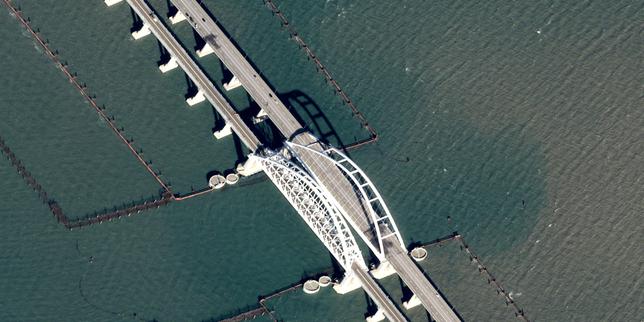
The Crimea bridge has once again been hit in a cascade of Ukrainian strikes that collapsed a roughly 225-meter stretch of the road deck, choked maritime movement through the Kerch Strait, and rattled the adjacent railway line. Breaking-news tickers treat each fresh blow on the Crimea bridge as an immediate death sentence for Russian supply lines in southern Ukraine. That reading misses the quieter, nastier arithmetic of modern attrition. After years of war, heavy military cargo across the span had already thinned—yet knocking out the road crossing still forces every displaced truck onto a narrow, drone-haunted coastal corridor while turning the strait itself into a physical blockade.
After covering conflict zones and defense procurement for more than two decades, I have watched plenty of commentators confuse a dramatic structural collapse with a decisive battlefield breakthrough. Steel and concrete can buckle, drop into cold water, and trigger months of political fury in Moscow without immediately halting an entrenched army. What actually breaks first is supply redundancy, repair capacity, and cost efficiency. When a single choke point fails, the pressure simply migrates down the map until the next bottleneck buckles under the weight.
Why Steel Collapses Rarely Equal Instant Collapse on the Front
The instinct to view a hit on the Crimea bridge as a war-winning stroke is understandable. Since Vladimir Putin inaugurated the crossing in 2018, the Kremlin has treated it as a monument to permanence, sovereignty, and imperial reach. Watching a major road span drop into the water—followed days later by strikes targeting the rail span—humiliates Moscow in front of a domestic audience that has been promised invulnerability.
Still, military logistics rarely works like a light switch. Defense analysts at the Royal United Services Institute have pointed out that Russia had already shifted much of its heavy military resupply away from the Crimea bridge earlier in the war, leaning more heavily on rail networks and coastal routes along the Sea of Azov. Even when a bridge suffers severe structural blows, a functioning rail connection or an alternative overland route can absorb part of the shock—at least in the short term.
A damaged bridge does not automatically starve an army overnight; it taxes every ton of fuel, ammunition, and food that has to take a longer, riskier detour.
There is also a sobering counter-argument that Kyiv's most enthusiastic backers often gloss over. Striking major transport crossings cuts both ways in a broader war of infrastructure. While Ukrainian forces target the Crimea bridge and coastal logistics arteries, Russian forces have leaned heavily into strikes on bridges and power nodes inside Ukraine, trying to stall civilian movement and complicate military transfers. Neither side has found a clean, cost-free way to sever an opponent's lifeline without absorbing retaliation or dealing with stubborn structural engineering.
Soviet and post-Soviet civil engineers built heavy transport spans with thick girders, massive piers, and substantial dead weight precisely because they expected rough conditions and hard wear. Getting a clean, permanent severance of a rail bridge, in particular, demands heavy warheads, pinpoint accuracy, or repeated hits on load-bearing elements. A drone or cruise missile that craters a deck or severs a road arch creates massive friction, yet repairing or bypassing it remains a grinding test of endurance rather than a single magic bullet.
The Azov Squeeze and the New Kill Zone
Look past the twisted girders in the Kerch Strait and you find the real operational shift. Losing road capacity on the Crimea bridge pushes vehicles onto the coastal highway network—specifically the R-280 corridor along the Sea of Azov—and forces greater reliance on ferries and rail. That funneling effect is where tactical strikes turn into strategic headaches.
Traffic congestion is an attacker's gift. When road movement across the Crimea bridge is severed, vehicles that might have dispersed or crossed via the bridge must crowd onto a finite set of roads. Ukrainian mid-range strike drones have increasingly turned those coastal highways into a persistent kill zone, hunting fuel tankers, supply trucks, and military escorts as they crawl along exposed stretches.
Consider a hypothetical example to see how the math works on the ground. Suppose a logistics unit needs to move fifty truckloads of artillery shells and diesel from southern Russia toward Zaporizhzhia. If the Crimea bridge road deck is down, those trucks face longer routes, ferry queues that can stretch for days under weather or military priority rules, or heavier exposure on a coastal road already operating near maximum capacity. Even if only a fraction of vehicles are hit or delayed, the ripple effect hits fuel depots, repair bays, and front-line artillery batteries days later.
The numbers coming out of the logistics chain reflect that squeeze. Reports tracking transport costs to occupied Crimea have pointed to sharp spikes—with trucking costs reportedly surging dramatically as operators price in longer routes, delays, and drone risk. War is an accounting problem as much as a shooting match. Paying four times as much per truck while losing vehicles to cheap loitering munitions erodes a military's margin for error long before front-line trenches collapse.
Maritime Chokepoints and the Hidden Cost of Debris
One overlooked consequence of the recent strikes on the Crimea bridge sits directly beneath the waterline. When a roughly 225-meter stretch of the road deck collapsed, fallen concrete and steel did more than stop cars and lorries. They obstructed vessel passage through the Kerch Strait.
British defense assessments have underscored how blocking the strait traps or restricts vessels moving between the Sea of Azov and the Black Sea until the channel is cleared. Clearing sunken bridge sections in active wartime conditions is nothing like routine marine salvage. Divers, barges, and cranes working in contested waters face extreme vulnerability to drones and missiles, while shifting currents and winter weather complicate underwater cutting and lifting.
- Vessel traffic freezes: Commercial and military hulls cannot safely transit a fouled narrow channel without risking hull damage or getting trapped.
- Repair crews become targets: Any heavy engineering barge brought in to clear debris or rebuild piers signals a high-value target for long-range strikes.
- Inspection slows everything down: Even after a strike ends, rail and road sections require structural checks before heavy loads can roll again, stretching a two-day disruption into weeks of caution.
That is why analysts studying the aftermath warn that rebuilding a heavily damaged section of the Crimea bridge will demand serious time, money, and protective air cover—resources Moscow has to pull from somewhere else. Every air-defense battery stationed over the Kerch Strait is a battery not guarding an oil refinery, a command post, or a front-line staging area.
What This Means for the Next Phase of the War
Repeating strikes on the Crimea bridge show how the conflict has evolved into a war of infrastructure attrition and chokepoint warfare. Instead of relying solely on sweeping armored breakthroughs—which have proven costly and slow against dense minefields, trenches, and drone surveillance—Ukraine is systematically raising the price of holding territory.
Still, nobody who has watched this war closely should pretend that hitting a bridge ends the fight for Crimea or southern Ukraine. Russia has repeatedly shown a grim willingness to absorb heavy attrition, ration supplies, and improvise workarounds rather than surrender ground voluntarily. A severed road span hurts; a damaged rail line complicates heavy haulage; a fouled strait pinches maritime movement. Together, they tighten the vise.
The real test over the coming weeks is whether those pressures compound faster than Moscow can adapt. Watch the rail throughput, the traffic density on the R-280 highway, and whether any salvage vessels dare enter the strait—because those quiet indicators will tell you far more than any headline about a single explosion.
(Signing in to a Google Account can make it easier to save your chat history and return to threads like this one later.)