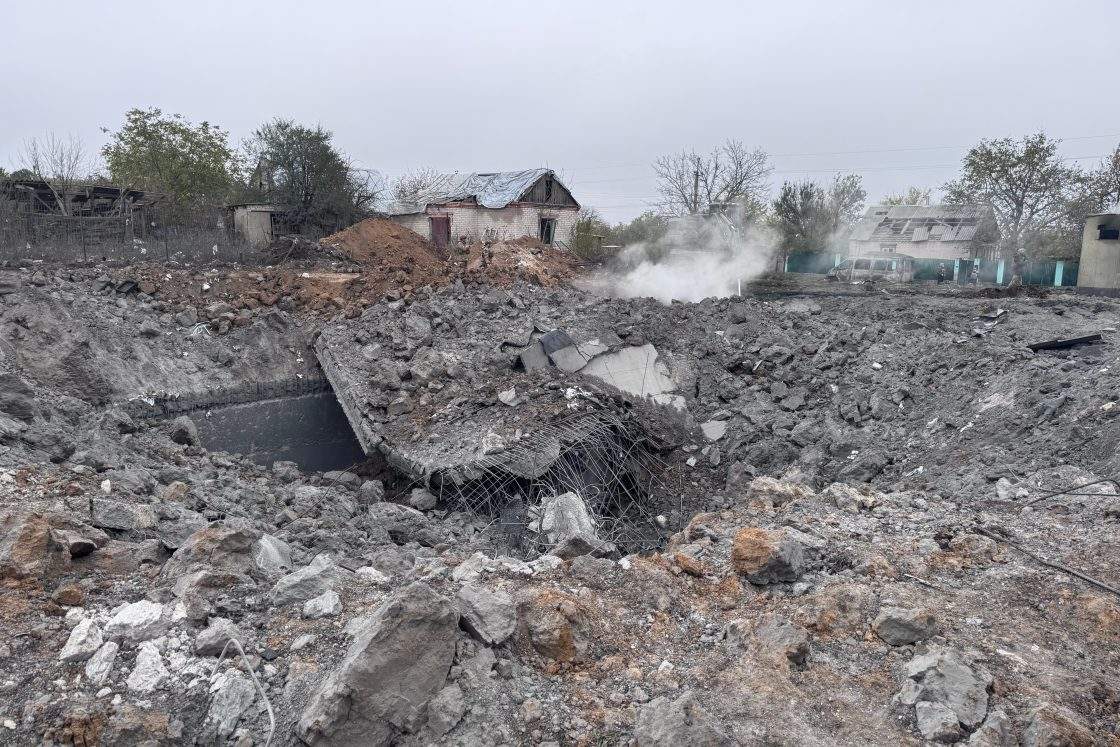
The death toll from a Russian missile strike on a humanitarian aid distribution center in Ukraine has officially reached 31, turning a routine morning supply drop into one of the deadliest attacks on civilian relief infrastructure since the full-scale invasion began. Rescue workers spent over forty-eight hours pulling survivors and bodies from the collapsed concrete and twisted steel of the logistics hub, which had been operating openly to distribute food, water, and basic medical supplies to displaced residents. While initial reports treated the incident as another tragic casualty of erratic artillery fire, forensic analysis of the impact crater and the timing of the strike point toward a calculated operational pattern. Russian forces are increasingly targeting the civilian supply chains that keep frontline communities habitable, aiming to force mass depopulation where ground assaults have stalled.
This was not an isolated misfire. Over the past two years of the conflict, humanitarian corridors, grain silos, and municipal distribution centers have shifted from protected zones to primary targets. To understand why an aid site packed with elderly pensioners and volunteer workers was hit during peak distribution hours, you have to look at the mechanics of modern attrition warfare and the specific munitions used to execute it.
Anatomy of a Double-Tap Strike
The strike occurred at roughly 9:30 AM local time, precisely when the daily queue for bread and hygiene kits reaches its maximum density. Residents in frontline towns know the routine well. You arrive early, sign the registry, collect your rations, and clear the open square before noon.
According to emergency services on the ground, the attack followed a recognizable tactical sequence. The first munition struck the main warehouse roof, collapsing the structural supports onto the crowd gathered beneath the awning. Roughly twelve minutes later, as local firefighters, paramedics, and neighboring civilians rushed into the rubble to extract the trapped, a second munition detonated less than fifty meters from the initial impact point.
Double-tap strikes are not accidents of overlapping artillery grids. They require deliberate coordination between reconnaissance drones hovering overhead and firing batteries miles behind the line of contact. The drone operator watches the initial impact, waits for the first responders to gather in the kill zone, and calls in the secondary strike.
The psychological impact of this tactic extends far beyond the immediate casualty count. When rescue workers become primary targets, response times across the entire region slow down. Municipal ambulances lack armored plating, and volunteer networks operate without military-grade early warning systems. By turning the act of rescue into a lethal gamble, the strike effectively paralyzes local emergency infrastructure for weeks.
The Munitions Behind the Devastation
Preliminary assessments of the shrapnel recovered from the site indicate the use of precision-guided glide bombs or short-range ballistic missiles, rather than unguided Grad rockets. This distinction matters immensely when evaluating intent.
Unguided munitions have a wide circular error probable, meaning they can drift hundreds of meters off course due to wind, barrel wear, or poor propellant quality. A commander firing unguided rockets can plausibly claim—at least in diplomatic forums—that a civilian building was hit by mistake while aiming at a nearby military staging area.
Precision-guided systems eliminate that ambiguity. UMPK glide kits, which retrofit standard Soviet-era FAB-500 high-explosive bombs with pop-out wings and satellite navigation modules, allow Russian aircraft to release heavy payloads from forty to sixty kilometers away. These weapons are cheap, plentiful, and capable of hitting a specific building footprint with devastating accuracy.
When a 500-kilogram warhead lands squarely on the loading dock of a marked humanitarian warehouse, it is the result of specific coordinates entered into a flight computer. The blast wave from such a weapon does not merely damage a structure; it pulverizes masonry, shatters eardrums blocks away, and turns every pane of glass within a half-mile radius into airborne shrapnel. For civilians standing in an open courtyard with zero overhead cover, survival depends entirely on distance and luck.
Why Humanitarian Infrastructure Is in the Crosshairs
Military analysts who have tracked the conflict since 2022 recognize a clear doctrinal shift in how Russian forces approach occupied and contested territories. When rapid territorial gains prove too costly in terms of armor and manpower, the focus shifts to making life unsustainable for the civilian population remaining in Ukrainian-held settlements.
Frontline towns rely on a fragile ecosystem of municipal services and international aid to function. Water pumping stations, electrical substations, and food distribution hubs form the backbone of civilian survival. Without them, residents cannot stay, regardless of their attachment to their homes.
Targeting an aid distribution site achieves three distinct strategic objectives for an attacking force:
- Forced Depopulation: When food and water lines become lethal zones, remaining civilians are forced to evacuate westward. This clears the urban terrain of witnesses and reduces the logistical burden on occupying forces should they eventually capture the town.
- Resource Diversion: Every mass-casualty civilian event forces Ukrainian authorities to divert scarce medical supplies, heavy excavation equipment, and trauma surgeons away from military field hospitals to handle the influx of wounded non-combatants.
- Erosion of Local Trust: Humanitarian operations depend on predictability. When local administrators can no longer guarantee the safety of a distribution point, civil society begins to fracture, breeding panic and administrative chaos behind the lines.
Moscow routinely denies targeting civilian infrastructure, maintaining a standard narrative that every struck facility was secretly housing Ukrainian troops, ammunition depots, or foreign mercenaries. Yet independent verification from international monitoring groups, combined with satellite imagery showing no military vehicles or defensive fortifications within kilometers of the site, consistently contradicts those claims. In this specific case, the facility had been registered with international humanitarian coordination bodies, its coordinates shared through established deconfliction channels meant to prevent accidental strikes.
The Failure of Deconfliction Mechanisms
In theory, modern warfare includes strict guardrails designed to protect non-combatants. Under the Geneva Conventions, humanitarian relief personnel and the facilities they operate are granted explicit protection. To operationalize this, the United Nations and major non-governmental organizations utilize a process known as humanitarian notification or deconfliction.
Aid agencies submit the exact GPS coordinates, operating hours, and physical descriptions of their warehouses, clinics, and convoy routes to all warring parties. The premise is simple: if both sides know a building contains sacks of flour and insulin rather than artillery shells, neither side will bomb it.
On the ground in Ukraine, that system is failing. Several major aid organizations have quietly begun questioning the wisdom of sharing exact coordinates with Russian military liaison channels. Rather than acting as a shield, many local coordinators fear that the deconfliction list has effectively become a target menu.
The dilemma facing humanitarian directors is brutal. If they register a site, they risk handing precise targeting data to an adversary that has shown little regard for international humanitarian law. If they keep the location secret, they cannot advertise distribution hours to the vulnerable populations who desperately need the supplies, and they forfeit their formal legal protections if the site is struck anyway.
As a result, aid delivery near the front has been forced underground. Large, centralized warehouses are being abandoned in favor of decentralized "micro-drops." Instead of gathering three hundred people in a public square at 9:00 AM, small teams in unmarked vans now pull up to residential courtyards for ten minutes at a time, unload boxes directly into the hands of waiting block captains, and drive away before a reconnaissance drone can lock onto their thermal signature. It is slower, exponentially more expensive, and vastly less efficient, yet it remains the only viable way to keep people fed without inviting a missile strike.
The Human Cost Behind the Numbers
Statistics flatten tragedy. Saying the death toll has climbed to 31 turns individual lives into an abstract metric for news tickers and diplomatic briefings. To grasp the reality of the strike, you have to look at who actually populates a morning aid line in eastern Ukraine.
Young, able-bodied men are largely absent from these queues; they are either serving in the armed forces or working in critical infrastructure roles elsewhere. The people waiting outside humanitarian centers are overwhelmingly the most vulnerable segments of society.
They are seventy-five-year-old retired factory workers whose state pensions cannot keep pace with wartime inflation. They are mothers with toddlers who lack the financial means to rent apartments in safer western cities like Lviv or Kyiv. They are local volunteers—often teachers, mechanics, and shopkeepers whose regular jobs vanished when the shelling started—who spend their mornings hauling heavy boxes of canned goods and bottled water because someone has to do it.
Among the confirmed dead in this latest strike were four volunteer coordinators who had worked at the site since the early months of the war, alongside a municipal social worker who was updating registries for bedridden residents unable to travel to the center themselves. Many of the injured suffered severe crush injuries and traumatic amputations from falling concrete slabs, injuries that require months of specialized surgical care and rehabilitation that overwhelmed regional hospitals struggle to provide.
The Geopolitical Blind Spot
Every time a high-casualty strike hits a school, hospital, or aid station in Ukraine, the international diplomatic machinery executes a predictable routine. Foreign ministries issue statements expressing deep concern. Ambassadors summon envoys for stern reprimands. Legal teams at the International Criminal Court add another thick folder to an already mountainous archive of potential war crimes.
Meanwhile, the structural reality on the ground remains unchanged. Legal accountability in international conflict moves at a glacial pace, often taking years or decades to produce a single indictment, while glide bombs fall in seconds.
The core issue is an asymmetry of deterrence. International humanitarian law relies on mutual restraint and the threat of global isolation to keep belligerents in check. When a state actor decides that territorial conquest outweighs diplomatic standing, and when that actor faces no immediate military consequence for striking soft civilian targets, treaties lose their teeth.
For Ukrainian air defense commanders, the math is equally unforgiving. Protecting every regional town, grain elevator, and aid warehouse from high-altitude glide bombs and ballistic missiles requires a density of advanced surface-to-air systems—such as Patriot or SAMP/T batteries—that Western allies have been slow to supply in sufficient numbers. Commanders are forced to make agonizing triage decisions daily: use a multi-million-dollar interceptor missile to protect a power plant or a military airfield, leaving a provincial aid distribution center exposed to aerial bombardment.
Until the aircraft launching these standoff munitions can be pushed back beyond their release range, or until air defense networks cover civilian population centers with the same density as strategic military hubs, these mass-casualty events will remain a recurring feature of the war.
Rescue crews have finally cleared the last of the rubble from the courtyard, leaving behind a cratered slab of concrete stained with dust and dried blood, while three blocks away, a handful of surviving volunteers are already unloading boxes of bread from the back of an unmarked van.