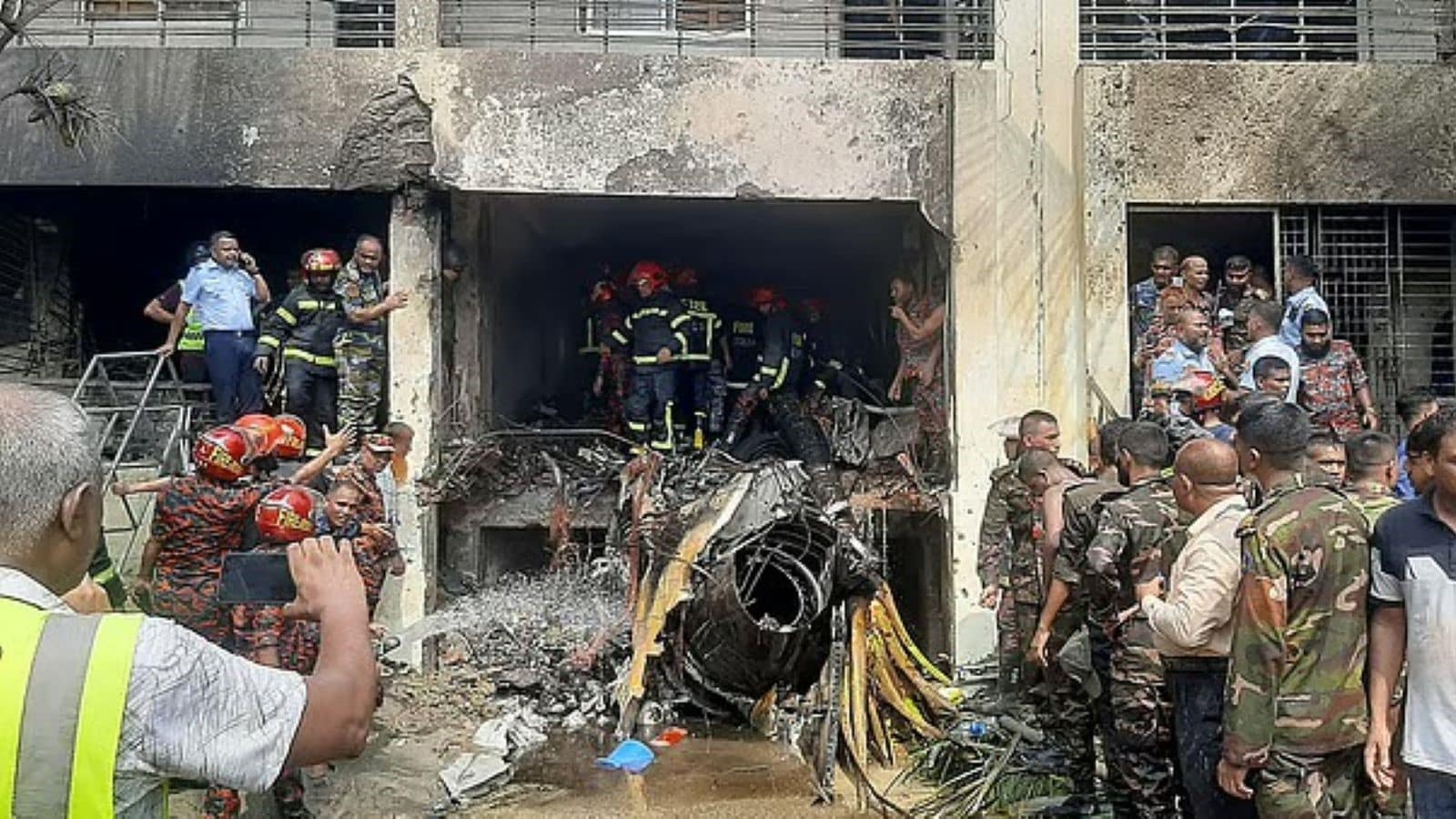
On July 21, 2025, a Bangladesh Air Force FT-7BGI training fighter jet stalled and plummeted into the Haider Ali building at Milestone School and College in Dhaka's Diabari area. The crash and subsequent fireball claimed 36 lives, including 28 students, their teachers, guardians, and the pilot, Flight Lieutenant Towkir Islam. An official government investigation commission concluded that the disaster resulted from a catastrophic combination of human error during a solo flight maneuver and severe urban planning failures. A sudden stall during a low-altitude turn sent 2,100 liters of jet fuel exploding through an overcrowded, unapproved school structure that lacked basic emergency exits.
Beyond the initial shock, the tragedy exposed a systemic breakdown across military oversight, civil aviation management, and municipal construction enforcement.
The Anatomy of an In-Flight Stall
Military flight operations demand razor-thin margins for error. On the afternoon of the crash, the pilot was executing his first solo mission in the Chengdu FT-7BGI aircraft, taking off from BAF Base Bir Uttom A.K. Khandker. Minutes into the flight, the mission parameters drifted away from standard safety protocols.
Flight data records reveal that the flight supervisor instructed the young pilot to return to the initial approach position after his first circuit, a command that deviated from standard solo flight training profiles. During the subsequent base-to-final turn, the fighter jet tilted well beyond safe thresholds.
Within four seconds, the aircraft's bank angle steepened from 59 degrees to 65.3 degrees.
In a frantic attempt to correct the steep tilt, the pilot pulled hard on the control stick. That sudden input caused the angle of attack—the pitch of the nose relative to oncoming airflow—to surge past its critical 24-degree boundary, reaching 27.3 degrees within two seconds. The air stopped flowing smoothly over the wings. Lift vanished instantly.
At an altitude too low to eject safely, the interceptor entered an unrecoverable aerodynamic stall. The jet lost altitude rapidly, shearing past nearby roofs before striking the main entrance of the Haider Ali building.
Urban Density Meets Flight Paths
Flight paths around major international airports require clear zones free of dense civilian infrastructure. Dhaka's rapid urban expansion systematically ignored those boundaries over several decades.
The airport came first. The residential towers and schools arrived later.
Civil aviation guidelines strictly prohibit high-density educational institutions inside direct runway approach lanes. Yet municipal regulators at Rajdhani Unnayan Kartripakho permitted massive urban encroachment right up to the airfield fence line. Milestone School and College operated seventeen distinct structures on its Diabari campus. Official land audits later revealed that only seven of those seventeen buildings held valid construction permits.
The Haider Ali building had no official clearance whatsoever.
Built on reclaimed marshland in 2006, the three-story structure had already suffered foundation settlement, causing its original ground floor to sink partially below grade. Despite its unauthorized status and physical degradation, school administrators packed 19 classrooms into the venue, housing over 737 students and 50 staff members during peak operational hours.
When the FT-7BGI struck the front portal, its belly tanks ruptured, dumping more than two metric tons of high-grade aviation fuel directly into the ground floor entrance.
A Fire Trap Built by Negligence
The physical impact of the jet was destructive, but the immediate fire turned the incident into a mass casualty event.
With the main entrance and sole staircase engulfed in flames within seconds, occupants on the upper floors found themselves trapped. Building codes explicitly require at least three separate fire exits for any school facility housing over 500 occupants. The Haider Ali building had only one narrow central stairwell, four feet wide instead of the required six-foot clearance.
Survivors inside faced an impossible corridor filled with toxic chemical smoke.
Teachers attempted to guide children toward window ledges, but structural grilles blocked escape. Emergency service vehicles arriving ten minutes after impact struggled to position their ladders due to unapproved outer walls and narrow access lanes surrounding the illegal campus layout.
The investigative panel noted that proper adherence to national building codes would have allowed hundreds of children to evacuate before the fuel fire consumed the upper levels. Instead, structural non-compliance converted an aviation accident into an inescapable death trap.
Suppression of Official Findings and Delayed Accountability
In the days following the catastrophe, public demand for answers led to the formation of a nine-member independent investigation commission chaired by former government officials and urban planners. The panel completed its exhaustive inquiry, submitting a detailed final report to executive authorities in November 2025.
That report remains officially unpublished.
Leaked sections of the document expose a troubling pattern of institutional self-preservation. The report explicitly outlines military supervision failures, noting that flight supervisors failed to monitor the novice pilot's flight envelope parameters adequately during his final approach. It also singles out municipal inspectors who turned a blind eye to illegal commercial structures along active military departure vectors.
Public interest litigation filed in the Supreme Court sought mandatory financial restitution for surviving families along with criminal prosecutions against municipal inspectors and school trustees. Lower courts dismissed early private petitions citing procedural technicalities.
State authorities proposed standardized compensation packages of 2 million taka for bereaved families and 500,000 taka for injured survivors. Bereaved parents unanimously rejected the offer.
Families point out that medical treatments for severe thermal burns and lifelong respiratory damage exceed the government's lump-sum offer by millions. More importantly, financial payouts do nothing to address the structural hazards that remain in place today.
Unresolved Risks Along the Runway Corridor
A year after the disaster, jet engines still roar directly above the open courtyards of schools, private hospitals, and dense residential apartments surrounding Diabari.
Urban planning experts argue that patching up individual building violations will not solve the underlying hazard. Moving primary military training operations out of congested metropolitan airbases to dedicated rural airfields represents the only viable path toward permanent safety. Similar relocations have been executed by defense departments worldwide to protect civilian centers from training mishaps.
Yet military leadership and civil aviation administrators have taken no concrete steps to alter training flight patterns away from Dhaka's northern suburbs.
The failure to enact structural reforms leaves thousands of students exposed to daily danger. Every low-altitude military flight over dense neighborhoods carries the unaddressed risk of another catastrophic stall, another structural impact, and another preventable fire. True accountability requires more than silent investigation reports—it demands the total removal of high-risk military flight profiles from heavily populated urban skies.