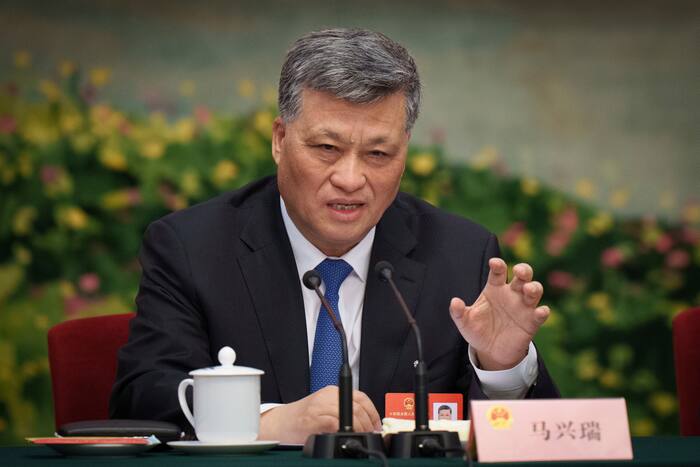
Former Chinese Politburo member Ma Xingrui has been formally charged with accepting massive bribes, marking one of the highest-profile takedowns of a senior technocrat during Xi Jinping’s third term. Prosecutors allege that Ma, who previously served as the Communist Party secretary of the sensitive Xinjiang region and governor of the economic powerhouse Guangdong, abused his sweeping administrative authority to secure lucrative contracts, state subsidies, and regulatory favors for private enterprises and state-linked entities in exchange for personal wealth. The indictment follows months of opaque disciplinary investigations by the Central Commission for Discipline Inspection and strips a once-untouchable aerospace engineer of his political standing, liberty, and legacy.
For years, foreign analysts viewed Ma as proof that technical competence could coexist with ideological loyalty inside Beijing’s upper echelons. That illusion is dead. His prosecution confirms that nobody inside the inner circle holds permanent immunity, regardless of their pedigree in strategic industries or their stewardship of critical frontier regions.
The Anatomy of a Technocrat's Rise
To understand why Ma’s collapse sends shockwaves through Beijing’s ministries, you have to look at how he got there. Unlike traditional party apparatchiks who climbed the ranks through provincial youth leagues or ideological propaganda bureaus, Ma built his career on hardware and orbital mechanics.
Trained as an aerospace engineer, he led the China Aerospace Science and Technology Corporation (CASC), overseeing landmark lunar exploration missions and manned spaceflight programs. In the early 2010s, Xi Jinping began systematically plucking executives from the defense and aerospace sectors—the so-called military-industrial clique—to govern major provinces. The logic was straightforward. Engineers solve problems. They execute directives without getting bogged down in local factional patronage networks.
Ma became the poster child for this recruitment model. He moved from aerospace executive to deputy party secretary of Guangdong, then party chief of Shenzhen, governor of Guangdong, and finally, in late 2021, party secretary of Xinjiang—a post carrying automatic entry into the 24-member Politburo.
At every stop, he controlled colossal capital flows.
In Shenzhen and Guangdong, he sat atop China’s most dynamic manufacturing and tech hub, dispensing land rights, tax breaks, and infrastructure tenders worth hundreds of billions of yuan. In Xinjiang, he managed massive central government transfer payments aimed at economic stabilization, industrial relocation, and domestic security infrastructure. Where state capital flows at that velocity, rent-seeking inevitably follows.
How Corruption Operates in Strategic Sectors
Standard reporting on Chinese corruption cases tends to treat bribery as a simple transaction—a bag of cash handed over in a private banquet room. In reality, high-level graft within China’s state-capitalist apparatus operates through far more sophisticated channels, often disguised as legitimate industrial policy.
When a senior official oversees sectors like aerospace, semiconductors, or green energy, the state actively encourages aggressive capital deployment. Regulators loosen oversight to speed up technological self-reliance. Procurement rules get bent in the name of national urgency.
Consider a hypothetical example of how this mechanism functions in practice. Imagine a provincial governor championing a multi-billion-yuan aerospace industrial park to meet central government innovation targets. Because the project carries a national security designation, standard public bidding requirements are waived. A proxy firm controlled by an associate of the governor wins the primary construction and supply contracts, subcontracts the actual work at a fraction of the price, and funnels the margin into offshore holding companies or equity stakes held by the official’s family members. On paper, it looks like rapid industrial development. In the ledgers of discipline inspectors, it is textbook embezzlement and bribery.
The indictment against Ma points directly to this intersection of state-directed industrial policy and private enrichment. Investigators have spent the past two years tearing through the defense and aerospace conglomerates where Ma cut his teeth, pulling down former colleagues, procurement chiefs, and rocket force generals along the way.
The Xinjiang Factor and Political Optics
Replacing Chen Quanguo as Xinjiang’s top official in 2021 was supposed to be Ma’s crowning achievement. Chen had implemented harsh, heavily criticized security measures across the region; Ma was brought in to pivot toward economic development, cross-border trade with Central Asia, and supply chain integration while maintaining strict social stability.
His subsequent fall creates a severe optics problem for Beijing.
- Governance Credibility: Xinjiang is the centerpiece of Beijing’s domestic security narrative and its Belt and Road trade ambitions. Charging the region's former top administrator with systemic bribery undermines the state's claim that its governance model in the western frontier is clean and efficient.
- Supply Chain Anxiety: Foreign companies already face intense regulatory pressure regarding supply chains linked to Xinjiang. Revelations that top-level regional contracts and subsidies were tainted by graft add another layer of compliance risk for international firms doing business anywhere near the region's industrial parks.
- Cadre Paralysis: When a Politburo member falls, mid-level bureaucrats freeze. No provincial department head wants to sign off on a major infrastructure project or approve a foreign joint venture if the political winds can retroactively turn an administrative decision into a criminal indictment.
Why Loyalty No Longer Buys Protection
A persistent myth among Western observers is that Xi Jinping’s anti-corruption campaign is solely a tool for purging political rivals. While factional elimination certainly drove the early waves of the crackdown a decade ago, Ma Xingrui was never a rival. He owed his entire political career to Xi’s patronage. He was a handpicked lieutenant.
His prosecution reveals a much harder truth about how power functions in contemporary Beijing. Political loyalty is a baseline requirement, not a shield.
As China’s economy grapples with structural headwinds—a protracted property slump, mounting local government debt, and slowing export growth—the central leadership has zero tolerance for financial leakage. Every yuan siphoned off by corrupt officials in strategic sectors is a yuan missing from the state's technological competition with the United States. In the aerospace and defense sectors specifically, graft does not just waste money; it compromises hardware reliability and military readiness.
Furthermore, the Chinese Communist Party relies on perpetual internal purging to maintain legitimacy. By demonstrating that even a sitting or former Politburo member from the prized technocratic elite can be hauled before a court, the leadership signals to the public that the system is self-correcting, even if the underlying structural causes of corruption remain untouched.
The Structural Flaw Beijing Cannot Fix
The fundamental contradiction at the heart of Ma Xingrui’s downfall is one the Chinese system refuses to resolve. You cannot concentrate unchecked administrative power in the hands of a single party secretary while expecting them to resist the financial temptations of a multi-trillion-dollar economy.
In Guangdong and Xinjiang, Ma exercised absolute authority over the local judiciary, the media, the police, and the state-owned banks. There were no independent auditors capable of challenging his directives, no opposition lawmakers to question his budgets, and no investigative press to expose suspicious contracts. The only check on his power was the Central Commission for Discipline Inspection—an internal party organ that typically intervenes only after the damage has been done for years.
Until Beijing separates administrative execution from unchecked political authority, or allows independent institutional oversight of state capital, the cycle will repeat itself endlessly. Today it is Ma Xingrui standing in the dock. Tomorrow it will be the very technocrat appointed to clean up his mess.


