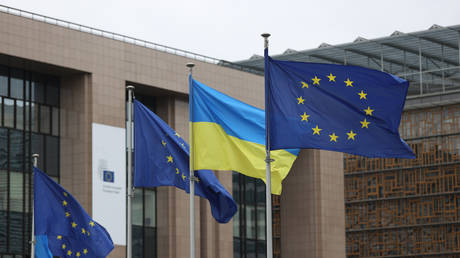
The European Commission has proposed a new limited-recourse loan of up to €45 billion for Ukraine in 2027, split into €25 billion for military assistance and €20 billion for general budget support. Kyiv will not have to repay the principal unless and until Russia pays war reparations.
On paper, Brussels calls this predictable support. In reality, it is a high-stakes accounting maneuver designed to plug a widening fiscal hole without forcing national treasuries to write immediate checks.
Only months after launching a €90 billion Ukraine Support Loan covering 2026 and 2027, European officials realized the math no longer worked. Escalating missile and drone strikes, battered energy infrastructure, and shrinking domestic tax capacity have pushed Ukraine's projected 2027 external financing gap toward €70 billion. The new proposal aims to cover roughly two-thirds of that shortfall, leaving international allies to scramble for the rest.
Why the Old Math Broke Down
War finance has a habit of mocking neat multi-year projections. When Brussels rolled out its €90 billion loan package for 2026 and 2027, policymakers assumed that combined European and partner commitments would match the tempo of the conflict.
That assumption collided with industrial reality. Defense officials in Brussels warn that drone warfare has exploded in scale, with projections pointing to tens of millions of drones used across the front lines. Interceptors, artillery ammunition, air defenses, and grid repairs cost money faster than peacetime procurement cycles can adjust.
Meanwhile, keeping hospitals open, teachers paid, and municipal utilities running in Kyiv and other cities requires steady hard currency. Raising taxes deeply inside a war zone risks choking off whatever commercial activity survives, while slashing public spending further would accelerate social strain. Brussels opted to borrow more instead.
How Limited-Recourse Debt Actually Works
Call it a loan if you want to keep political critics quiet at home. Call it a contingent transfer if you read the fine print.
Under the proposed structure, the European Union raises the money by issuing debt on capital markets, backed by the EU budget headroom—the legal ceiling between what member states have agreed the bloc can spend and what it actually budgets. Ukraine receives the funds as a limited-recourse loan, meaning repayment of the principal is tied directly to future Russian reparations.
A loan that only comes due if a hostile state eventually pays reparations functions very differently from a commercial mortgage.
If reparations never materialize—or arrive decades late and in contested installments—somebody has to absorb the financial weight of servicing and eventually settling that debt. The Commission proposes amendments to the Ukraine Loan Cooperation Mechanism so future windfall profits from immobilised Russian sovereign assets can help cover eligible loans once earlier G7-backed obligations are repaid. Even then, legal and political hurdles around sovereign assets remain fierce, and windfall yields are no guarantee of full principal recovery.
The proposal also introduces a €5 billion channel backed by guarantees from AAA/Aaa-rated non-EU countries through the Ukraine Facility. That lets outside partners plug into Brussels' borrowing machinery while shielding the core Union budget from extra exposure.
The Fractures Inside the Union
Unanimity has long been the Achilles' heel of European foreign and financial policy. With this package, capitals are openly bargaining over who carries the risk and who gets carve-outs.
Following summit discussions in Brussels, 24 EU countries backed the push for additional 2027 funding, yet fault lines stayed visible. Bulgaria signaled willingness to join only the non-military portion tied to regions with a Bulgarian minority. Slovakia refused to join the new loan while pledging not to block it, and Hungary and the Czech Republic maintained opposition during summit debates.
German Chancellor Friedrich Merz pressed for all 27 member states to share responsibility and tied the debate to broader negotiations over the 2028–2034 Multiannual Financial Framework. That linkage is telling. National leaders know that emergency fixes stacked on top of emergency fixes strain institutional credibility.
- Opt-outs and carve-outs: Partial participation weakens the political symbol of a united bloc and complicates burden-sharing formulas.
- Budget headroom pressure: Stretching the EU budget ceiling for successive Ukraine facilities leaves less room for other shocks or future priorities.
- Conditionality tensions: Linking budget support to anti-corruption and rule-of-law benchmarks is sound governance in theory, yet wartime ministries face severe administrative bottlenecks.
Defense Industry Integration and Moral Hazard
Brussels pairs cash with industrial policy. Half-plus of the proposed €45 billion—up to €25 billion—is earmarked for military support and deeper integration between European and Ukrainian defense industries.
That serves two masters at once. European defense manufacturers get long-term demand signals and cross-border production ties, while Kyiv gains faster access to weapons, drones, and air defenses without relying solely on ad-hoc national stockpiles.
Still, experts and skeptics point to real trade-offs. Rushing procurement and bypassing standard timelines to get hardware to the front can create oversight gaps. And when external backers repeatedly step in to cover two-thirds of a war budget, domestic fiscal discipline inevitably takes a back seat to survival.
Consider a hypothetical example from a mid-sized European finance ministry. Suppose a country's treasury already carries elevated sovereign debt from pandemic borrowing and energy subsidies. Adding contingent guarantees through EU budget headroom does not spike today's deficit line item, yet it ties the state's balance sheet to geopolitical outcomes well into the next decade.
What Comes Next in December
The European Council faces a December reckoning to finalize the financing mechanics. Legal drafting, member-state opt-out language, and coordination with non-EU partners will decide whether the full €45 billion reaches Kyiv on schedule in 2027.
Even if Brussels clears its hurdle, €45 billion is not a magic wand. Roughly €25 billion of Ukraine's projected 2027 external gap still depends on other allies stepping up.
Europe has chosen to buy time with capital-market borrowing rather than surrender leverage or watch Kyiv's budget buckle. Whether reparations ever pay back that wager will be decided not in Brussels boardrooms, but on the battlefield and at the negotiating table.