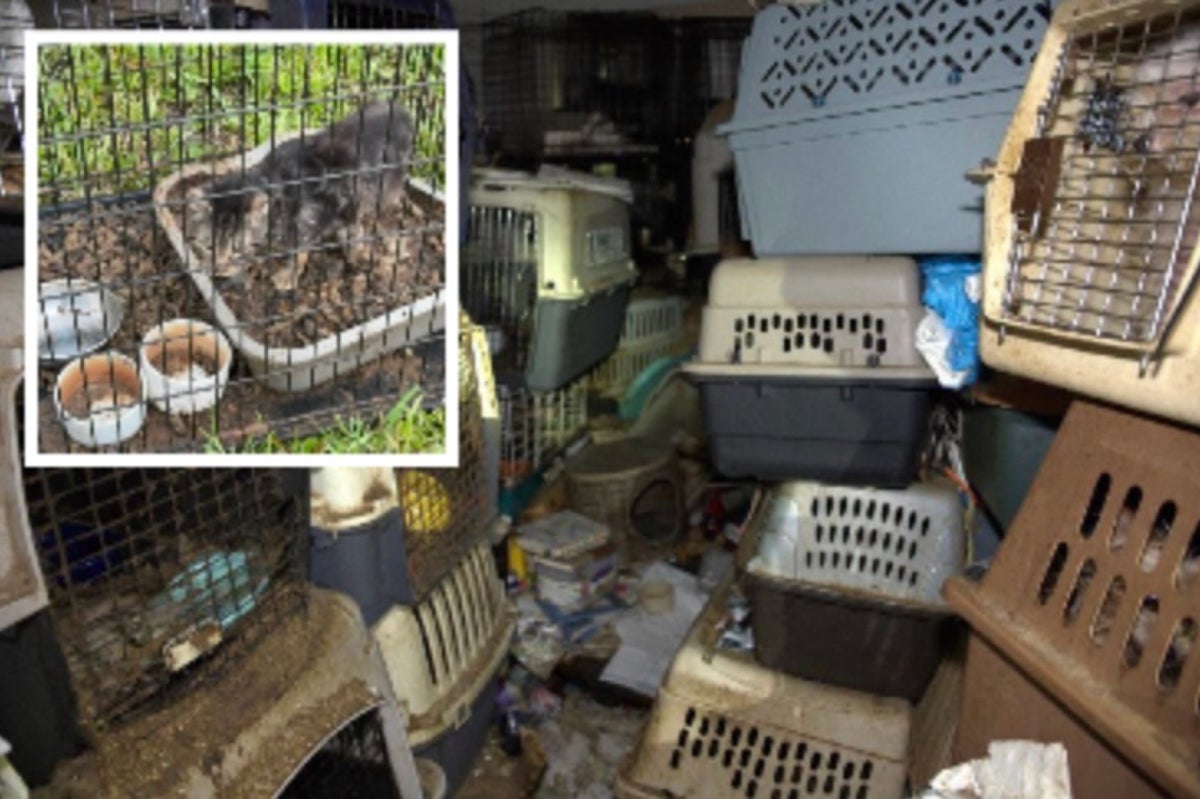
When law enforcement officers in Lee County, Florida, stepped into a local postal worker’s residence, the living conditions defied basic sanitary standards. Authorities removed roughly 80 cats from the premise—animals the long-time mail carrier admitted to gathering off the street along her daily delivery path over several years. What initially surfaced as a bizarre local blotter story quickly raised uncomfortable questions about public service accountability, institutional blind spots, and the psychological mechanics of animal hoarding.
How does a public employee collect dozens of animals from the same geographic area without triggering alarm bells at work or among municipal animal control services?
The reality sits at the intersection of systemic worker isolation, overburdened municipal welfare programs, and a psychological phenomenon known as animal hoarding disorder. It is a crisis that quietly plays out across rural and suburban America every month, rarely making headlines until the body count or property damage becomes impossible to ignore.
The Anomaly on the Route
Postal carriers occupy a unique space in American civic life. They possess unrivaled access to neighborhood rhythms. They notice uncollected mail, altered routines, and stray animals long before anyone else in the community does.
In this Florida case, however, that specialized access reversed its normal function. Rather than serving as a line of defense reporting stray populations or animal welfare issues to local shelters, the carrier became an unauthorized, unmonitored collector.
Public record filings and animal control interventions across the country paint a distinct pattern. Individuals engaging in severe animal hoarding frequently view their actions through a lens of rescue. They operate under a distorted belief system where their care—regardless of how overcrowded or unsanitary the environment becomes—is superior to the alternative of euthanasia or street life.
When a person has daily, unmonitored access to stray animals along a fixed geographic line, the route effectively acts as a pipeline. The habit compounds subtly. One stray kitten in an alley behind a commercial depot becomes three, which becomes ten, until natural reproduction within an unneutered home environment accelerates the count into dozens.
Why Institutional Alarms Failed to Sound
The United States Postal Service operates under rigorous performance metrics. Routes are mapped down to the minute. Scanners track location, movement, and idle time with relentless accuracy. Yet, the personal conduct of carriers off the clock—or subtle detours during a shift—remains notoriously difficult to monitor unless performance metrics collapse.
Several operational gaps allow this specific type of behavior to persist under the radar.
- Separation of Duty and Personal Life: Supervisors evaluate delivery accuracy and route efficiency. Unless a carrier actively brings animals into a processing facility or vehicle, management rarely has grounds to inspect personal habits.
- Neighborhood Familiarity as a Shield: Residents along a mail route often build casual trust with regular carriers. A carrier seen picking up a stray kitten is typically viewed as a good Samaritan rather than someone engaging in illicit animal collection.
- Overwhelmed Municipal Welfare Systems: Regional animal services in Florida and across the Sunbelt operate at perpetual capacity limits. Stray animal reports often fall down the priority list unless an immediate threat or bite incident occurs, creating a massive void where private intervention goes unchecked.
The broader public health implications of 80 animals residing in a standard residential property are catastrophic. High concentrations of animal waste produce dangerous levels of ammonia, harboring pathogens like Toxoplasma gondii, Salmonella, and various fungal infections. The structural degradation of the property often renders the structure unhabitable, costing tens of thousands of dollars in hazardous material remediation.
The Psychological Mechanics of Collection
To understand how an individual reaches the point of housing 80 animals, one must look at the psychiatric framework of hoarding disorder.
The American Psychiatric Association recognizes hoarding as a distinct mental health condition. Animal hoarding, specifically, carries a high rate of recidivism—studies estimate it approaches nearly 100 percent if the underlying psychological triggers remain untreated without specialized intervention and legal enforcement.
Pathological hoarders typically suffer from severe attachment disorders, trauma, or profound social isolation. The animals become emotional surrogates. As the number of animals increases, the individual’s ability to provide adequate food, water, and veterinary care collapses entirely. Yet, due to a cognitive blind spot known as anosognosia, the hoarder remains genuinely unable to recognize the squalor and suffering surrounding them.
"They do not see suffering; they see a sanctuary they personally created, even as the walls crumble around them."
When this psychological profile meets a job that provides a continuous stream of vulnerable animals, the feedback loop becomes nearly impossible to break without external legal intervention.
The Cost of Public Inaction
Remediating a case of this magnitude strains local government resources far beyond the initial police response.
First comes the immediate medical triage. Municipal animal services must intake, scan, vaccinate, treat, and evaluate 80 traumatized animals simultaneously. Many of these animals suffer from upper respiratory infections, severe flea infestations, malnutrition, and untreated injuries resulting from overcrowding. The cost of veterinary care for an event of this scale routinely runs into tens of thousands of dollars, virtually all of it absorbed by local taxpayers or non-profit rescues.
Second is the legal and code enforcement process. Seizing property—even living animals—requires strict adherence to due process. Search warrants must hold up in court. Civil forfeiture hearings must be conducted to strip the legal ownership rights from the hoarder so the animals can legally be placed for adoption or humanely euthanized if their medical condition is terminal.
Finally, structural remediation presents a long-term hazard. When urine and feces penetrate drywall, subflooring, and HVAC systems, simple cleaning is useless. In severe cases, homes must be completely gutted down to the studs or condemned by municipal building inspectors.
Redefining Community Vigilance
Relying solely on institutional oversight to catch these situations is a proven failure. Postal agencies cannot police the private mental health of their workforce, and local animal control agencies lack the manpower to investigate every informal pet rescue operation popping up in suburban neighborhoods.
Prevention relies heavily on early intervention at the neighborhood level. Strong indicators of severe domestic animal hoarding include persistent chemical odors (particularly ammonia) emanating from a residence, windows obscured by boards or heavy blankets, swarms of flies, constant uncoordinated animal noises, and a complete absence of visible veterinary care visits despite a high volume of animals on the property.
Municipalities that successfully curb high-density hoarding cases rely on multi-agency task forces. By linking code enforcement, adult protective services, local police, and humane societies, local governments can intervene before an individual accumulates dozens of animals in unlivable conditions. Without integrated approaches, these cases will continue to emerge from the quiet corners of regular delivery routes, leaving communities to pay the emotional and financial bill.
/IndonesianWoman-5ab91881ba61770037463fbd.jpg)
