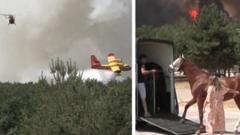
A catastrophic wildfire in the historic Fontainebleau forest, just 42 miles south of Paris, has forced the emergency evacuation of 150 elite sport horses from the Grand Parquet equestrian center. The blaze has exposed a glaring vulnerability in European disaster management: the near-total lack of coordinated infrastructure for large-scale animal evacuations during climate emergencies. As the fire enters its second day of out-of-control spread, forcing the closure of the critical A6 highway and disrupting major rail networks out of Gare de Lyon, the frantic rescue operation by the French military and local volunteers has revealed that the safety of multi-million-dollar equine industries and agricultural livestock is currently relying entirely on ad-hoc panic rather than structured state planning.
The fire broke out during western Europe's third red-alert heatwave of the year, transforming the ancient forest into a tinderbox. With winds shifting unpredictably, the front of the blaze advanced within a hundred meters of residential neighborhoods in Vaudoué and Achères-la-Forêt, prompting the evacuation of nearly 900 human residents. But while civil protection agencies have established protocols for human relocation, the sudden threat to the Grand Parquet—a premier European equestrian venue—left handlers scrambling.
The Myth of Northern Security
For decades, wildfire management in France was viewed through a regional lens. The Mediterranean south and the pine forests of the southwestern Gironde were the traditional battlegrounds for emergency services. Northern and central France, characterized by more temperate climates and deciduous woodlands, were long considered safe zones.
That geographic insurance policy has expired. The 2026 heatwaves have stripped the moisture from the soil in the Île-de-France region, leaving the historic oaks and pines of Fontainebleau highly susceptible to ignition. When the canopy caught fire, local authorities found themselves facing an "exceptional scale" blaze in an area structurally and psychologically unprepared for megafires.
Firefighters accustomed to urban and suburban responses were suddenly tasked with managing a fast-moving woodland inferno. The proximity to Paris introduces compounding complications. Smoke plumes do not merely threaten local villages; they drift into major transit corridors, choking visibility on commuter routes and forcing transit authorities to halt high-speed trains. The structural deficit is not one of effort, but of expectation. Regional planning simply never accounted for a world where the outer rim of Paris burns like the hills of Provence.
The Logistical Chaos of Moving Flight Animals
Evacuating a human population involves clearing roads, deploying buses, and establishing shelters in community gymnasiums. Evacuating 150 horses is an entirely different logistical equation. Horses are prey animals driven by an intense flight instinct. When confronted with the smell of smoke, the roar of approaching crowns, and the flashing lights of emergency vehicles, their natural response is to panic.
Loading a terrified, 1,200-pound animal into a metal trailer requires calm, expertise, and time. None of those assets were available at the Grand Parquet. As the flames advanced, the civilian transport network quickly collapsed under the weight of the emergency. Private horse vans were trapped in the traffic gridlock caused by the preemptive closure of the A6 highway.
[Fontainebleau Fire Perimeter]
       │
       ├──► [A6 Highway Closed] ──► Massive Traffic Gridlock
       │
       └──► [Grand Parquet Equestrian Center]
                │
                └──► 150 Panicked Flight Animals
                        │
                        └──► Requires: Specialized Trailers & Handlers
The French military had to be deployed to assist with the evacuation. While soldiers provided the raw manpower and heavy transport vehicles needed to break through the logjam, the operation highlighted a dangerous dependency. If the military had been deployed elsewhere, or if the fire had struck multiple facilities simultaneously, the outcome would have been catastrophic.
Furthermore, equine evacuation is not merely a matter of moving animals from point A to point B. It requires an immediate destination equipped with secure stabling, access to clean water, and isolation capabilities to prevent the spread of stress-induced diseases. The surrounding equestrian properties and local racing networks stepped forward out of solidarity, offering stalls and open paddocks. Reliance on the goodwill of neighbors is an admirable trait, but it is a indictment of formal emergency planning.
The Hidden Toll of Smoke Inhalation
The immediate focus of any rescue operation is avoiding fatalities. In this regard, the Fontainebleau evacuation has been deemed a success, with no animal or human casualties reported in the initial chaos. However, for high-performance athletic horses, surviving the fire is only the beginning of the crisis.
Smoke contains a toxic mix of carbon monoxide, particulate matter, and volatile organic compounds from burning synthetic materials and treated timber. When a horse inhales these particulates, they settle deep within the lower respiratory tract. Unlike humans, a horse cannot easily clear its lungs through coughing alone during periods of high stress.
- Acute Bronchospasm: The immediate constriction of airways due to chemical irritation, causing oxygen deprivation.
- Alveolar Damage: Long-term scarring of the deep lung tissue, which permanently reduces gaseous exchange efficiency.
- Secondary Infection: Choked respiratory defenses allow opportunistic bacteria to take hold, leading to severe pneumonia.
For a sport horse competing at the international level, a 5% reduction in lung capacity is the difference between a podium finish and forced retirement. The economic impact of smoke inhalation can ruin stables just as effectively as a direct burn. Insurance policies often cover the literal destruction of property or the death of an animal, but they rarely compensate for the subtle, degenerative loss of athletic capacity caused by environmental smoke exposure.
The Threat of Intentional Destruction
As hundreds of firefighters battle shifting winds to contain the remaining outbreaks, the structural focus is turning toward causation. Regional administration officials have confirmed that an active arson investigation is underway. The possibility that a fire of this scale was deliberately set adds a layer of malice to an already fragile situation.
The Fontainebleau forest is not a remote wilderness. It is an urban-adjacent green space heavily trafficked by tourists, rock climbers, and local residents. Managing fire security in such an accessible zone is nearly impossible without aggressive surveillance and strict enforcement of forest closures during high-risk heatwaves. France has historically resisted restricting public access to its national forests, viewing open access as a fundamental civic right.
That cultural stance is now in direct conflict with ecological reality. If arsonists can exploit open access during red-alert heatwaves to ignite fires near critical infrastructure and major animal centers, the policy of open access must be re-evaluated. The state cannot protect its agricultural and sporting assets if it refuses to secure the perimeters of the drying forests that surround them.
A Blueprint for Modern Equine Defense
The events at Fontainebleau demonstrate that the current approach to animal safety during natural disasters is broken. To prevent the next wildfire from becoming a mass-casualty event for livestock and sport horses, the agricultural and emergency sectors must implement a standardized, state-supported defense strategy.
First, regional governments must establish a mandatory registry of all large-animal facilities, detailing the number of head, available transport infrastructure, and designated secondary shelter zones. This data must be integrated directly into civil protection databases so that dispatchers can calculate the logistical footprint of an evacuation before the smoke enters the stables.
Second, transit corridors must include emergency exemptions for animal transport vehicles during structural evacuations. When highways are shut down to clear paths for emergency services, authorized animal transport networks must be granted access to those same cleared routes to avoid being caught in civilian gridlock.
Finally, large-scale venues like the Grand Parquet must invest in localized, high-volume shelter-in-place infrastructure. This includes perimeter clearing to create wide firebreaks, industrial-grade sprinkler systems capable of wetting down entire stable blocks, and independent air-filtration systems for indoor arenas. When evacuation becomes impossible due to rapidly shifting winds or closed roads, a facility must be capable of surviving as an island in the middle of the burn zone. The chaotic scramble south of Paris must be the final warning. The climate is shifting faster than the logistics, and the cost of inaction will eventually be paid in lives.