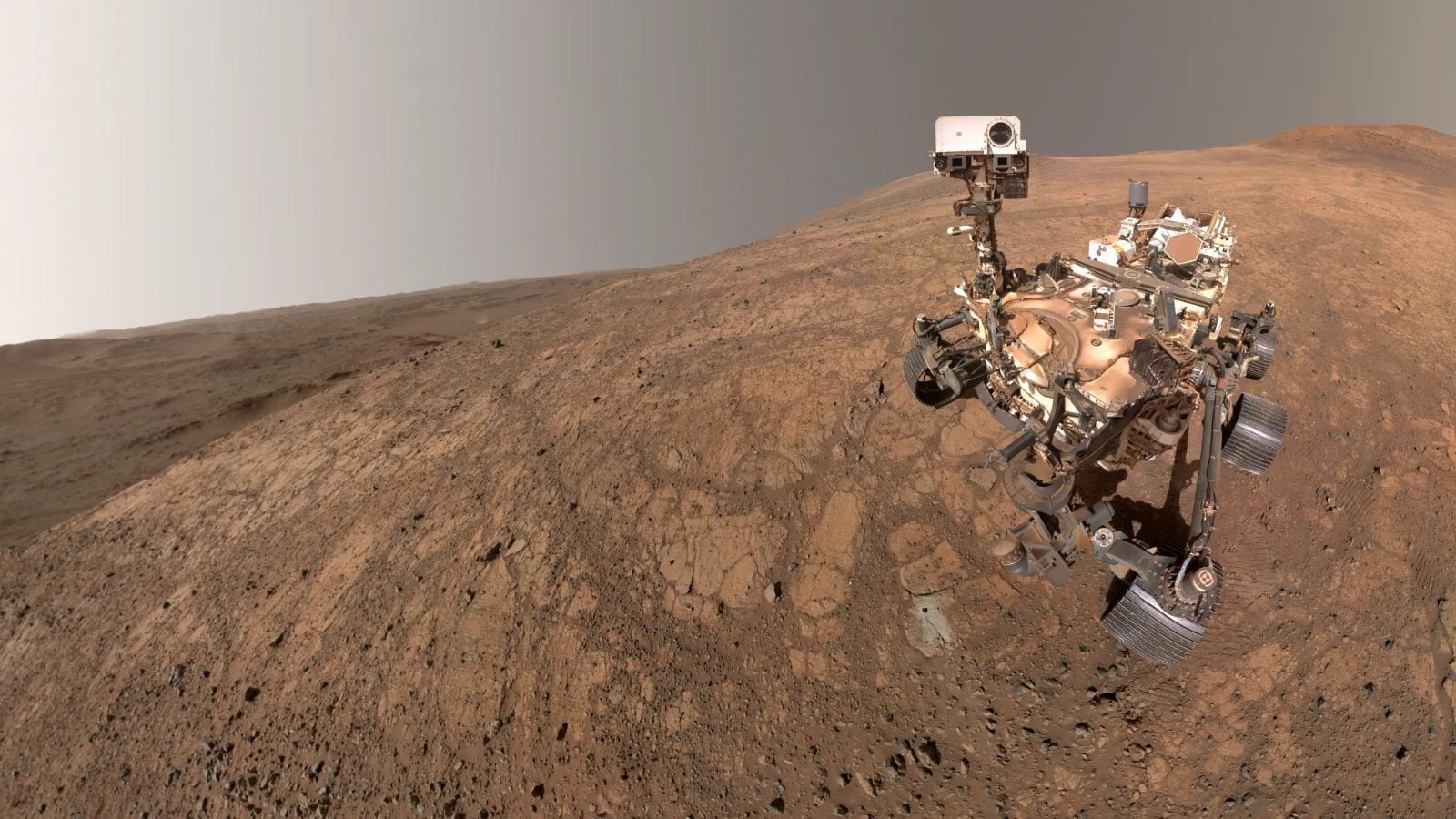
NASA’s Perseverance rover has officially bypassed the ancient lake deposits of Jezero Crater to expose a 245-foot-thick stack of bedrock dating back more than 3.9 billion years. This discovery, located at a jagged geographic formation dubbed Broom Point, provides the first intact physical record of the solar system’s most violent era—a chronological window completely erased on Earth by tectonic activity. Rather than revealing a serene cradle for early life, the data beams home an chaotic baseline of early planetary evolution characterized by a relentless barrage of asteroid impacts.
The primary scientific asset here is not just the extreme age of the rock, but its structural state. Because Mars lacks plate tectonics (the continuous recycling of a planet's crust via subduction zones), its primordial surface acts as an unedited geological archive. On Earth, any crust dating back four billion years has been crushed, melted, and repurposed multiple times over. At Broom Point, Perseverance is grinding into material that has remained largely untouched since the inner solar system was an active shooting gallery.
The Anatomy of a Cosmic Weather Report
To understand what Perseverance found, one must understand how geology records energy. The rover’s Mastcam-Z and SuperCam instruments dissected six distinct rock layers within the Broom Point member. What they found was not the slow, rhythmic settling of lake mud, but a violent alternating sequence of breccias (rocks formed from jagged, angular fragments shattered by sheer force) and highly pulverized rock dust.
+-------------------------------------------------------------+
|               BROOM POINT STRATIGRAPHIC STACK               |
+-------------------------------------------------------------+
| Layer 6: Fine Pulverized Impact Dust (Distant Strike)       |
+-------------------------------------------------------------+
| Layer 5: Coarse Breccia with Vesicular Cavities (Molten)    |
+-------------------------------------------------------------+
| Layer 4: High-Density Impact Spherule Bed (Glass Beads)     |
+-------------------------------------------------------------+
| Layer 3: Fine Pulverized Impact Dust                        |
+-------------------------------------------------------------+
| Layer 2: Debris Flow Melt (Ground-Hugging Surge)           |
+-------------------------------------------------------------+
| Layer 1: Basal Impact Breccia                              |
+-------------------------------------------------------------+
The telltale signature of these impacts lies in the microscopic details. The rock fragments within the breccias are heavily pocked with vesicular cavities—frozen gas bubbles that prove the stone was entirely molten when it was flying through the atmosphere.
More telling are the high concentrations of tiny, dark, glassy beads distributed through the sediment. While highly localized volcanic eruptions can spit out glass droplets, the overwhelming volume and scale of these beads point directly to hyper-velocity asteroid impacts. The largest of these Martian spherules match the dimensions of the debris thrown across Earth when the Chicxulub impactor snuffed out the dinosaurs. This is not a record of an isolated bad day; it is a ledger of a planet being repeatedly reshaped by kinetic energy.
The Planetary One Two Punch
The structural geometry of Broom Point requires an explanation that goes beyond simple cratering. The layers do not lie flat. They are tilted, fractured, and thrust upward, pointing to a multi-stage history of destruction.
Project geologists reconstruct the landscape through two massive events. First, a massive asteroid punched into the region, carving out the 1,200-mile-wide Isidis Basin. This cataclysm literally upended the existing regional bedrock, tilting flat horizons into steep angles. Hundreds of millions of years later, a second, smaller impactor struck the edge of this tilted rim, creating the 28-mile-wide Jezero Crater. This second blow fractured the already distorted rock, hoisting the Broom Point sequence into the exposed, 490-foot-tall rim section the rover is climbing today.
What complicates this picture is the subtle signature of water. Several of the fine-grained dust layers exhibit characteristics of ground-hugging debris flows. This suggests that even as asteroids were vaporizing parts of the crust, they may have been interacting with surface ice or transient underground aquifers, creating scalding mudslides that rushed across the broken terrain.
The Sample Return Bottleneck
Perseverance has already used its rotary percussive drill to extract two physical core samples from this sequence, caching them in hermetically sealed titanium tubes. The scientific community desperately wants these tubes. While the rover's onboard spectrometers can tell us what the rock is made of, they cannot provide absolute dating.
To pinpoint the exact week, or even millennium, these impacts occurred, the samples must be placed inside terrestrial cleanrooms. Only massive, building-sized mass spectrometers on Earth can measure the ultra-precise isotopic decay of potassium-argon or uranium-lead inside those glassy beads.
The immediate dilemma is logistical. The Mars Sample Return campaign faces severe budgetary and engineering hurdles in Washington. The rover has done its job, logging over 26 miles across the Martian terrain and securing the most critical geological library ever assembled. The core samples are sitting on the cold Martian floor, waiting for a retrieval mission that is still trapped on the drawing board. Until that hardware flies, our clearest view of the infant solar system remains trapped behind the lens of a remote robotic explorer.


