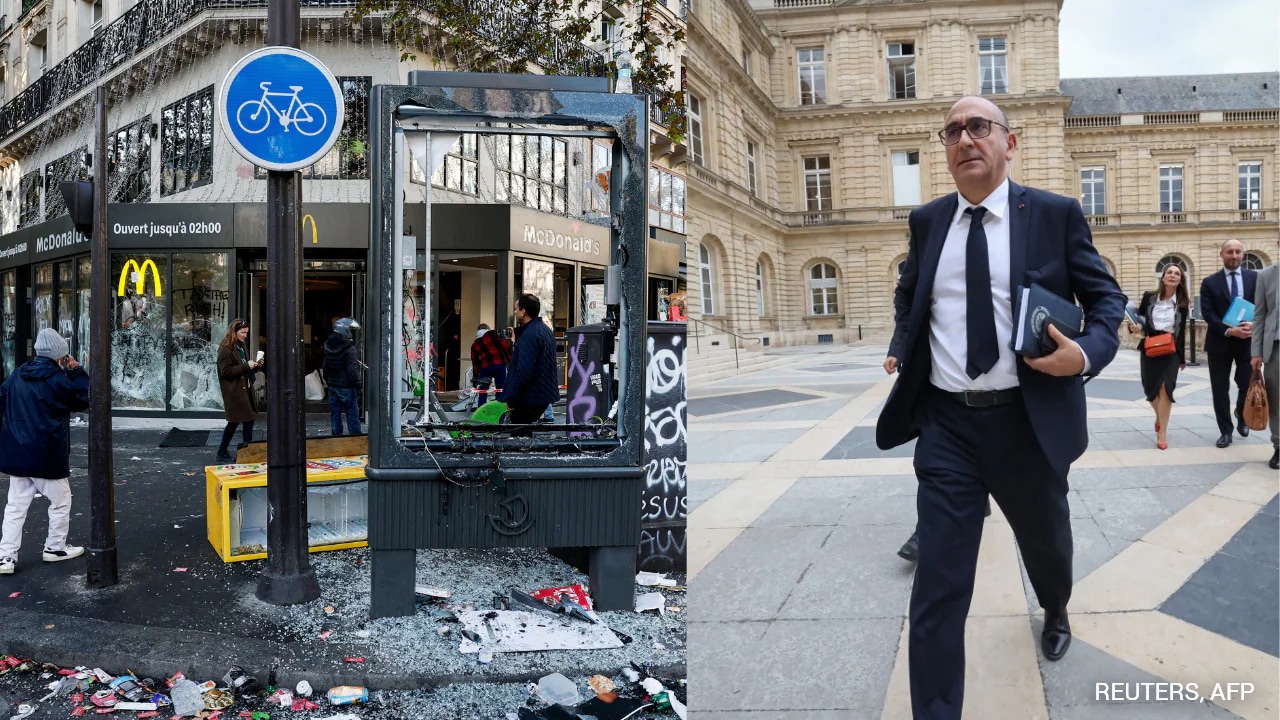
French cities face a sweeping security crackdown because weeks of protests over high living costs, strained public services, and underfunded schools exploded into violent clashes across Paris, Marseille, and Lyon—leaving authorities scrambling with demonstration bans, transit closures, and overstretched riot police. Yet the surface story of curfews, tear gas, and mass arrests misses the deeper fracture underneath. What started in September as localized student anger over state school conditions fused in mid-October with wage fury, rising fuel bills, and trade union strikes, turning major urban centers into flashpoints where law enforcement and municipal politics collide.
Look closely at the square in that frame—Place de la République—and you can see how thin the line between civic assembly and street confrontation has become. On October 17, hundreds of thousands marched nationwide in what Interior Minister Laurent Nuñez put at around 550,000 participants—and organizers at up to 800,000—while violence broke out in pockets of Paris, Marseille, and Lyon, alongside arson in Limoges. Around 1,500 shops suffered severe damage, roughly 3,000 more were looted, and more than 2,400 people were arrested across the wider wave of unrest. A crackdown followed fast: protest bans in cities like Marseille and Lyon for late October, dozens of closed Paris metro stations, railway checks, and calls for partial curfews.
How Student Grievances Became a National Tangle
Most quick-hit dispatches treat the riots as a sudden eruption out of nowhere. They were not.
The fuse was lit in September when high school and university students began protesting deteriorating conditions and thin funding in state schools. For weeks, those actions looked like a familiar seasonal pressure campaign. By October 17, however, student organizations converged with trade unions, farmers, climate activists, and returning Yellow Vest figures around a much sharper grievance: everyday affordability. Groceries, fuel, and rents were squeezing households at the exact moment public services felt worn down.
When grievances stack like that, single-issue marches rarely stay contained. A student worried about overcrowded classrooms and a public-sector worker watching wages lag behind inflation share the same basic arithmetic: work harder, pay more, get less back from the state. Once that math reaches street level, every police cordon or delayed train feels like confirmation of neglect.
- Education to economics: Student blockades and school funding complaints expanded into broader anti-government demonstrations over cost of living and fuel prices.
- Coalition friction: Peaceful marchers, union members, climate campaigners, and masked agitators occupied the same urban corridors, complicating crowd control and public messaging.
- Regional spillover: Frustrations echoed beyond France's borders into neighboring European cities, from Milan and Bologna to Brussels and Lisbon, where housing and inflation pressures also boiled over.
The Police Strain Nobody Can Hide Behind Rhetoric
Officials in Paris have pointed fingers at black bloc tactics, far-left agitators, and opportunistic looters for turning demonstrations destructive. Nuñez called the violence and attacks on security forces—including a petrol bomb thrown at gendarmes in late October—extraordinary and intolerable. Prime Minister Sébastien Lecornu and President Emmanuel Macron have pushed a hard line on restoring order, warning against "illegitimate" gatherings while the 2027 presidential race looms in the background.
Here is the inconvenient reality for any government ordering a crackdown. You cannot project limitless force with a force that is running on fumes.
Police unions have warned of severe exhaustion among CRS riot officers, with some reporting officers away from home for up to seven weeks and mass absenteeism hitting around 1,000 officers nationwide—and spiking to 80–90% in certain units amid disputes over hazard pay and working conditions. Over two decades, CRS headcount has fallen by roughly 3,000 personnel. Even intelligence and policing insiders have raised questions about how neatly all the unrest can be blamed on a single organized faction when investigation findings remain contested.
| Pressure Point | What Authorities Emphasize | What Field Reality Shows |
|---|---|---|
| Crowd Control | Protest bans, metro closures, and station checks deter repeat riots. | Tens of thousands still turn out, and clashes shift across neighborhoods and dates. |
| Force Capacity | Firm policing protects institutions, shops, and public order. | Long deployments, pay grievances, and high absenteeism strain remaining units. |
| Root Causes | Disorder stems from radical troublemakers and looters exploiting marches. | Wage stagnation, high living costs, and school strain keep fueling repeat mobilizations. |
When forces stretch thin, mistakes happen fast. In Paris on October 17, tear gas drifted over a 400-piece classical orchestra performing near Place de la République, forcing musicians to pack up mid-set even as nearby shopkeepers welcomed police protection from looting. That contrast captures the bind: bystanders and merchants want safety from vandalism, while peaceful demonstrators and artists feel caught in a dragnet.
City Halls, Street Maps, and the Politics of Order
A national crackdown looks uniform on paper. On the ground, it plays out city by city.
In Marseille, municipal leaders imposed daytime bans on public gatherings after October 17 violence damaged shops and a municipal police station and saw demonstrators briefly enter the lobby of the Hôtel de Ville. In Lyon, authorities likewise moved to ban protests on October 24 after hooded attackers vandalized and set fire to a branch of the city's tourist office. Meanwhile, in Paris, Mayor Emmanuel Grégoire told a lower-house commission on November 16 that visible disparities in how policing was deployed across different parts of the capital—more intervention in western Paris, perceived gaps in eastern districts—fed public frustration.
Banning a march on a calendar does not erase the grievances that filled the avenue in the first place.
There is a real gray area here that partisans on both sides tend to flatten. Critics of heavy-handed policing point to injured demonstrators, civil liberties concerns, and the risk that aggressive crowd dispersal radicalizes people who came out merely to vent. Defenders of strict measures counter that arson at town halls, attacks on officers, and ransacked storefronts cross a line that any democratic state must punish. Both points can be true at once without cancelling each other out: a state must stop violent property destruction and assaults, yet baton charges and blanket bans rarely fix underfunded classrooms or stagnant paychecks.
What Happens When Bans Meet Burnout
Consider a hypothetical example of how a municipal crackdown can backfire in real time. Suppose a city prefectorate bans a Saturday demonstration in the historic center and shuts down nearby transit stops to keep agitators away from shops. Peaceful marchers still arrive in smaller clusters, festive or defiant, while a smaller group of masked youths looks for softer targets or skirmishes with tired officers. If riot units are understaffed and stretched thin from weeks of back-to-back deployments, containment turns reactive—producing dramatic street footage that fuels another round of anger online and in the streets.
Five weeks into sustained protest cycles and strikes, the French crackdown is testing a core assumption of modern crisis management. Curfews, bans, and arrests can buy quiet for a weekend. Quiet is not consent, and an exhausted security apparatus cannot carry a fractured social contract indefinitely.
Watch the next flashpoint in Lyon, Marseille, and Paris: not just how many officers stand behind the shields, but whether anyone in power addresses why so many citizens decided the streets were their only leverage left.