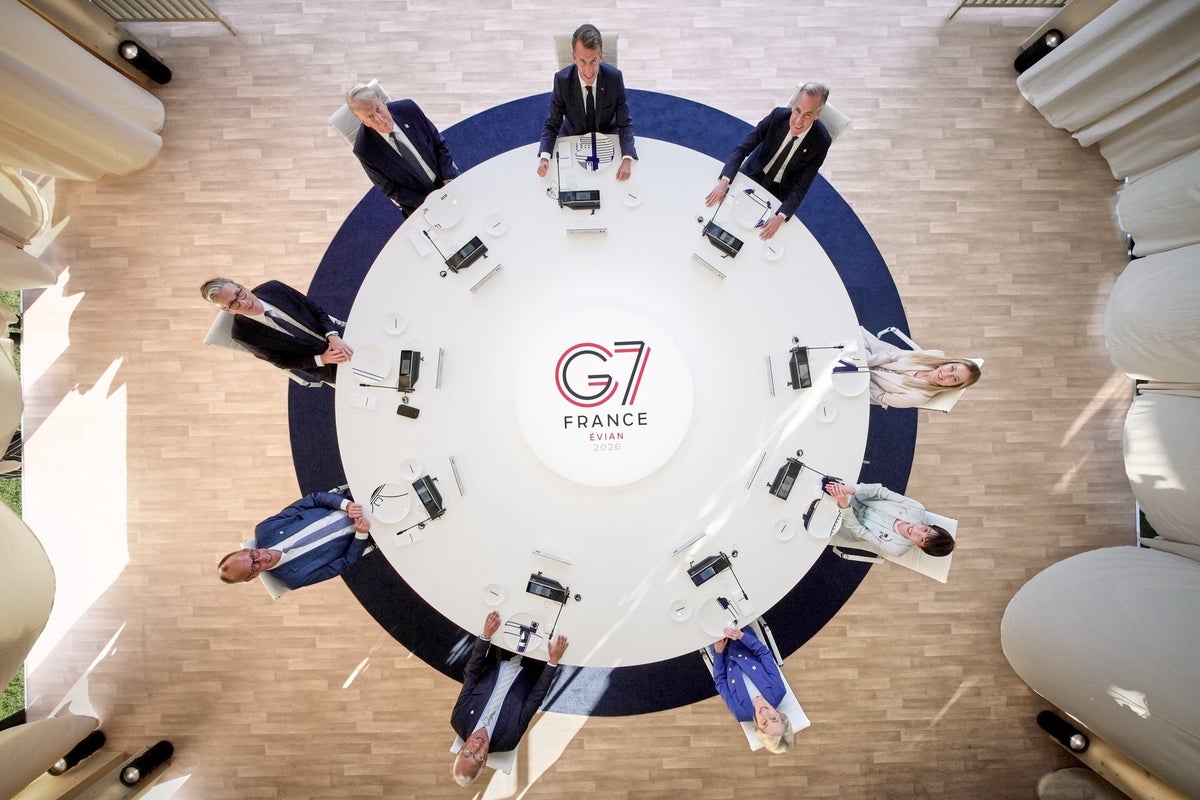
A single drone shot taken from high above the manicured lawns of the G7 summit in Évian-les-Bains tells two entirely different stories depending on who you ask. In the image, shared widely by French hosts, a cluster of world leaders grin upward at the lens. At the edge of the frame stands Donald Trump, looking visibly detached, his posture rigid while those around him lean into the collective moment. Tabloids quickly weaponized the frame, running cheap headlines about an awkward American president isolated on the world stage.
But reducing this moment to a simple social gaffe misses the real mechanism of modern geopolitics. World summits are no longer just about backroom deals and text-heavy communiqués. They are highly calculated arenas where visual optics are weaponized by participating nations to control narratives back home. The French hosts wanted an image of unified global leadership grinning in the face of immense geopolitical strain. Trump, by refusing to play along with the choreography, signaled a deliberate rejection of multinational theater.
This is the hidden theater of summitry. It is an optics war where the camera lens is used as an instrument of statecraft, and every participant knows exactly how to manipulate the angle.
The Strategy Behind the Lens
When an official host country releases a photograph, it undergoes a rigorous vetting process through diplomatic channels and communications teams. The Évian-les-Bains aerial shot was calculated to project stability during a week filled with volatile policy shifts, including unexpected friction over a newly announced regional trade and energy framework.
Host nations use distinct visual setups to achieve specific political goals.
- The Unified Front: High-angle group shots that minimize individual stature and emphasize collective agreement.
- The Active Working Session: Mid-range candid photos showing leaders rolling up their sleeves over documents, projecting competence and hard work.
- The Master-Class Portrait: Tight frames focusing on a single leader dominating a room, a favorite tactic of nations looking to boost a leader’s domestic standing.
By standing apart, Trump executed a familiar playbook. For a domestic base that views international bodies with skepticism, an image of their leader looking out of place among smiling foreign dignitaries is not a political failure. It is proof of concept. It shows a leader who refuses to be absorbed into the globalist collective, converting a perceived diplomatic snub into raw domestic political capital.
A History of Weaponized Framing
This is far from the first time a single image has been used to define an entire international summit. In 2018, a photograph captured by a German government photographer at the G7 in Canada became an instant classic. It showed Angela Merkel leaning across a table, surrounded by allied leaders, facing a seated Trump who had his arms crossed defensively.
The German government leaked that image precisely because it made Merkel look like the defender of the rules-based international order. Within hours, however, the White House released its own photos from the exact same meeting. In the American version, taken from an entirely different angle, Trump was seen smiling and looking directly at his European counterparts, completely changing the power dynamic of the room.
Photography at this level is never accidental. It is a calculated leak designed to serve a specific domestic agenda before the ink on any treaty is even dry.
The current aerial photo from France operates on the exact same logic. The French press office released an image that highlighted a cheerful, cooperative alliance. Trump’s team countered by highlighting his exclusive schedule, including a highly publicized dinner at the Palace of Versailles with French President Emmanuel Macron. By shifting the focus from a crowded group photo to an elite, one-on-one dinner in a historic setting, the American communications team effectively neutralized the narrative of isolation.
The Friction Behind the Smiles
The true danger of focusing entirely on whether a leader looks awkward in a photograph is that it obscures the high-stakes policy battles occurring just out of frame. While commentators debated the body language in the drone shot, actual diplomatic fault lines were fracturing in real time.
Capitol Hill lawmakers were already voicing deep skepticism over a proposed deal aimed at lifting naval restrictions in the Strait of Hormuz. Lawmakers from both parties demanded thorough briefings, questioning the unresolved enforcement mechanisms of the agreement. At the same time, the British delegation was dealing with severe internal leadership strain, trying to secure a firm date for an upcoming UK-EU summit while facing mounting domestic pressure at home.
These are massive, structural shifts involving billions of dollars in trade, energy security, and military positioning. Yet, the public discourse remains heavily fixated on who smiled, who crossed their arms, and who stood on the periphery of the frame.
The Professional Choreography of Summitry
To understand how these situations happen, one must understand the role of the diplomatic "sherpas"—the behind-the-scenes operatives who negotiate every single detail of a summit long before the heads of state arrive. Sherpas do not just negotiate tariff percentages and security guarantees. They negotiate the physical blocking of the group photo.
They map out exactly where each leader will stand, who walks in first, and how long the press pool is allowed in the room. A leader arriving late or choosing to break from the assigned blocking disrupts the entire script, forcing official photographers to scramble. The resulting images are rarely accidental blunders; they are the visual fallout of a breakdown in diplomatic choreography.
International summits have evolved from serious deliberative bodies into high-stakes content factories. Leaders are fully aware that a single frame can outlast any joint statement they sign. As long as domestic audiences reward performative defiance or carefully staged unity, the true work of international diplomacy will continue to happen in the dark, entirely hidden by the glare of the flashbulbs.