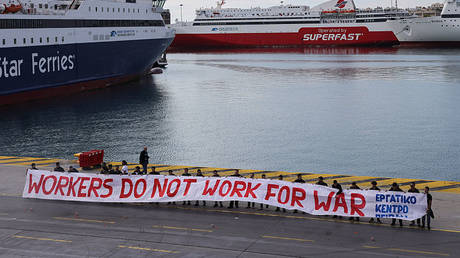
Maritime unions across Europe, North America, and the Middle East are refusing to load or unload vessels carrying weapons and military hardware bound for Israel, triggering a decentralized global dockworker strike against Israeli and US military shipments. The labor actions do not rely on a single unified walkout. Instead, port workers are executing targeted work stoppages, blocking specific berths, and flagging suspicious manifests to disrupt defense supply chains at their most vulnerable chokepoints.
The strategy is surgical. While mainstream coverage often frames these events as sprawling, indefinite port shutdowns, the operational reality on the docks is far more calculated. Longshoremen and crane operators are isolating dual-use cargo and defense contractor freight while allowing commercial consumer goods to pass through. This precision prevents immediate economic backlash from local retailers while maximizing friction for defense logistics networks.
How Maritime Chokepoints Work in Modern Defense Logistics
Modern warfare runs on commercial infrastructure. Contrary to popular belief, the United States and Israel do not rely exclusively on gray-hulled naval vessels to move ammunition, armored vehicle components, and spare parts across oceans. A massive percentage of military logistics is outsourced to private shipping conglomerates like Maersk, ZIM Integrated Shipping Services, and MSC.
These vessels operate on tight, automated schedules known as liner services. A container ship carrying commercial electronics, agricultural equipment, and sealed defense containers might call at five different ports in ten days. When dockworkers in Genoa, Barcelona, or Antwerp refuse to touch a single block of containers on that vessel, the entire itinerary fractures.
Port terminals are designed for continuous velocity. Cranes must move between thirty and forty containers per hour to keep berths clear and demurrage fees from spiraling out of control. If a crew of six crane operators and lashing specialists walks off the pier for four hours when a flagged vessel arrives, the terminal operator faces an immediate spatial crisis. There is nowhere to put the incoming boxes, and the outgoing boxes miss their rail and trucking connections.
The financial pressure hits the shipping lines instantly. Charter rates for large container vessels can exceed tens of thousands of dollars per day. A forty-eight-hour delay caused by a labor dispute eats directly into the profit margins of commercial carriers, forcing corporate executives to weigh the value of defense contracts against the stability of their broader commercial routes.
The Anatomy of a Targeted Berth Blockade
To understand why these actions succeed where street protests fail, you have to look at the mechanics of port manifests and bill of lading disclosures. Freight rarely travels with a label reading "Tank Shells" or "Drone Guidance Systems." Instead, military cargo is typically routed through freight forwarders under generic Harmonized System (HS) codes—classified broadly as "machinery parts," "metal castings," or "electronic components."
Dockworker unions have adapted to this opacity by building cross-border intelligence networks. Information flows through encrypted messaging channels between union locals in export hubs—such as ports along the US East Coast—and transshipment hubs in the Mediterranean.
When a union representative in New Jersey spots a container originating from a known defense contractor facility, that container's unique eleven-character alphanumeric identification code is logged and transmitted ahead of the vessel's arrival in Europe or the Middle East. By the time the ship drops anchor in Piraeus, Tangier, or Bilbao, the local stevedores already know which bay, row, and tier holds the cargo.
The Legal Tightrope of Refusal to Handle
Refusing to move cargo puts dockworkers in direct collision with domestic labor laws. In the United States, the Taft-Hartley Act strictly prohibits secondary boycotts—situations where a union strikes against an employer to force that employer to stop doing business with another entity. Federal courts have consistently ruled that politically motivated work stoppages violate collective bargaining agreements, exposing unions to crippling financial damages and injunctions.
European labor frameworks offer slightly more maneuverability, though the risks remain severe. In countries like Italy, Spain, and Greece, unions frequently invoke health and safety protocols rather than declaring an overtly political strike.
Union safety stewards board a vessel, inspect the hazardous materials declarations required under the International Maritime Dangerous Goods (IMDG) Code, and identify discrepancies in how explosives, propellants, or lithium-heavy military electronics are stowed. Under European maritime safety regulations, a legitimate safety objection legally halts crane operations until port state control inspectors verify compliance. That bureaucratic verification process alone can delay a vessel by days.
Historical Precedents on the Waterfront
Dockworkers using their control over global trade bottlenecks for geopolitical ends is not a new phenomenon. The waterfront has functioned as an unofficial foreign policy battleground for nearly a century.
- The 1938 Dalfram Dispute: Australian waterside workers in Port Kembla refused to load pig iron onto the steamship Dalfram, which was bound for Imperial Japan during its invasion of China. The standoff lasted ten weeks and forced the Australian government to confront its trade policies.
- The 1974-1979 Anti-Pinochet Boycotts: Dockworkers in the United Kingdom, Australia, and California systematically refused to service vessels linked to Augusto Pinochet's military junta in Chile, leaving naval engines rusting in warehouses for years.
- The 1984 Dunnes Stores and Durban Solidarity Actions: Port workers across Western Europe and North America coordinated blockades against South African cargo vessels to enforce economic isolation against the Apartheid regime.
- The 2008 Iraq War Protests: On May Day 2008, members of the International Longshore and Warehouse Union (ILWU) shut down every major port on the US West Coast for an eight-hour shift to protest the wars in Iraq and Afghanistan, halting billions of dollars in trade despite fierce legal pushback from the Pacific Maritime Association.
The critical difference today is speed and decentralization. In 1984, coordinating an international boycott required telex machines, physical mailings, and formal executive board votes that took months to execute. Today, a crane operator in Oakland can photograph a shipping label, verify the consignee through public procurement databases, and alert union counterparts in Marseille before the ship even clears the Golden Gate Bridge.
The Corporate and Military Counter-Response
Defense ministries and global shipping lines are not passive observers in this standoff. As maritime labor resistance has hardened, logistics planners have deployed specific countermeasures to bypass hostile ports and insulate supply chains from union interference.
The most common tactic is transshipment rerouting. If a commercial carrier anticipates a blockade at a primary European hub like Genoa or Antwerp, the vessel alters course to call at ports with weak union representation, heavy state security, or automated terminal infrastructure. Terminals with high levels of automation—where remote-controlled cranes and autonomous guided vehicles replace human dockworkers—are far less susceptible to spontaneous wildcat actions.
Another method is cargo splitting and air-bridge substitution. High-priority munitions and critical guidance components are increasingly pulled off commercial container ships altogether and routed through military airlift networks or chartered cargo planes. However, air freight is exponentially more expensive and severely constrained by weight limits. You can fly microchips and optical sensors across the Atlantic in twelve hours, but you cannot efficiently airlift thousands of tons of artillery shells, armored plating, or heavy vehicle chassis. Sea freight remains the irreplaceable backbone of sustained military resupply.
Shipping companies have also begun inserting strict force majeure and indemnification clauses into defense transport contracts, shifting the financial penalties of union-induced delays back onto government agencies or defense contractors. Meanwhile, port authorities in several jurisdictions have increased private security patrols around specific berths and threatened union leaders with criminal prosecution under national security and critical infrastructure protection statutes.
Overlooked Vulnerabilities in the Maritime Supply Chain
While public attention focuses on dramatic videos of union rallies at port gates, the real vulnerability lies in the intermodal transition zones—the railheads, barge terminals, and customs clearance yards sitting just outside the port perimeter.
A container ship does not operate in isolation. Even if a shipping line successfully uses non-union labor or military personnel to unload a vessel at a secure naval pier, that cargo still has to move inland or transfer to feeder vessels. That transition requires tugboat captains, harbor pilots, customs brokers, railway switchmen, and heavy-haul truckers.
Harbor pilots hold an especially critical position. Large deep-draft container vessels cannot safely navigate narrow port channels or dock without a licensed local pilot on the bridge. Pilots are typically independent contractors or members of tight-knit professional guilds rather than traditional dockworker unions, meaning they rarely join political strikes. Yet when pilot associations express concern over civil unrest or safety hazards on the pier, port operations grind to a halt instantly.
Similarly, bunkering crews—the workers who operate the fuel barges that refuel massive container ships—wield quiet leverage. A ship can be loaded and cleared by customs, but if the bunkering barge refuses to tie up alongside it, the vessel cannot sail.
The Structural Limits of Waterfront Activism
For all its disruptive power, a decentralized dockworker blockade faces hard structural limits. Labor unions are fundamentally built to protect the wages, pensions, and safety of their members, not to function as permanent geopolitical enforcement agencies.
Sustained blockades carry a heavy financial toll for the workers involved. In ports where longshoremen are paid on a per-shift or piece-rate basis through hiring halls, refusing to work a vessel means forfeiting a day's wages. Without formal strike authorization from national union leadership—which rarely happens due to legal liability—rank-and-file workers absorb the immediate economic hit themselves.
There is also the problem of enforcement asymmetry. A terminal operator in a heavily unionized port can simply divert future defense contracts to a competing port fifty miles down the coast where labor is desperate for hours and willing to handle any manifest. Over time, persistent blockades risk permanently shifting lucrative shipping routes away from militant ports, eroding the very union jobs that give those workers their leverage in the first place.
Furthermore, commercial shipping data is becoming harder to track. Following early leaks of container tracking numbers, defense logistics coordinators have tightened operational security. Military freight is increasingly moved under dummy shell companies, routed through non-transparent bonded warehouses, and stripped of identifying contractor markings long before it reaches the port gate.
What the Chokepoints Reveal About Modern Globalization
The confrontation on the docks exposes a fundamental contradiction in twenty-first-century geopolitics. Governments and defense contractors spent three decades dismantling dedicated state-owned logistics fleets in favor of lean, privatized, just-in-time commercial supply chains to cut costs and maximize efficiency.
That efficiency depends entirely on uninterrupted global cooperation. By embedding military resupply inside the same commercial arteries that carry consumer goods, defense planners gained massive scale and speed—but they also handed everyday civilian workers direct physical access to the machinery of war.
You cannot automate away every human decision on a waterfront, nor can you militarize every commercial berth from Tacoma to Piraeus without collapsing global trade. As long as weapons move through civilian ports, the men and women operating the cranes retain a quiet, physical veto over where that cargo goes.