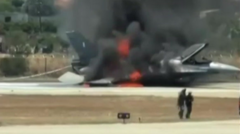
A Hellenic Air Force F-16C Fighting Falcon scraping down a commercial runway on its belly, engulfed in a sudden fireball, is not what thousands of European tourists expected to witness on their summer holidays. The emergency gear-up landing of the multi-million dollar fighter jet at Zakynthos International Airport on July 9, 2026, instantly shut down one of Greece’s busiest vacation gateways, forcing major airlines like British Airways, TUI, and easyJet to divert mid-flight to Athens and Corfu. While the unnamed pilot walked away completely uninjured and the airfield’s ground crews acted with exceptional speed to suppress the flames, the incident exposes a delicate friction point in modern European security. Military readiness operations are increasingly colliding with critical civilian infrastructure at the height of peak tourism season.
The aircraft, assigned to the 116th Combat Wing operating out of Araxos Air Base in the northwestern Peloponnese, was executing a routine training sortie over the Ionian Sea when the cockpit indicators flashed a severe malfunction warning. Confronted with an in-flight emergency that initial reports suggest involved an onboard engine fire or critical hydraulic failure, the pilot faced a brutal split-second calculation. Meanwhile, you can find related developments here: Why Taiwans Kinmen Coast Guard Patrol with Foreign Lawmakers Matters.
The Anatomy of a High Stakes Belly Landing
Military pilots are trained to preserve their aircraft whenever possible, but when systems fail over open water or heavily populated islands, the options narrow rapidly. Ejecting guarantees the destruction of a vital national defense asset and risks sending an unguided, fuel-heavy fighter jet crashing into coastal resorts or civilian towns. The pilot elected to steer the crippled F-16 towards Dionysios Solomos Airport on the island of Zakynthos, a facility designed for commercial narrow-body airliners, not high-performance military interceptors.
Leaked social media footage and eyewitness accounts confirm that the jet approached the single runway without its landing gear extended. To explore the complete picture, check out the excellent analysis by The New York Times.
A gear-up landing is an extraordinary measure of last resort. When the metal underbelly of an F-16 contacts asphalt at speeds exceeding 150 miles per hour, the friction creates an immediate, intense thermal reaction. Sparks instantly ignited trapped fuel vapors and hydraulic fluids, sending a plume of thick black smoke and bright orange flames trailing behind the airframe as it slid dozens of meters along the strip.
Airport fire rescue teams, alerted ahead of the touchdown, were already deployed along the runway. Their rapid intervention prevented the fire from breaching the main fuel cells or compromise the cockpit structure before the pilot could safely exit the aircraft.
The Logistics of Chaos at a Single Runway Terminal
While the operational response inside the cockpit and on the tarmac was a textbook display of crisis management, the systemic fallout for civilian aviation was immediate and severe. Zakynthos operates on a single-runway system. There is no backup strip, no parallel taxiway capable of handling commercial departures, and no margin for error when an accident occurs.
Zakynthos Flight Disruption Profile (July 9, 2026)
--------------------------------------------------
Airfield Status:      Suspended via NOTAM
Diverted Carriers:    British Airways, TUI, easyJet
Diversion Hubs:       Athens, Corfu, Thessaloniki
Recovery Timeline:    Multi-hour shutdown for specialized military removal
The Notice to Airmen issued shortly after the crash effectively isolated the island by air, stalling the high-volume transit network that feeds the local economy. For regional airport operators, the presence of a military asset blocking a primary commercial artery presents a unique nightmare. Specialized military hardware cannot simply be towed away by standard commercial ground handling equipment. A dedicated recovery team from the Hellenic Air Force had to be dispatched from the mainland to assess the structural integrity of the airframe, ensure the safety of any unspent ordnance or hazardous systems, and carefully lift the jet to clear the runway.
Military Training in Civilian Airspace
This incident highlights a broader, overlooked reality facing NATO’s southeastern flank. The Aegean and Ionian seas are highly congested airspace corridors where commercial tourism routes intersect directly with intensive military training sectors. Greece maintains a high state of air force readiness due to regional geopolitical positions, requiring constant flight operations, live-fire drills, and intercept simulations.
When these high-intensity military exercises take place adjacent to holiday destinations during the summer peak, the safety margins shrink.
Defenders of the current airspace architecture point out that emergencies of this nature are incredibly rare, proving that the coordination between military air traffic controllers and civilian authorities generally functions well. However, critics argue that relying on small, single-runway island airports as emergency diversion fields for heavily armed or malfunctioning fighter jets introduces an unacceptable layer of risk to civilian travelers and ground operations.
The investigation launched by the Hellenic Air Force will focus heavily on the mechanical root cause of the initial fire indication. Investigators will scrutinize maintenance logs at Araxos Air Base to determine whether the failure stems from component fatigue, a systemic supply chain issue with F-16 spare parts, or an isolated operational anomaly.
Until those findings are made public, the image of a burning fighter jet on a holiday runway remains a stark reminder of the hidden infrastructure supporting European defense, and how quickly it can disrupt the civilian world.


