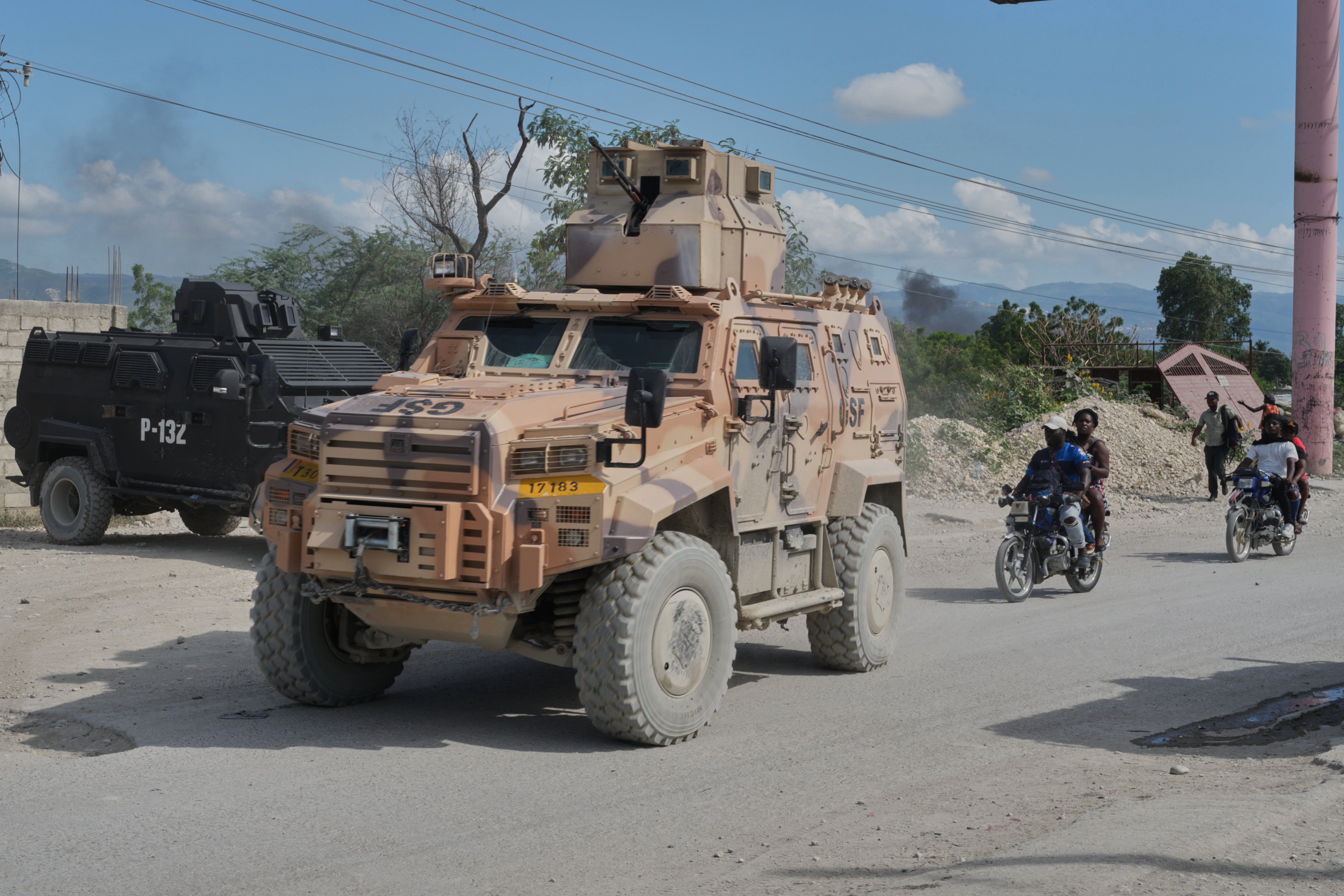
El Salvador’s President Nayib Bukele announced a military operation in late October to rescue four Salvadoran aviation technicians abducted by gangs in Haiti. Within weeks, that narrow hostage-recovery pledge swelled into a unilateral deployment of roughly 2,500 Salvadoran soldiers, seven helicopters, and armed robots operating across Port-au-Prince and the Ouest Department.
Anyone who has covered security interventions in the Caribbean knows how quickly a rescue mission changes shape. At first, officials speak in surgical terms about recovering missing personnel. Then the perimeter expands, the rhetoric shifts toward total pacification, and a four-person disappearance becomes the pretext for exporting a domestic iron-fist model abroad.
The four technicians—serving alongside the multinational Gang Suppression Force—vanished on October 18 after an ambush near Croix-des-Bouquets, in territory contested by heavily armed factions including 400 Mawozo, Chèn Méchan, and Kraze Barye. Their fate remains officially unconfirmed, even after 400 Mawozo leader Wilson Joseph told the Associated Press they were dead. Yet by early November, Bukele was posting footage of helicopter strikes on gang leaders’ compounds and promising Haitians he would help them take back their country.
How Four Missing Technicians Became an Expeditionary Force
On paper, El Salvador already had a lane inside Haiti’s international security architecture. Its personnel were operating under the Gang Suppression Force, a U.N.-authorized effort meant to backstop Haiti’s strained national police.
Bukele chose a different route. Instead of routing a surge strictly through multinational command channels, San Salvador dispatched a standalone expeditionary contingent that soon outnumbered the U.N.-authorized force on the ground. Analysts at groups like the International Crisis Group have flagged that choice as a deliberate break from multilateral guardrails. When a leader bypasses established command structures, accountability gets blurry fast.
Logistics tell part of the story. Moving thousands of troops, rotary-wing aircraft, and unmanned systems into a fractured island state requires quiet coordination far beyond San Salvador’s own borders. Reports point to logistical backing involving the United States, Colombia, and the Dominican Republic, alongside a phone call in which U.S. President Donald Trump reportedly told Bukele to do what he had to do.
Still, Washington’s posture has looked split rather than unified. Some officials welcome aggressive pressure against entrenched gang networks that have driven roughly 1.5 million Haitians from their homes and pushed more than half the population into acute humanitarian need. Others worry about operating outside clear legal mandates in a country already scarred by foreign interventions.
The political calculus in San Salvador is hard to miss either. Bukele built his international brand on mass incarceration, states of exception, and aggressive security sweeps at home. Projecting that persona across the Caribbean turns a crisis in Port-au-Prince into a stage for regional strongman projection.
A rescue operation that expands into open-ended counter-gang warfare rarely stays confined to its original legal or operational boundaries.
Why Street Cheers Do Not Equal Lasting Control
Walk through parts of Port-au-Prince or provincial towns like Belladère, Jérémie, or Kenscoff, and you will see real enthusiasm for the Salvadoran arrival. Thousands of Haitians have rallied in the streets to cheer the troops, frustrated by years of gang extortion, blocked roads, and state paralysis.
Desperation breeds appetite for shock therapy. When armed groups control supply corridors and police stations sit overmatched, residents often welcome any force willing to hit the gangs hard. Even polling in El Salvador has reflected broad public backing for the intervention and confidence in rescuing the technicians alive.
Crowds cheering a convoy, however, are not the same thing as reclaimed territory. Holding ground requires boring, exhausting municipal governance—courts, prosecutors, neighborhood policing, tax collection, and basic services that gangs cannot easily replace.
Consider a hypothetical example of how a single raid plays out without follow-through. Suppose an armored column and a helicopter strike clear a gang boss’s compound at dawn, driving gunmen into side streets for a few hours. If no local police or holding units remain behind by nightfall, armed fighters slip back in, check residents’ phones for informers, and punish anyone who waved at foreign soldiers.
Observers tracking operations around Plaine du Cul-de-Sac and Canaan have warned of precisely that pattern. After strikes on compounds linked to figures like Wilson Joseph and Taliban gang leader Jeff Larose, permanent holding forces were not always left in place, allowing armed groups to return and intimidate locals. Raids make great short-form video clips. Clearing and holding neighborhoods takes years.
The Civilian Toll Behind the Drone and Helicopter Clips
Social media clips of precision strikes and cheering crowds flatten a messy reality on the ground. In dense urban areas where gang checkpoints sit meters from apartment blocks and clinics, firepower carries immediate consequences for noncombatants.
Around Plaine du Cul-de-Sac, fighting has already displaced roughly 2,000 more residents caught between armed gangs and security operations. During the first week of Salvadoran operations, Médecins Sans Frontières reported treating 30 wounded people—among them women and children—struck by gunfire or drone blasts. A week later, Zanmi Lasante reported material damage to its facilities in Santo amid armed clashes.
Bukele has pushed back sharply against criticism over aerial munitions and civilian harm, disputing accounts of bomb drops and insisting Salvadoran helicopters arrived after certain statements were issued. Disputes over exact strike timing and weapon types are common in fast-moving urban conflicts, especially when independent verification is difficult.
What is not in dispute is the legal standard. Under international humanitarian law, an ambush on foreign personnel—even a brutal kidnapping of four technicians—never justifies collective punishment or reckless harm to civilians. Explosive drones and heavy sweeps in crowded districts create collateral exposure that can alienate the very population security forces claim to protect.
| Dimension | Rescue Framing | Expanded Military Campaign |
|---|---|---|
| Stated Objective | Locate and recover four abducted Salvadoran technicians | Degrade powerful gangs and help restore state control |
| Command Alignment | Tied to multinational Gang Suppression Force support | Large unilateral deployment operating alongside local forces |
| Tactical Footprint | Focused search, intelligence, and extraction | Helicopters, armed robots, sweeps, and street patrols |
| Primary Risk | Mission failure if hostages are already dead | Civilian casualties, unclear exit rules, and gang reprisal |
Haiti’s Fragile State and the Exit Trap
Even the most capable foreign troops cannot fix Haiti’s institutional hollowness for Haitians. Prime Minister Alix Fils-Aimé’s government has welcomed the intervention, formed a coordination cell to reduce overlap among security actors, and reiterated ambitions to extend state authority across the country. Some analysts have even argued the shock to gang dominance could open a brief window toward long-delayed elections.
Yet Haiti has seen outside interventions promise a clean reset before. Past missions—including the long-running U.N. stabilization operation that ended in 2017—left deep political scars and mixed security legacies without curing underlying state weakness.
Salvadoran officials have indicated their forces intend to leave once the missing technicians are found. That creates a sharp exit dilemma. If the technicians are confirmed dead or never recovered, what triggers withdrawal—a set calendar, a territorial milestone, or political exhaustion at home?
And if foreign troops pull out before Haiti’s police and justice system can hold contested turf on their own, gangs often regroup with ferocious vengeance against communities perceived as collaborators. Real stability requires pairing kinetic pressure with vetted Haitian police growth, credible courts, and a clear political path forward.
Watch how the coordination cell operates in Port-au-Prince over the coming weeks, whether permanent Haitian holding forces follow behind each raid, and what happens to the Salvadoran deployment once the rescue mandate collides with the reality of an unfinished war.