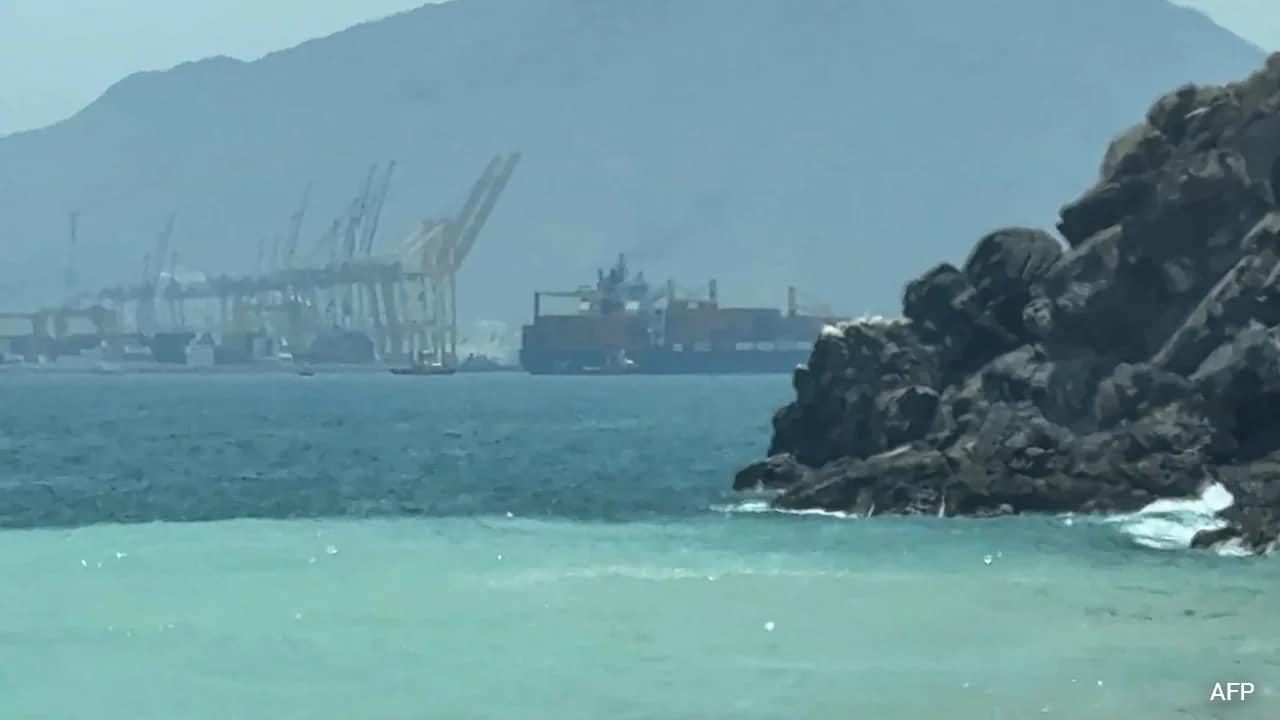
American military forces operating in the Gulf of Oman have once again opened fire on a commercial merchant vessel, targeting the oil tanker M/T Lavine after its crew repeatedly ignored orders and attempted to run the stringent U.S. naval blockade surrounding Iranian ports. According to U.S. Central Command, the vessel tried to breach the exclusion zone multiple times before Navy personnel fired directly into its engine room, a kinetic enforcement method that has quickly transitioned from an extraordinary contingency to a terrifyingly routine standard operating procedure.
This escalation underscores a much broader, brutal reality playing out across Middle Eastern waters. The United States military is not merely monitoring maritime traffic; it is actively enforcing a chokehold designed to starve Tehran of commercial shipping access, a policy born out of the catastrophic closure of the Strait of Hormuz. When regional peace talks stall and diplomatic channels fracture, Washington relies on five-inch naval guns, F/A-18 cannon rounds, and precision Hellfire missiles to settle commercial disputes on the high seas.
The Mechanics of Maritime Interdiction
To understand why a cargo ship ends up with a missile embedded in its smokestack, one must examine the clinical, unyielding mechanics of modern maritime blockades. A naval exclusion zone is only as effective as its willingness to inflict total propulsion kills. When an unladen tanker or a container ship steams toward an Iranian terminal in defiance of CENTCOM warnings, a calculated sequence unfolds.
First come the radio hails. Then bridge-to-bridge warnings. When those fail, American destroyers or carrier-based aircraft escalate to visual signals, flare drops, and warning shots across the bow. If a civilian master refuses to heave to after dozens of documented advisories, the rules of engagement shift instantly from law enforcement to asset denial.
A Hellfire missile slicing into an engine room or 20mm rounds chewing through a rudder assembly is designed to achieve a singular objective: permanent neutralization without necessarily sinking the hull or triggering a catastrophic environmental disaster. Yet, hitting a massive steel merchant ship with explosive ordnance in crowded international waters is an inherently high-risk gamble. It transforms commercial mariners into frontline combatants, regardless of whether the crew consists of coerced contract sailors or ideological loyalists.
Economic Fallout and Energy Vulnerabilities
The physical violence occurring in the Gulf of Oman is tightly coupled with a global economic tremor. The Strait of Hormuz—historically responsible for moving roughly a fifth of the world's petroleum and liquefied natural gas—has largely transformed into a closed military zone following initial regional strikes.
Global energy markets are paying an astronomical price for this standoff. Insurance premiums for any hull daring to venture near the Persian Gulf have skyrocketed to prohibitive levels, while major shipping lines reroute vessels entirely, adding weeks to transit times between Asia and Europe. The U.S. blockade on incoming and outgoing Iranian traffic compounds these pressures. By forcing commercial captains to choose between facing the wrath of the U.S. Navy or navigating a war-torn theater, Washington is effectively shrinking global maritime commerce to a trickle of state-vetted lanes.
Military briefers in Washington emphasize that intercepted vessels are given ample opportunity to turn around. They point to dozens of redirected ships and multiple disabled hulls as proof of operational restraint. Critics, however, argue that turning international trade routes into a shooting gallery creates a legal and moral gray area that international maritime law was never designed to accommodate. A blockade historically requires a declared state of war between recognized sovereign belligerents; the current environment of perpetual kinetic enforcement, proxy strikes, and stalled ceasefires blurs those definitions until they are unrecognizable.
Retaliation Loops Across the Region
Every time American forces disable a tanker in the Gulf, the shockwaves register immediately across military installations ashore. The enforcement of the blockade does not occur in a vacuum. As the U.S. military neutralizes merchant ships attempting to slip through the cordon, Iranian assets and regional proxy groups respond with asymmetric strikes of their own.
Air defense systems across northern bases and logistics hubs find themselves under constant threat from explosive drones and incoming rocket fire. Watchtowers belonging to naval support elements hundreds of miles away absorb retaliatory hits, proving that a kinetic action against a single cargo ship off the coast of Oman carries immediate, bloody consequences for personnel stationed thousands of miles inland.
The strategy relies on a dangerous assumption that escalating economic isolation will eventually force Tehran to the negotiating table on Western terms. History suggests a different trajectory. Heavy-handed naval interdictions often harden resistance, driving illicit shipping underground into darker networks of ship-to-ship transfers, phantom flags, and clandestine nocturnal runs.
Commercial mariners are left holding the steering wheel in a theater where diplomacy has failed and military planners dictate the terms of trade. As long as the exclusion zone remains active, every vessel approaching the horizon represents another potential flashpoint, waiting for a warning to be ignored and a missile to be fired.