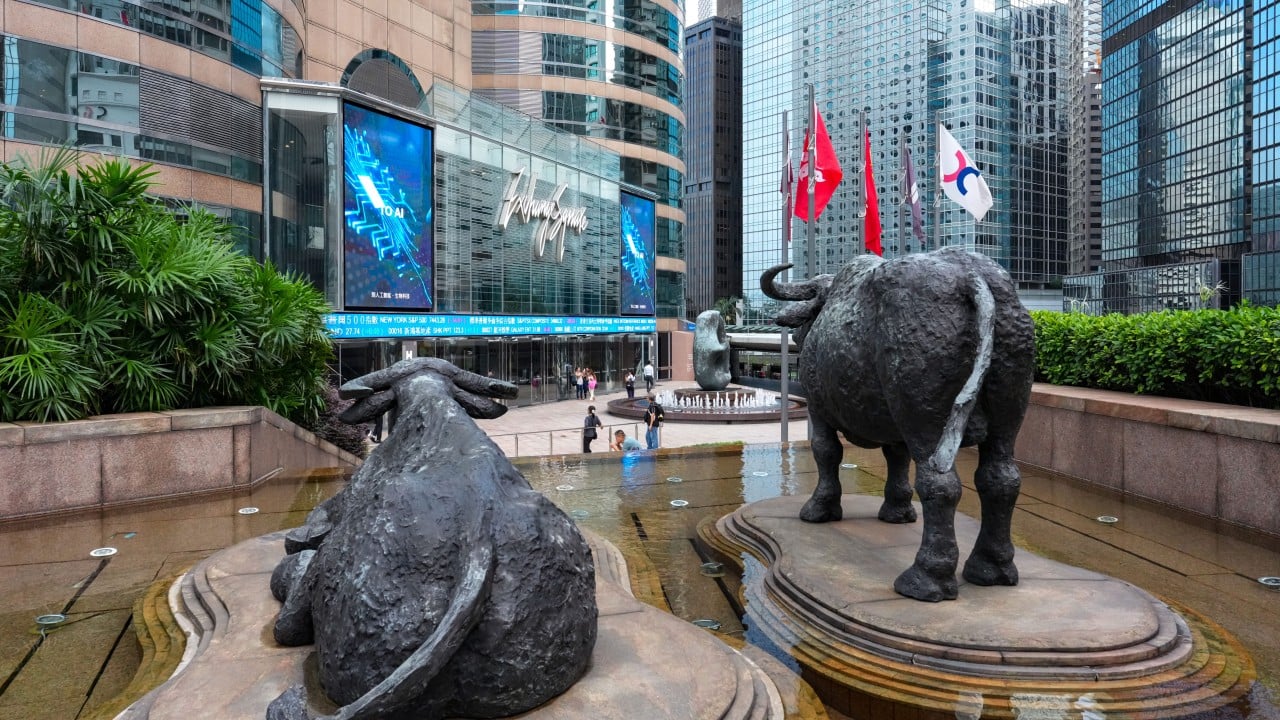
Hong Kong stocks did not hit a 19-month low simply because artificial intelligence fell out of fashion on Wall Street. The real story behind the sharp Asian equity sell-off is a brutal collision between global tech repricing, offshore liquidity drainage, and structural fragilities inside China’s capital markets.
When a benchmark index like the Hang Seng tumbles to multi-year depths, surface-level market commentary almost always blames a single catalyst. This week, that scapegoat is the global AI sell-off. Traders watched high-flying American semiconductor and cloud infrastructure names stumble under the weight of massive capital expenditure bills and delayed monetization, and they immediately hit the sell button in Hong Kong. Yet treating this rout as a mere sympathy drop misses the actual mechanics of how capital moves—and flees—across the Pacific.
Hong Kong does not trade like New York, London, or even Tokyo. It operates as an open-air financial pressure valve for mainland China, pegged to the US dollar while tied to Chinese corporate earnings. When global risk appetite sours, foreign institutional desks do not carefully trim their least favorite positions across twenty different emerging markets. They sell what is liquid. And in Asia, Hong Kong is the automatic teller machine.
Why Wall Street's AI Hangover Hit Asia Twice as Hard
To understand why an AI pullback in Silicon Valley triggers a localized panic in Central, you have to look at index concentration and valuation asymmetry.
Over the past decade, the Hang Seng Index transformed from a sleepy collection of British-era banks, utilities, and local property developers into a high-beta proxy for Chinese consumer internet and hardware giants. Companies like Tencent, Alibaba, Meituan, Baidu, and Xiaomi carry massive weightings in the benchmark. When international funds buy Hong Kong, they are overwhelmingly buying Chinese tech.
For months, bullish desks pitched a clean narrative. American AI stocks were priced for perfection, trading at nosebleed multiples that assumed flawless execution for the next decade. Chinese tech stocks, by contrast, were dirt cheap. The pitch was simple. Buy Asian tech as a discounted AI play. As large language models rolled out across Chinese cloud providers and consumer apps, these companies would supposedly enjoy a massive valuation re-rating without the downside risk of crowded US trades.
That thesis just collided with reality.
First, the global AI trade hit an inflection point where institutional investors stopped rewarding companies for spending billions on graphics processing units and started demanding immediate return on invested capital. When US hyperscalers stumble over margin compression, investors do not rotate into cheaper foreign equivalents. They question the entire asset class.
Second, Asian technology firms face a much harder monetization path than their American counterparts. In the United States, enterprise software spending provides a deep, high-margin reservoir to absorb AI infrastructure costs. In China, enterprise software adoption remains historically low, and consumer spending is still recovering from a multi-year property downturn. You cannot easily pass the cost of expensive compute onto businesses or households that are actively tightening their belts.
When global funds decided to reduce their overall exposure to artificial intelligence, those "cheap" Hong Kong tech positions were the first to go. They lacked the defensive earnings floor that still props up established American software monopolies.
The Invisible Hand of the Hong Kong Dollar Peg
Blaming tech sentiment alone ignores the monetary vice squeezing Hong Kong equities from underneath. Because the Hong Kong dollar is strictly pegged to the US dollar under a linked exchange rate system, the Hong Kong Monetary Authority must mirror Federal Reserve interest rate policy in lockstep. It has zero monetary independence.
Consider what that means in practice. The United States economy has spent the last several years running hot, keeping borrowing costs elevated for far longer than global markets initially anticipated. Meanwhile, mainland China—the actual economic engine powering corporate revenues for companies listed in Hong Kong—has been battling deflationary pressures, weak domestic demand, and a prolonged real estate slump.
Hong Kong is stuck importing tight American monetary policy into an economy deeply tied to mainland deflation.
High local interest rates make holding cash attractive and penalize leveraged equity positions. Margin financing becomes expensive. Dividend yields on traditional Hong Kong blue chips—historically a major draw for local retail investors and regional pension funds—suddenly look far less compelling when risk-free US Treasury bills pay a generous yield with zero equity risk.
Liquidity Evaporation and the Bid-Ask Trap
Experienced traders know that prices do not crash because of massive volume alone. They crash when the buyers step back.
Over the past year and a half, daily turnover on the Hong Kong Stock Exchange has frequently shriveled compared to its historical peaks. When global macro funds decide to dump $500 million worth of Hang Seng futures or large-cap tech shares during an Asian morning session, there simply is not enough institutional depth on the other side of the trade to absorb the shock smoothly.
Market makers widen their spreads. Stop-loss orders trigger automatically. A routine 2 percent pullback in New York cascades into a 4 or 5 percent air pocket in Hong Kong before lunchtime.
The Geopolitical Discount That Never Left
There is an uncomfortable truth that sell-side research reports often bury in footnotes: global capital allocation is no longer purely a math problem.
For a generation, emerging market fund managers treated Hong Kong as an essential core holding. You could not beat your benchmark without owning the major Chinese platforms listed there. Today, that career risk has flipped entirely. For many North American and European pension funds, endowments, and sovereign wealth vehicles, holding heavy exposure to Chinese-linked equities has become a compliance and headline risk.
Export controls on advanced semiconductors sit right at the center of this anxiety. Every time Washington tightens restrictions on high-end chips, lithography equipment, or cloud computing access, investors have to recalculate the long-term competitive ceiling for Asian tech firms. Can a Chinese cloud giant compete globally in foundational AI models if it is permanently locked out of next-generation silicon? Even if domestic chipmakers close the gap over time, the transition period means higher capital costs, lower compute efficiency, and slower product rollouts.
That uncertainty creates a permanent geopolitical risk premium. Whenever a global shock hits—whether it is an AI valuation reset, a currency fluctuation, or a spike in bond yields—allocators do not wait around to see how Hong Kong earnings hold up. They treat any rally as an opportunity to exit structural exposure they no longer want on their books.
Mainland Buyers Cannot Carry the Market Alone
Whenever foreign money flees Hong Kong, commentators inevitably point to Southbound Stock Connect—the trading link that allows mainland Chinese investors to buy Hong Kong-listed shares—as the cavalry coming to the rescue.
On paper, the numbers look encouraging. Mainland institutions, insurers, and retail traders have steadily funneled billions of yuan into Hong Kong equities, drawn by lower valuations than equivalent A-shares on the Shanghai and Shenzhen exchanges, as well as high-dividend state-owned enterprises.
In reality, Southbound flows cannot prevent a 19-month low when global sentiment breaks.
Mainland investors and foreign institutions play completely different games. Domestic Chinese buyers overwhelmingly favor high-yielding state-owned banks, telecom operators, and energy producers—stocks that offer steady cash payouts in an environment where domestic bond yields have fallen to record lows. Foreign funds, by contrast, dominate trading in the high-growth technology, biotech, and consumer discretionary names that drive index volatility.
Furthermore, mainland capital controls mean domestic investors cannot simply step in with unlimited firepower to buy distressed tech assets. When foreign funds liquidate their growth portfolios en masse, Southbound buyers are not waiting with open arms to catch those specific falling knives. The two pools of capital operate in parallel lanes, leaving a massive liquidity void right where the index is most vulnerable.
What History Tells Us About Multi-Year Market Bottoms
Veterans of Asian markets have seen this movie before. In 1998, during the Asian Financial Crisis. In 2008, when global leverage unraveled. In late 2022, when pandemic lockdowns and regulatory crackdowns pushed the Hang Seng to levels not seen since the global financial crisis.
Every single time, the headlines at the bottom look identical. Analysts declare the market uninvestable. Trading volumes dry up. Foreign desks close their regional books and vow never to return.
Yet markets do not bottom when the news turns good. They bottom when the last forced seller has finished liquidating.
To gauge whether this 19-month low marks true capitulation or merely a pause before another leg down, watch three concrete indicators rather than daily financial television chatter:
- Corporate Share Buybacks: Cash-rich Chinese tech giants have aggressively repurchased their own stock over the past eighteen months. When companies retire shares at single-digit earnings multiples, they steadily shrink the public float, meaning it takes progressively less buying pressure to spark a violent short-covering rally.
- The HIBOR-SOFR Spread: Watch the gap between the Hong Kong Interbank Offered Rate and the US Secured Overnight Financing Rate. Until local liquidity loosens meaningfully or the Federal Reserve cuts rates deeply enough to relieve pressure on the currency peg, Hong Kong equities will remain fighting against a monetary headwind.
- Earnings Revisions vs. Multiple Compression: A market falling because price-to-earnings multiples are shrinking is painful, but normal during a global tech reset. A market falling because analysts are actively slashing next year's revenue and profit forecasts is far more dangerous. Right now, Hong Kong is suffering mostly from the former, though weak consumer data threatens to bleed into the latter.
A hypothetical portfolio manager running a global emerging markets fund today faces an asymmetric dilemma. Buying into a falling knife in Hong Kong risks immediate career pain if global AI stocks drop another 15 percent next month. Yet ignoring a market trading at historically depressed valuations means risking massive underperformance the moment global bond yields slip and value hunters rotate back into Asia.
The Structural Shift Beneath the Headlines
The real takeaway from this sell-off has very little to do with whether artificial intelligence chatbots generate enough ad revenue next quarter. It is about the permanent fragmentation of global capital markets.
For thirty years, globalization meant that a dollar of earnings in Shenzhen or Hong Kong was valued roughly on par with a dollar of earnings in New York or Frankfurt, adjusted for simple growth rates. That era is dead. Today, liquidity is regional, capital flows are increasingly politicized, and cross-border shockwaves travel faster than ever through algorithmic baskets and index derivatives.
Hong Kong remains one of the deepest, best-regulated financial hubs in the world, backed by massive foreign exchange reserves and the world's second-largest economy just across the border. Those fundamentals do not vanish overnight because Nasdaq had a bad week.
Until domestic Chinese consumption stages a convincing recovery and global interest rates ease the vise on the Hong Kong dollar peg, every tremor in Silicon Valley will continue to trigger an earthquake in Central.