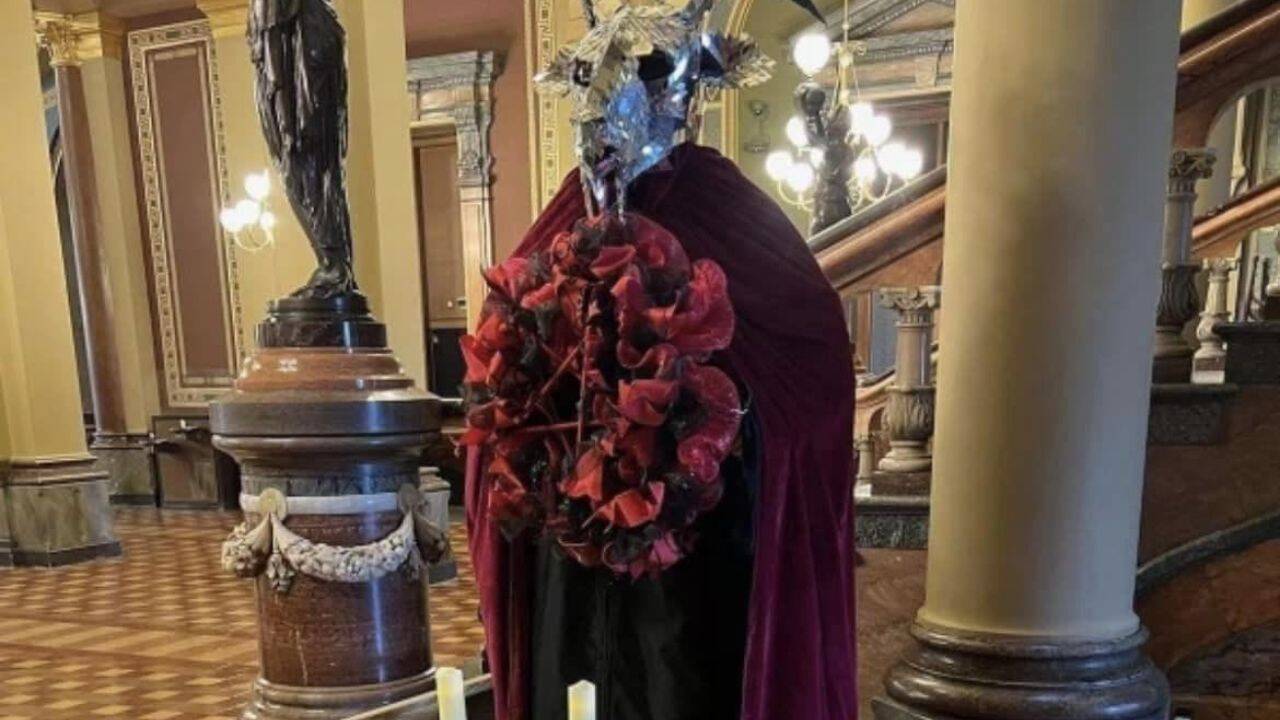
A federal judge has ruled that the state of Iowa violated the First Amendment when it denied The Satanic Temple permission to host an event inside the Iowa State Capitol. The court found that once a government opens a public building as a forum for expressive activity, it cannot selectively bar groups based on their religious or philosophical viewpoints. Iowa officials have already signaled their intent to appeal the decision, setting up a high-stakes appellate battle over the boundaries of religious neutrality in public spaces.
The ruling strikes at a recurring fault line in American constitutional law. Statehouses across the country routinely allow civic organizations, advocacy groups, and religious denominations to hold rallies, prayer breakfasts, and holiday displays in their rotundas. When a controversial or non-traditional organization applies for the exact same access under the exact same rules, state administrators often scramble to invent new reasons to say no. Federal courts, however, rarely tolerate that kind of post-hoc gatekeeping.
The Mechanics of a Public Forum
To understand why the court sided with The Satanic Temple, you have to look at how the law categorizes government property. Under First Amendment doctrine, spaces like the interior of a state capitol building are not treated like a private living room where the owner can invite whomever they please. When a state establishes a permitting process allowing outside groups to hold events in a capitol rotunda, it creates what legal scholars call a designated public forum or a limited public forum.
In either classification, the government surrenders its right to engage in viewpoint discrimination. Officials can enforce reasonable, content-neutral restrictions—rules about fire codes, noise levels, maximum occupancy, or insurance requirements. They can say no open flames. They can say no amplified sound during legislative sessions. What they cannot do is evaluate the merits, popularity, or orthodoxy of the speaker's message.
Iowa's Department of Administrative Services found itself trapped by its own historical openness. Over the years, the Capitol rotunda has hosted a wide spectrum of religious and political gatherings. By granting access to mainstream Christian groups, political lobbyists, and cultural associations, the state established a clear baseline of public use. When The Satanic Temple sought to host its own event under those established guidelines, the state's refusal looked less like neutral building management and more like an ideological veto.
Why States Keep Losing These Battles
This legal collision is entirely predictable. State officials frequently succumb to intense political pressure when an unpopular group requests a permit. Phone lines ring off the hook. Legislators demand action. Governors issue fiery statements promising to protect statehouse decorum.
The problem is that political theater makes for terrible constitutional law.
Courts examine the administrative record, not the press releases. During litigation, judges look closely at the exact criteria used to deny an application and compare them against past approvals. If a state agency suddenly enforces an obscure rule that it ignored for dozens of previous applicants, the court will strike down the denial as arbitrary and discriminatory. Furthermore, if the state argues that an event might spark protests or offend visitors, judges routinely reject that defense under the heckler's veto doctrine. The First Amendment does not allow the government to silence a speaker simply because bystanders might react negatively to the message.
We saw this exact dynamic play out in statehouses from Florida to Illinois over the past decade. Whenever a state opens the door to religious expression, it legally opens that door to everyone—including groups whose primary mission is to test whether the government actually believes in religious pluralism.
The Strategic Playbook of The Satanic Temple
Contrary to widespread public misconception, The Satanic Temple does not worship a literal devil. Founded in 2013, the organization operates as a non-theistic religious group that uses Satanic imagery as a literary metaphor for rebellion against arbitrary authority and the pursuit of personal sovereignty. More importantly, from a legal standpoint, the Internal Revenue Service recognizes the organization as a tax-exempt church.
That federal recognition carries massive weight in court. State attorneys cannot simply dismiss the group as a prank or a political stunt to bypass religious liberty protections. Under the First Amendment, the government is prohibited from deciding which beliefs constitute a "real" religion and which do not.
The organization's legal strategy is built on strict religious neutrality. Rather than suing to tear down Christian monuments or ban prayer events at government buildings, The Satanic Temple demands equal space right alongside them. This approach forces state officials into a binary choice. The government must either allow all recognized religious groups equal access to public forums, or it must close the forum entirely to everyone.
For state politicians, both options carry heavy political costs. Closing the capitol rotunda to all outside events means telling local church groups, veterans' associations, and high school choirs they can no longer gather under the dome. Keeping it open means watching The Satanic Temple set up tables and host assemblies in the exact same space.
The Shifting Ground of the Establishment Clause
Iowa's decision to appeal reflects a broader belief among conservative legal strategists that the federal judiciary is shifting in their favor. Over the last several years, the U.S. Supreme Court has significantly reshaped how courts interpret the Establishment Clause—the constitutional provision barring the government from establishing an official religion.
In recent landmark cases, the high court abandoned the decades-old "Lemon test," which scrutinized whether a government action had a secular purpose or appeared to endorse religion. Instead, the Court instructed lower judges to interpret the Establishment Clause by looking at "historical practices and understandings." That shift gave states much wider latitude to accommodate traditional religious displays and practices in public life.
However, state officials often misread what that doctrinal shift actually accomplishes. While the Supreme Court has made it easier for governments to allow religious expression in public spaces, it has simultaneously strengthened the Free Exercise Clause and Free Speech Clause protections for minority viewpoints. In other words, expanding the space for religion in the public square does not give the state permission to play favorites among competing faiths.
If Iowa takes this case to the Eighth Circuit Court of Appeals, its legal team will have to thread an exceptionally narrow needle. They will need to convince appellate judges that the state had a legitimate, viewpoint-neutral reason for blocking the event—one that was applied consistently to every other applicant who ever walked through the Capitol doors.
What the Appeal Actually Risks for Iowa
Appealing a federal district court injunction is rarely just a matter of pride; it is a financial and strategic gamble. Under federal civil rights law, specifically 42 U.S.C. § 1988, a plaintiff who prevails in a constitutional challenge against a state government is generally entitled to recover reasonable attorney's fees from the state.
Every brief filed, every deposition taken, and every oral argument scheduled at the appellate level adds tens of thousands of dollars to the potential tab paid by Iowa taxpayers. If the Eighth Circuit affirms the district court's ruling, the state will not only be forced to host the event—it will also have to cut a substantial check to The Satanic Temple's legal counsel.
Beyond the financial exposure, an appellate loss creates binding circuit precedent. Right now, a district court ruling applies primarily to the specific dispute in front of that judge. If a three-judge panel at the Eighth Circuit issues a published opinion affirming the decision, that ruling becomes the law of the land across seven states: Arkansas, Iowa, Minnesota, Missouri, Nebraska, North Dakota, and South Dakota. State administrators across the entire Midwest would lose whatever wiggle room they thought they had left.
The Administrative Reality Behind Capitol Permits
When the political noise dies down, managing a state capitol comes down to mundane bureaucratic consistency. Capitol complexes across the country handle hundreds of permit requests every legislative session. Most are approved by mid-level facilities managers who care far more about whether an event will scratch the marble floors than what the speakers plan to say.
Problems arise only when upper-level executives intervene in that routine process. Whenever a governor's office or a cabinet director steps in to override a standard permit approval because of the applicant's identity, they create a paper trail of emails, text messages, and internal memos. In federal litigation, that internal communications record is gold for the plaintiff's attorneys.
Consider a hypothetical scenario that plays out regularly in state agencies: a facilities coordinator sends an email confirming that a specific date in the rotunda is open and meets all capacity rules. Two days later, after a local news outlet reports on the upcoming event, an agency director orders the coordinator to revoke the reservation citing "scheduling conflicts" or "security concerns." When those emails surface during discovery, the state's defense collapses instantly. Judges do not need to guess at the government's motive when the timeline documents the political pivot in black and white.
To survive judicial scrutiny, state permitting systems must be strictly mechanical. Rules regarding advance notice, time limits, spatial boundaries, and cleanup deposits must be written clearly, published publicly, and enforced without exception. If a state wants to restrict capitol events strictly to official government business, it has the legal authority to pass a rule doing exactly that. What it cannot do is run an open mic night and unplug the microphone only when an unpopular guest steps onto the stage.
The federal court's decision in Iowa reinforces a principle that has anchored American free speech jurisprudence for nearly a century. The First Amendment exists precisely to protect expression that the majority finds offensive, unsettling, or bizarre. State officials can draft tighter neutral rules for their buildings, or they can accept the presence of dissenting groups in the rotunda, because the Constitution leaves them no third option.