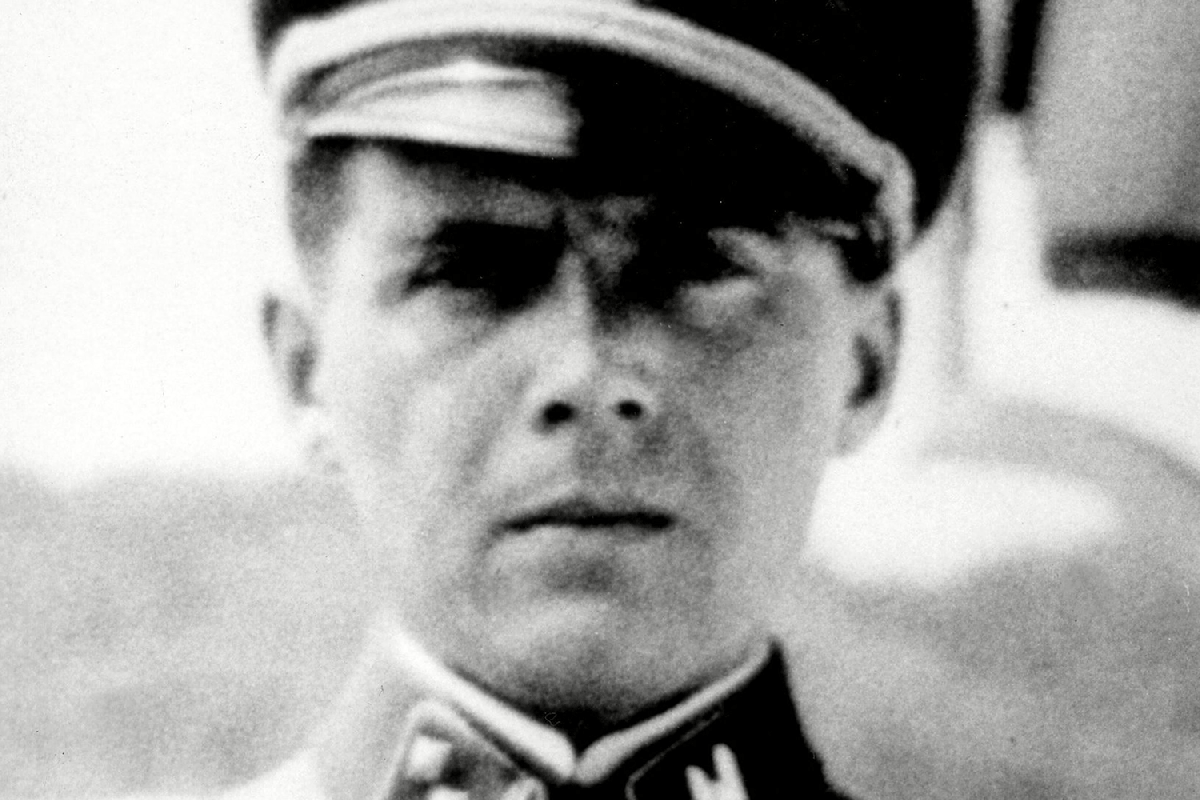
The myth of the solitary fugitive dying in obscurity always served convenience. For decades, the narrative surrounding Josef Mengele—the Auschwitz physician known as the "Angel of Death"—was fixed on a miserable, paranoid existence in South America until his drowning in Brazil in 1979. But official state secrecy rarely protects the dead; it protects institutions. Switzerland's Federal Intelligence Service has finally uploaded a redacted 200-page dossier on Mengele to the public archives, following a fierce legal challenge by historian Gérard Wettstein. Originally locked away until 2071 under the guise of national security and privacy laws, the file shatters the comfortable Swiss myth of wartime and post-war containment, pointing instead to institutional blind eyes, unpunished cross-border movements, and an administrative apparatus that chose bureaucratic preservation over historical reckoning.
The Anatomy of an Institutional Wall
Governments do not classify documents for seven decades by accident. The rationale presented by Swiss authorities for keeping the Mengele dossier sealed until 2071 always rested on a fragile legal pillar. Officials claimed the extended protection period was necessary to safeguard personal data and maintain state security. Yet, when a court challenge forces open the filing cabinets, a different reality emerges.
The documents compiled by the police service of the federal prosecutor's office—the precursor to modern Swiss intelligence—reveal a state grappling not with active security threats, but with historical embarrassment. Historians had long pointed out that Mengele's wife, Martha, rented an apartment near Zurich in 1961, and that Swiss police placed her under surveillance. West Germany had already issued an international arrest warrant for the Nazi doctor by then.
If a notorious war criminal could maneuver through European transit networks or brush against the Swiss border while an international manhunt hummed in the background, the host nation faces uncomfortable questions. The files do not merely outline a dead man's ghost trail; they expose the mechanics of operational indifference.
Consider how intelligence archives handle sensitive internal failures. When a state agency compiles reports on suspects who potentially sheltered a fugitive, those pages represent professional exposure. Protecting sources from the 1960s is a standard archival practice, but blanking out entire investigative trajectories often serves a secondary purpose. It shields the descendants of complicit administrative structures from public scrutiny.
Unpacking the Redactions
The release has not arrived without immediate friction. Historians examining the newly published digital dossier have voiced sharp criticism over the heavy-handed redactions applied by the intelligence service. Critics argue that a transparent historical accounting requires raw data, not a sanitized corporate product where critical names and foreign intelligence linkages remain obscured behind black marker bars.
Sacha Zala, president of the Swiss Society for History, suggested that the true sensitivity within these pages might involve foreign intelligence entities, including Mossad operations, rather than purely domestic lapses. Foreign intelligence cooperation—or the lack thereof—often forms the core of what governments prefer to bury. When foreign powers hunt war criminals across neutral territory, local law enforcement agencies frequently find themselves caught between sovereign protectionism and international pressure.
If the Swiss files demonstrate that federal authorities tracked suspicious movements or received actionable intelligence regarding Mengele's presence near Kloten or Zurich and chose administrative inaction, the legal rationale for sealing the files instantly transforms from state security to reputational damage control. Democracies fail their own foundational ethics when the preservation of an unblemished national image supersedes the public right to historical truth.
The Global Infrastructure of Impunity
Mengele did not survive decades in South America through sheer luck. His escape relied on a well-greed apparatus of Red Cross travel documents, sympathetic clerical networks in Europe, and lax border controls. Switzerland was merely one node in a larger ecosystem of post-war evasion that allowed architects of industrial mass murder to slip through the fingers of allied justice.
The historical consensus long maintained that Switzerland acted as a strict neutral zone where Nazi assets were monitored and fugitives were turned away. Yet, the persistent rumors of Mengele's physical returns to European soil—whether to visit family, manage assets, or test the waters of safety—point to a porous border reality. When a state maintains a posture of rigorous neutrality while permitting financial and physical transit for individuals holding dubious or false identity papers, the definition of neutrality warps into complicity.
The timing of this document release also arrives at a dangerous cultural crossroads. As far-right ideologies resurface across digital platforms and historical revisionism sanitizes SS criminals into online aesthetic figures, the concrete documentation of Nazi atrocities and post-war evasion takes on urgent contemporary weight. Whitewashing the past is no longer confined to academic debates; it plays out daily in algorithmic feeds where names like Mengele are stripped of their horror.
Access to unvarnished archival truth acts as an antidote to this drift. When researchers are forced to battle administrative bodies in courtrooms just to read police logs from sixty years ago, the system creates a vacuum. In that vacuum, conspiracy theories thrive, and public trust in democratic institutions erodes further.
Transparency cannot be treated as a concession granted reluctantly under legal duress. It is the baseline requirement of historical accountability. The opening of the Mengele dossier proves that what governments lock away for generations is rarely a secret that threatens national safety, but rather a reflection of institutional cowardice that they simply could not bear to face.