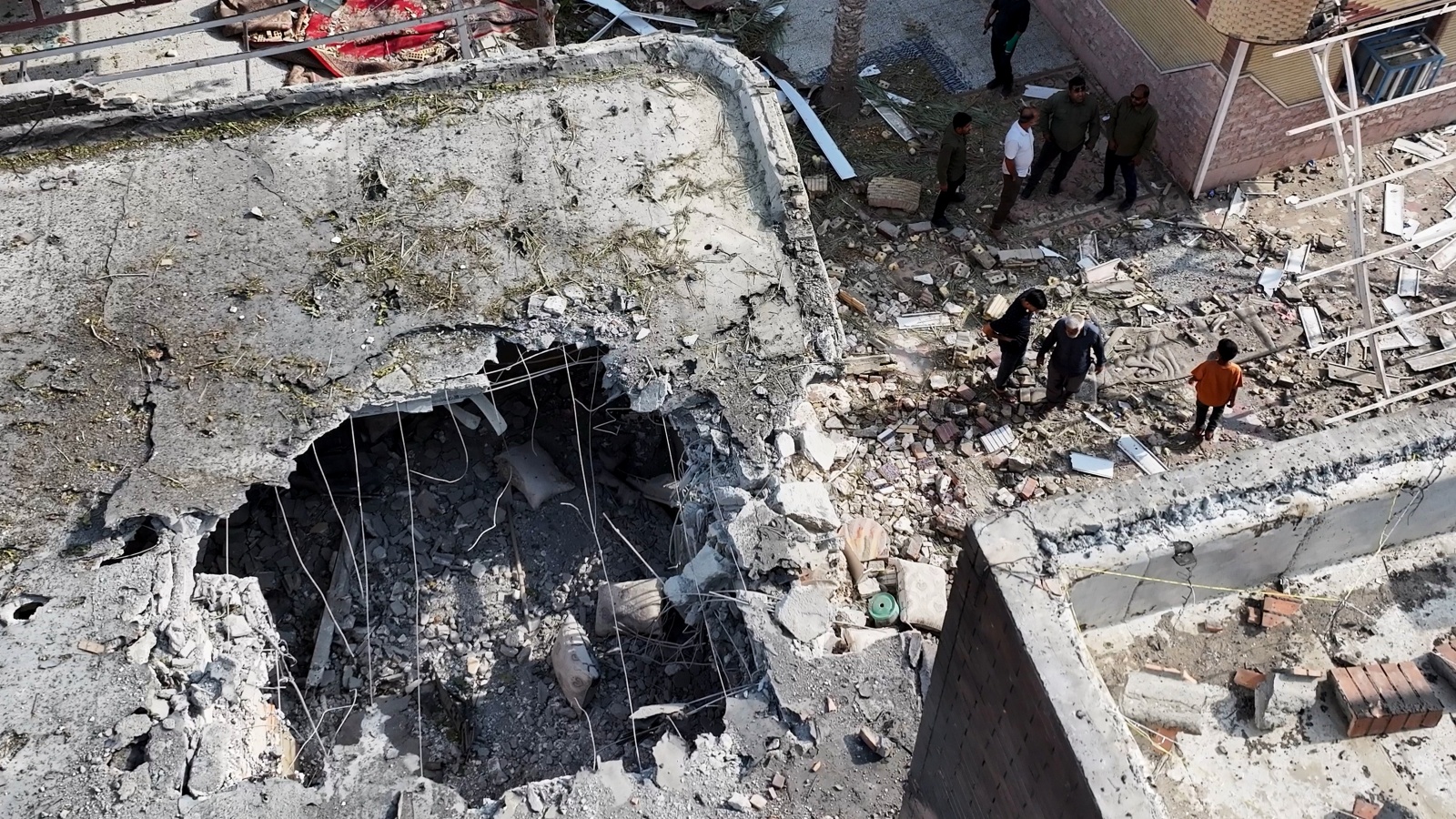
The sirens start long before the impact. They wail across the concrete canyons of Kyiv, a familiar, grating frequency that turns millions of ordinary civilians into instant calculators of risk. When a Russian attack on Kyiv strikes a residential high-rise, killing a resident, tearing open the upper floors, and turning a quiet neighborhood into an inferno, the news ticker reports it as a single incident. One dead. Fifteen evacuated. A fire extinguished.
Statistics sanitize the horror. They hide the grinding, mechanical reality of a campaign designed not necessarily to seize territory overnight, but to exhaust the spirit of a nation one apartment block at a time. Having watched this conflict evolve from armored columns on the highway to low-altitude buzzing in the dark, the shift is stark. The war has settled into a grim architecture of endurance where civilian apartment blocks serve as primary pressure points.
The Evolution of Long Range Terror
The deployment of jet-powered and propeller-driven loitering munitions against Ukrainian urban centers represents a fundamental shift in military economics. Traditional ballistic and cruise missiles are prohibitively expensive. They are precision tools reserved for high-value military nodes, power substations, or command bunkers. But when an air campaign relies heavily on mass-produced, long-range drones, the calculus changes entirely.
Quantity replaces elite precision. The objective is saturation.
Consider how a typical mid-rise or high-rise building absorbs these impacts. Modern urban construction relies on reinforced concrete frames filled with lighter cinder blocks or insulation panels. When a drone carrying a high-explosive warhead slams into the ninth floor of a residential tower, it does not collapse the entire structure like a controlled demolition. Instead, it punches a jagged maw through exterior walls, shatters internal partitions, and triggers fuel-fed fires that rage uncontrollably through modern synthetic insulation.
The structural integrity might technically hold, but the domicile becomes uninhabitable. Water lines rupture. Electrical grids short out. Toxic smoke cascades down stairwells. Multiply this by hundreds of nighttime raids across Kyiv, and the strategy becomes clear. It is an assault on municipal livability.
Living on the Ninth Floor
To understand the human cost of these strikes, one must abandon the bird's-eye view of maps and casualty counts. Walk through the neighborhoods just outside central Kyiv. Talk to the people who pack a single go-bag before sleeping in their hallways during every air raid alert.
The psychological toll is cumulative. Sleep deprivation has become a public health crisis. When air raid sirens sound three or four times a night, deep REM sleep vanishes from the population's collective biology. People drag themselves to factory floors, software offices, and grocery checkouts with raw nerves and hollowed eyes.
When a high-rise takes a direct hit, the immediate neighborhood absorbs the shockwave not just physically, but emotionally. Shards of glass coat parked cars like quartz dust. Window frames are twisted into bizarre metallic sculptures. Residents who spent months rebuilding their lives after previous bombardments find themselves sweeping up the remnants of their living rooms yet again.
Local authorities report that these sustained waves of strikes are calculated to test the absolute limits of air defense response times. Kyiv boasts some of the most sophisticated multi-layered air defense networks in the world, combining Western-supplied surface-to-air systems with mobile gun teams tracking low-flying targets with searchlights and heavy machine guns. Yet, physics imposes harsh limitations. When a swarm approaches from multiple vectors, filtering through river valleys and hugging the terrain to dodge radar, leaks happen. A single falling debris field or one unintercepted drone is enough to end a life on the ninth floor.
The Economic Attrition of the Home Front
We often discuss war in terms of GDP contraction, military budgets, and foreign aid packages. Rarely do we account for the micro-economics of urban survival.
Every time a residential tower in Kyiv catches fire, an economic chain reaction begins. Families lose their life savings stored in apartments. Real estate values in targeted suburbs fluctuate wildly, freezing local commerce. Insurance markets refuse to underwrite properties in active conflict zones, leaving homeowners entirely exposed to catastrophic loss.
Furthermore, the continuous barrage forces a massive reallocation of municipal resources. Firefighters, emergency medical technicians, and municipal repair crews work under constant threat of double-tap strikes—tactics where secondary munitions target first responders arriving at a blast site. The bravery required to climb the smoke-choked stairwells of a burning high-rise while listening for the distinctive put-put-put of an incoming drone engine defies easy categorization. It is simply the grim baseline of modern duty.
The international community watches these developments through the lens of political negotiations and military supply bottlenecks. Debates rage in foreign capitals over whether to permit long-range strikes against launch sites inside Russian territory. Meanwhile, down on the ground in Ukraine, the argument is much simpler. It is about whether the walls of an apartment building will hold against the next wave.
The Breaking Point That Never Arrives
There is a persistent assumption in military theory that relentless bombardment eventually breaks civilian morale, forcing populations to demand capitulation from their governments. Decades of historical precedent, from the Blitz in London to the bombings of industrial centers in Europe and Asia, proved this theory largely false.
If anything, the regular targeting of high-rise residential buildings in Kyiv hardens resolve. It strips away whatever lingering ambiguity might have existed among the populace. When the war arrives directly at the bedroom window, neutrality becomes impossible.
The smoke still rises over the capital's skyline after the all-clear sirens sound. Municipal workers immediately begin clearing the shattered glass from the asphalt before the afternoon commute even begins. Cranes arrive to stabilize dangling balconies. Neighbors share thermoses of hot tea on park benches while waiting to find out if their friends from the upper floors survived the night.
The resilience is striking, but it is also exhausting. Kyiv continues to absorb the blows, adapting its defenses, patching its concrete, and burying its dead, locked in a brutal contest of wills where the front line runs directly through the living rooms of ordinary citizens.