Between the Persian Gulf and the coasts of East Asia, governments and state-backed energy giants are pouring tens of billions of dollars into concrete caverns, underground salt domes, and coastal tank farms to hoard crude oil. This massive infrastructure push—the Middle East to Asia oil storage race—is driven by a brutal new reality in global energy markets. Producers in the Gulf want storage hubs closer to their biggest buyers so they can bypass chokepoints like the Strait of Hormuz and lock in market share, while Asian importers are building emergency reserves to shield their economies from supply shocks and price spikes.
For decades, the global oil market operated on a relatively predictable just-in-time delivery model. Tankers loaded in Ras Tanura or Basra, sailed through narrow maritime straits, and offloaded directly into refineries in Ulsan, Ningbo, or Jurong Island. That era is dead. Geopolitical friction, volatile OPEC+ production quotas, and the weaponization of supply chains have forced both sides of the Indian Ocean to rethink how crude is held, traded, and secured.
Why Producers Are Moving Their Tanks East
Historically, Middle Eastern national oil companies kept their storage close to the wellhead. You pumped the crude, piped it to a coastal terminal, and waited for a buyer's supertanker to arrive. If a maritime route closed or demand suddenly dropped, producers had to slash output, risking permanent damage to aging reservoirs.
Today, giants like Saudi Aramco, the Abu Dhabi National Oil Company (ADNOC), and Kuwait Petroleum Corporation are aggressively leasing and building storage capacity directly inside Asian consumption hubs. By holding millions of barrels in South Korea, Japan, and China, Gulf producers gain an immediate logistical advantage. When an Asian refiner needs an emergency cargo to cover a sudden outage, a producer with local storage can deliver it in days rather than weeks.
Consider a hypothetical scenario involving a sudden refinery disruption in South Korea. If an independent refiner loses access to a scheduled cargo due to severe weather or a geopolitical flare-up in the Arabian Sea, they cannot wait thirty days for a Very Large Crude Carrier (VLCC) to make the voyage from the Persian Gulf. They will immediately buy whatever grade is sitting in a bonded tank facility fifty miles down the coast. Whoever owns the crude in that tank wins the sale, sets the price, and secures a long-term customer.
This forward-deployment strategy also acts as an insurance policy against regional conflict. The Strait of Hormuz remains the single most vulnerable chokepoint in global trade, with roughly a fifth of the world's petroleum liquids passing through its narrow shipping lanes. Storing crude on the eastern side of the Indian Ocean ensures that Middle Eastern exporters can keep cash flowing and maintain contractual obligations even if maritime traffic in the Gulf grinds to a halt.
The Fujairah Blueprint and Overland Bypasses
Before shipping crude across the Indian Ocean, Gulf producers had to solve the vulnerability of their own export terminals. The United Arab Emirates led this charge by transforming Fujairah, a sleepy port on the Gulf of Oman, into one of the world’s premier oil storage and bunkering hubs.
Situated outside the Strait of Hormuz, Fujairah allows tankers to load crude without entering the Persian Gulf. Pipelines like the Abu Dhabi Crude Oil Pipeline (ADCOP) carry oil directly from inland fields to Fujairah’s massive above-ground tank farms and underground rock caverns. Saudi Arabia followed a similar logic with its East-West Pipeline, which transports crude from the Eastern Province to the Red Sea port of Yanbu, allowing exports to bypass Hormuz entirely.
These bypass hubs are the physical backbone of the new storage architecture. They decouple production from immediate maritime transit, giving state producers the flexibility to blend different crude grades, manage inventory during seasonal demand dips, and quietly store excess barrels when OPEC+ production cuts take effect.
Asia’s Obsession With Energy Security
While Middle Eastern producers build storage to protect market share, Asian importers are digging massive caverns to survive. Asia is the undisputed engine of global oil demand growth, yet its major economies produce a fraction of the crude they burn. China, India, Japan, and South Korea rely heavily on seaborne imports, leaving their industrial bases dangerously exposed to price shocks and supply disruptions.
The International Energy Agency (IEA) mandates that member countries hold emergency oil stocks equivalent to at least 90 days of net imports. Japan and South Korea have long maintained some of the most sophisticated Strategic Petroleum Reserves (SPR) on the planet, utilizing massive underground rock caverns and floating storage systems. Now, non-IEA giants are racing to catch up.
China has executed the most ambitious storage buildout in human history. Over the past fifteen years, Beijing has constructed dozens of massive tank farms and underground storage sites across coastal provinces like Zhejiang, Shandong, and Liaoning. Unlike the United States, which publishes weekly inventory figures through the Energy Information Administration, China treats its reserve levels as a state secret. Analysts rely on satellite imagery—measuring the shadows cast by floating tank roofs—and tanker-tracking data to guess how much oil Beijing actually holds.
This opacity gives China immense market leverage. When global crude prices crash, Chinese state-owned enterprises aggressively buy discounted barrels, pumping them into strategic and commercial reserves. When prices spike, Beijing slows its imports and instructs domestic refiners to draw down local inventories, effectively acting as a global price ceiling.
India is pursuing a similar, albeit more capital-constrained, strategy. Through its Indian Strategic Petroleum Reserves Limited (ISPRL), New Delhi has carved massive underground rock caverns at Visakhapatnam, Mangalore, and Padur. Recognizing the staggering upfront cost of filling these caverns, India adopted a clever public-private hybrid model, inviting foreign producers like ADNOC to lease space inside the facilities. Under these agreements, the foreign producer stores crude at its own expense and can sell it commercially to Indian refiners during normal times, but New Delhi retains the sovereign right to commandeer the oil during a declared national emergency.
The Engineering Reality Behind Mega-Storage
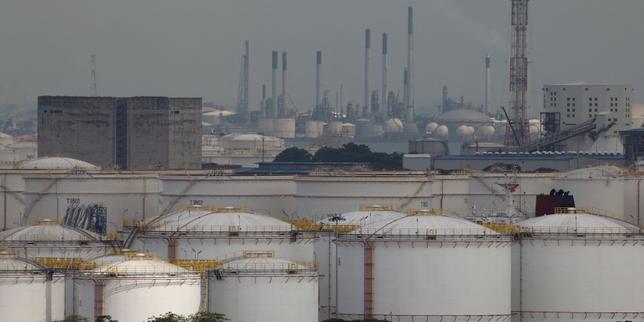
Building a strategic oil reserve is nothing like constructing a standard commercial tank farm. Above-ground steel tanks, while relatively cheap and fast to assemble, are vulnerable to extreme weather, fires, and military strikes. They also lose volume over time through evaporation and require constant maintenance to prevent corrosion.
To hold tens of millions of barrels safely for decades, governments turn to subterranean engineering. Two primary methods dominate the landscape:
- Salt Caverns: Engineers drill deep into massive underground salt formations and inject fresh water to dissolve the salt, creating vast, hollow chambers. Because salt is impermeable to hydrocarbons and self-healing under high geological pressure, these caverns are virtually leak-proof. Crude is pumped in, and when it needs to be extracted, brine is injected at the bottom to push the lighter oil back to the surface. The U.S. Strategic Petroleum Reserve uses this exact method along the Gulf Coast, and China has invested heavily in salt cavern storage in inland provinces like Jiangsu.
- Unlined Rock Caverns: In regions lacking suitable salt domes—such as South Korea, Japan, India, and the UAE—engineers excavate massive tunnels deep inside solid granite or basalt formations. These caverns rely on hydrostatic pressure rather than steel or concrete linings to contain the oil. They are dug well below the natural water table; the surrounding groundwater presses inward against the rock walls with greater force than the oil presses outward, trapping the crude inside the cavern.
These underground facilities cost billions of dollars and take years to excavate. Yet once operational, their maintenance costs are remarkably low, and they are practically impervious to aerial bombardment or severe typhoons.
The Hidden Financial Engine of Tank Farms
Security and geopolitics explain why governments fund strategic reserves, but pure financial arbitrage drives the private sector's obsession with commercial storage. In the oil trading world, physical tank capacity is essentially a license to print money during periods of market turmoil.
The key mechanism is a market structure known as contango. Normally, oil for immediate delivery costs more than oil delivered six months from now, a state called backwardation. However, when supply overwhelms demand—such as during a global economic slowdown or a sudden price war—spot prices collapse relative to future prices.
When the spread between the spot price and the six-month futures price exceeds the cost of financing, insuring, and storing the physical barrel, traders execute a risk-free arbitrage play. They buy cheap physical crude today, pump it into a leased tank in Fujairah, Singapore, or Yeosu, and simultaneously sell a futures contract for delivery six months later. They lock in the profit margin the moment the oil enters the tank.
During the historic oil price crash of April 2020, global storage capacity hit its absolute limit. Tank lease rates quadrupled overnight. Trading houses like Vitol, Trafigura, and Mercuria generated record-breaking profits simply because they controlled massive storage terminals across Asia and the Middle East. Those who owned the steel and concrete dictated terms to the entire energy market.
The Blending Advantage
Beyond simple price arbitrage, commercial storage hubs serve as giant chemical mixing bowls. Refineries are engineered to process very specific grades of crude oil with precise sulfur content and API gravity. However, the oil coming out of the ground rarely matches a refinery's exact specifications, especially as fields age or new unconventional supplies hit the market.
Storage terminals equipped with advanced blending manifolds allow traders to mix heavy, high-sulfur Middle Eastern crude with light, sweet grades from West Africa, the United States, or Central Asia. By creating bespoke blends tailored to the exact chemical appetite of Asian refiners, terminal operators capture significant margins. Southeast Asian hubs like Singapore and Malaysia’s Pengerang Deepwater Terminal have built entire ecosystems around this blending and bulk-breaking business, acting as the vital middlemen between mega-tankers from the Gulf and smaller regional refineries.
Overlooked Flaws in the Storage Boom
The conventional wisdom among energy analysts is that more storage equals greater stability. That assumption ignores several glaring operational and financial vulnerabilities that rarely make it into press releases.
First, crude oil is not static; it degrades over time. Heavy components like asphaltenes and wax settle to the bottom of tanks and caverns, forming thick layers of sludge that reduce usable capacity and require hazardous, expensive cleaning operations. Stored crude can also absorb water or suffer from microbial growth that increases its sulfur content, ruining its value for strict low-sulfur refining systems.
Second, the environmental and regulatory costs of coastal storage are skyrocketing. Tightening emissions standards around Volatile Organic Compounds (VOCs) force terminal operators to install expensive vapor recovery units and double-hulled floating roofs. In densely populated Asian port cities, local opposition to new petrochemical tank farms has driven up land acquisition costs and delayed permitting by years.
Third, there is the looming specter of stranded assets. The global energy transition is moving unevenly, yet major forecasting agencies agree that global gasoline and diesel demand will plateau and eventually decline as electric vehicle adoption accelerates in China and Europe. Building a massive subterranean rock cavern requires a thirty-to-forty-year amortization timeline. If Asian crude demand peaks earlier than state planners anticipate, nations and private operators could be left holding billions of dollars in underutilized concrete and granite.
Shifting Power Dynamics in the Indian Ocean
The rapid expansion of storage capacity from the Persian Gulf to the Sea of Japan is quietly rewriting the rules of global oil pricing. For decades, global benchmarks like Brent in the North Sea and West Texas Intermediate (WTI) in Cushing, Oklahoma, dictated the price of oil worldwide. Both benchmarks rely on dense networks of pipelines and storage tanks where physical delivery is guaranteed.
As the center of gravity in global oil shifts permanently toward Asia, the lack of a transparent, liquid physical storage hub in the East has long frustrated market participants. The emergence of massive, interconnected storage complexes in Fujairah, Zhoushan, and Ulsan is finally providing the physical infrastructure needed to support Asian price benchmarks, such as the Dubai/Oman assessments and the Shanghai International Energy Exchange (INE) crude futures contract.
When physical barrels can be seamlessly stored, blended, and delivered across multiple Asian ports, regional buyers no longer have to accept pricing formulas dictated by Western financial markets. They gain true price discovery rooted in regional supply and demand.
At the same time, this storage race deepens the interdependence between Gulf producers and Asian consumers, creating a complex web of mutual vulnerability. When Saudi Aramco or ADNOC stores millions of barrels inside Chinese or South Korean caverns, they are effectively placing massive physical collateral inside their customers' jurisdictions. Conversely, Asian refiners become increasingly reliant on the logistical networks and blending hubs controlled by Gulf national oil companies.
The tanks rising along the coasts of the Arabian Peninsula and East Asia are far more than simple holding pens for fossil fuels. They are physical shock absorbers built for a fractured global economy—a permanent acknowledgment that free-flowing maritime trade can no longer be taken for granted, and that in the next major energy crisis, survival will belong to whoever already has the oil locked safely underground.