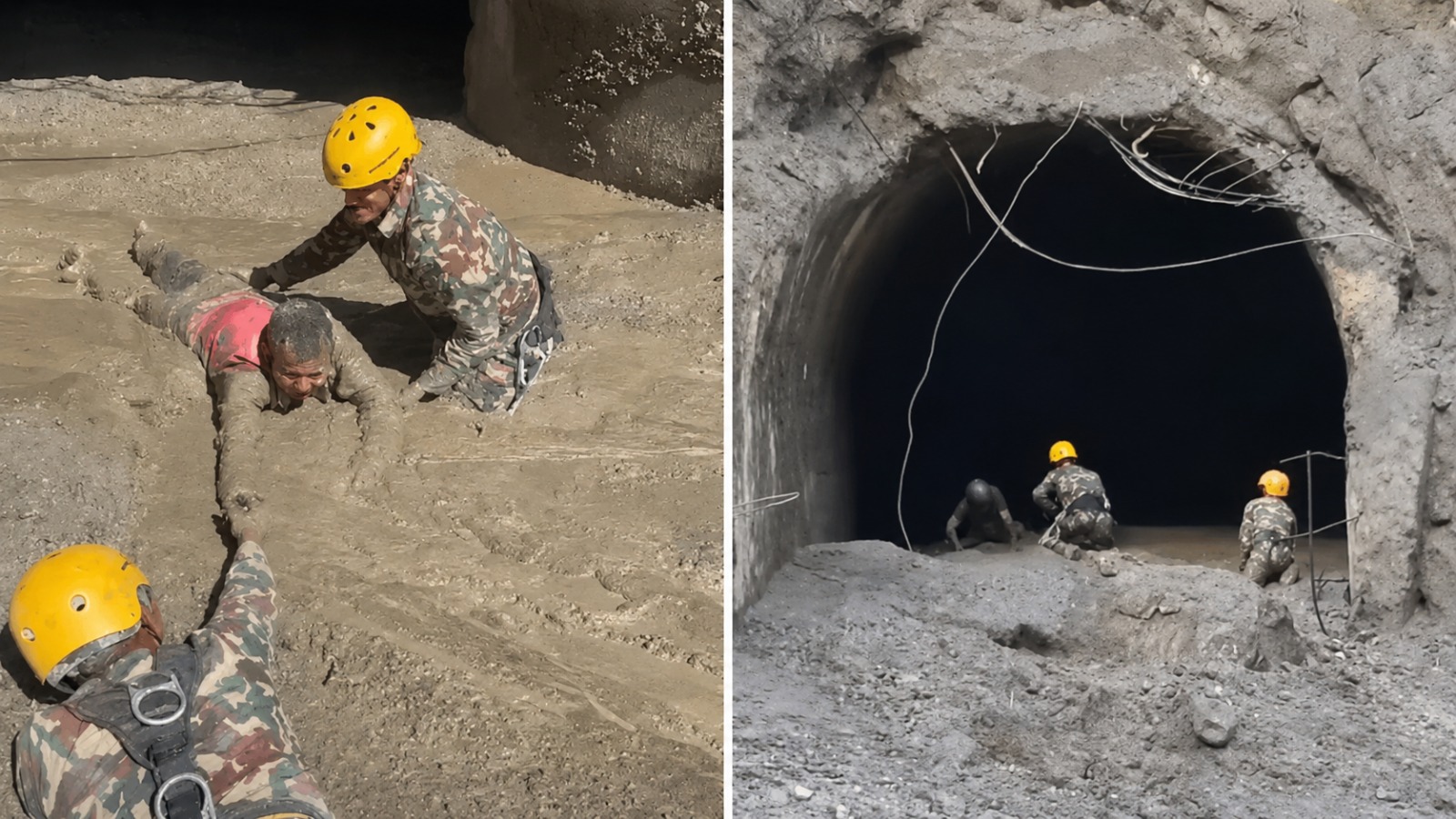
More than nine hundred workers found themselves trapped inside subterranean hydropower tunnels in Nepal following catastrophic monsoon floods, triggering a desperate rescue operation that exposed the systemic fragility of the Himalayan energy boom.
When the torrential downpours hit, they did not just swell rivers. They overwhelmed diversion gates, flooded access shafts, and transformed miles of underground concrete conduits into pressurized death traps. Surface media outlets focused heavily on the immediate headcounts and the raw emotion of waiting families gathered near the riverbanks. They missed the structural indictment. These tunnels are the physical manifestations of a headlong rush for renewable kilowatts, engineered in rugged terrain where climate volatility routinely outpaces geological forecasting.
Heavy monsoon rains are entirely predictable in South Asia. What remains unaddressed is the catastrophic failure to integrate emergency escape protocols into high-capacity subterranean infrastructure. When floodwaters breached the project sites, workers did not merely face rising water. They faced a hydraulic ambush.
The Engineering Blind Spot in the Himalayas
For decades, international development banks and domestic contractors have treated Himalayan rivers as untapped goldmines. The formula appears straightforward on paper. Divert a roaring glacial river through a desandings basin, plunge the water down a steep drop through a penstock or headrace tunnel, spin the turbines, and sell the power downstream.
The reality underground is far less forgiving.
Standard engineering models rely on historical weather data. That metric is dead. Climate change has fundamentally altered the volume and velocity of glacial outburst floods and monsoon cloudbursts. When a flash flood hits a river valley like the Trishuli or the Arun, the intake structures receive a slurry of mud, boulders, and pulverized rock. This debris chokes the spillways, forces water laterally into maintenance access tunnels, and cuts off electrical grids before backup generators can kick in.
In several of the affected sites, workers were deep inside the excavation zones when the power failed. Pitch blackness followed instantly. Then came the roar of displacement as millions of gallons of water rushed through shafts designed to handle controlled liquid flow, not violent sediment slurries.
Engineers know that long tunnels require redundant ventilation and independent evacuation routes. Yet, cost containment and tight construction schedules frequently relegate safety niches to secondary status. Workers sheltered on elevated platforms or crawled into high-level drainage pipes, praying that the air pockets would hold before the muddy tide crested.
The Logistics of Subterranean Extraction
Rescuing hundreds of people trapped miles inside a mountain requires a military-grade logistical apparatus that resource-strapped local authorities simply do not possess on a moment's notice.
When standard dewatering pumps fail due to debris-clogged intakes, rescue teams face an agonizing bottleneck. You cannot send divers into a churning, pitch-black tunnel filled with jagged construction debris, floating logs, and swirling silt. The risk profile is absolute. Every entry point must be cleared from the surface down, a process measured in days while trapped workers measure their survival in hours.
The government response relied heavily on military helicopters, army engineers, and local volunteers using whatever heavy machinery survived the washouts. But heavy excavators cannot enter a two-lane tunnel bore if the entrance is completely choked by twenty feet of gravel and mud.
Communication lines snapped almost immediately. Subterranean rock blocks radio frequencies with ruthless efficiency. Rescuers were forced to rely on seismic listening devices, hammering on steel pipes to listen for faint metallic taps echoing from miles deep within the mountain.
This is the hidden cost of rapid infrastructure expansion. Every mile of tunnel bored into a volatile tectonic zone adds an exponential layer of risk. If the access roads wash out—which they invariably do during a major monsoon event—the entire rescue chain breaks at the link closest to the victims.
The Human Cost of Energy Export Ambitions
Nepal sits on massive hydroelectric potential. Neighboring economic powerhouses like India hungry for green energy have poured billions into these river basins. The political pressure to bring projects online ahead of schedule creates an invisible culture of risk tolerance.
Workers inside these tunnels are predominantly migrant laborers from the rural plains or neighboring regions, men who take on high-risk, low-wage jobs because local economic alternatives are virtually nonexistent. They are the shock absorbers of regional energy development.
When safety margins are squeezed to maintain profit margins or meet political milestone deadlines, the people at the bottom of the hierarchy pay with their lives or their sanity. Survivors speak of hours spent clinging to scaffolding, breathing stale air laced with diesel exhaust from stranded machinery, listening to the grinding of boulders shifting outside the concrete walls.
The psychological trauma lingers long after the water recedes and the victims are hoisted to the surface. These are men who return to the exact same valleys month after month because poverty leaves no room for hesitation.
The Reckoning That Must Follow
The rescue operations eventually succeeded in pulling the trapped workers out, largely due to sheer human endurance and the frantic improvisation of local disaster response units. But celebrating a successful extraction misses the point entirely.
Survival should never be a matter of luck.
If the Himalayan energy sector is to avoid repeating this disaster on an even larger scale, regulatory frameworks must undergo a total overhaul. Environmental impact assessments must account for worst-case hydrological scenarios, not best-case operational averages. Independent safety audits must have the legal authority to shut down tunneling operations the moment monsoon warnings cross critical thresholds.
Furthermore, mandatory secondary egress shafts—completely independent of the main water conveyance tunnels—must become a non-negotiable baseline requirement for every megaproject licensed in the region.
The mountains are speaking louder each year. Ignoring their voice in pursuit of kilowatt-hours guarantees that the next group of workers trapped in the dark will not be so fortunate.