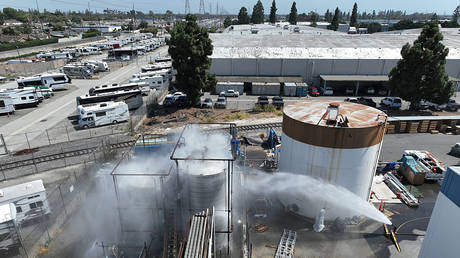
A volatile crisis is unfolding in Southern California, where more than 44,000 residents across six Orange County cities have been forced to flee their homes as emergency crews battle to prevent a catastrophic industrial explosion. The emergency center of gravity is an aerospace manufacturing plant in Garden Grove, where a crippled industrial storage tank holding roughly 7,000 gallons of highly reactive methyl methacrylate is teetering on the edge of total structural failure. Local fire officials have delivered a blunt assessment of the situation, warning that the unstable tank is inevitably going to fail.
The immediate threat has triggered an unprecedented mass evacuation spanning Garden Grove, Anaheim, Cypress, Stanton, Buena Park, and Westminster. While mainstream media coverage focuses heavily on the dramatic imagery of water cannons spraying down a single industrial vessel, the broader and more alarming systemic implications of the incident remain largely unexamined. This is not a standard industrial accident. It is a sobering demonstration of a specific chemical phenomenon known as thermal runaway, showcasing the hidden vulnerabilities built into the modern suburban-industrial interface. Recently making waves in this space: The Tibetan Diaspora is Fighting the Wrong War.
The Chemistry of a Nightmare
To understand why a single storage tank has brought a major metropolitan region to a standstill over the Memorial Day holiday weekend, one must look closely at the chemical properties of methyl methacrylate. This volatile liquid is a foundational building block for the global plastics and aerospace industries. It is heavily utilized in the fabrication of high-strength resins, acrylic glass, and lightweight aircraft components.
The chemical is inherently unstable. It requires continuous, active temperature regulation to remain benign. It possesses self-heating properties that make it susceptible to a chemical process called polymerization, where individual molecules rapidly bond together. Additional insights regarding the matter are detailed by The Guardian.
When a storage tank’s internal cooling infrastructure breaks down, this bonding process accelerates, releasing massive amounts of internal heat. The rising heat further accelerates the chemical reaction, creating a dangerous feedback loop. This self-perpetuating cycle is known as thermal runaway.
Once a tank enters this state, internal pressure escalates exponentially. The liquid has a boiling point lower than that of water, causing it to flash into heavy, highly flammable vapors that seek any path of escape.
First responders initially achieved some success on Thursday by neutralizing a separate, secondary tank that had been compromised at the facility. The primary crisis escalated dramatically on Friday morning when a critical pressure relief valve on the main tank became completely inoperable. This hardware failure eliminated the primary mechanical safety valve, stripping engineers of their ability to safely vent internal pressure or systematically draw down the highly reactive chemical product inside.
[Normal Storage] -> [Cooling System Failure] -> [Polymerization Begins]
                                                         |
[Catastrophic Rupture] <- [Pressure Spike] <- [Thermal Runaway Loop]
The Strategic Battle on the Ground
Emergency responders are currently trapped in a high-stakes waiting game with very few moves left on the board. Orange County Fire Authority teams have deployed specialized drones equipped with thermal imaging cameras to log exterior tank temperatures at strict ten-minute intervals.
Unmanned, frame-mounted master stream hoses are continuously drenching the steel structure with water. This effort is aimed at keeping the external shell cool enough to prevent the internal chemical mass from reaching a definitive ignition point.
The tactical reality is exceptionally stark. First responders are preparing for two distinct, undesirable outcomes.
The first scenario involves a physical structural breach. If the tank shell cracks under pressure, thousands of gallons of toxic liquid will spill directly into the facility's parking lot. While a mass spill is a severe environmental emergency, it is considered the more manageable of the two potential conclusions.
Crews have constructed extensive containment perimeters using sandbags to prevent the product from contaminating local storm drains, urban creeks, or the Pacific Ocean.
The second, far more dangerous scenario is a catastrophic explosion. If the internal pressure surpasses the physical limits of the steel casing before a localized leak occurs, the resulting blast will obliterate the immediate facility.
An explosion of this magnitude would shatter surrounding infrastructure, send heavy shrapnel into adjacent neighborhoods, and immediately ignite neighboring storage vessels containing industrial fuels and support chemicals.
The Suburbs in the Blast Zone
The geography of this incident underscores a deeper, structural challenge facing modern urban planning. The facility sits on Western Avenue in Garden Grove, a densely populated city located just 38 miles southeast of downtown Los Angeles.
The site sits less than a mile from Disneyland’s primary theme parks. This reality highlights how tightly intertwined heavy aerospace manufacturing and residential master-planned communities have become in Southern California.
Local authorities face a daunting logistical hurdle in enforcing the expansive one-mile evacuation zone. The region is home to one of the largest Vietnamese-American communities in the United States.
To combat communication gaps, local municipal leaders have partnered with native-language television networks and radio stations to translate emergency broadcast alerts in real time.
Despite these intensive efforts, local law enforcement reports that approximately 15 percent of residents within the hot zone have actively refused to leave their properties. Many cite concerns over property security during the holiday weekend or a fundamental lack of understanding regarding the invisible chemical dynamics at play.
The health risks driving the hard evacuation orders are severe and immediate. Methyl methacrylate produces vapors that are significantly heavier than ambient air.
If a massive rupture occurs, these toxic vapors will not dissipate safely into the upper atmosphere. Instead, they will settle and flow along the ground, pooling in low-lying residential streets, cul-de-sacs, and basements.
Public health officials have warned that acute exposure to these concentrated vapor plumes causes rapid respiratory tract inflammation, severe skin and eye irritation, dizziness, and intense nausea. Prolonged exposure carries significantly more severe neurological risks.
Broken Safety Nets and Missing Precedents
The unfolding situation has exposed a notable lack of historical precedent for this specific type of industrial failure within a high-density suburban zone. While chemical plants on the Gulf Coast are structurally isolated to manage thermal events, the integration of aerospace manufacturing deep within the Southern California basin means that an industrial asset failure immediately translates into a public safety crisis for tens of thousands of families.
The breakdown of the tank's cooling system and the subsequent mechanical failure of its primary control valve raise serious questions about regulatory oversight and preventative maintenance protocols.
Facilities handling volatile chemical volumes of this scale are required to maintain multiple redundant safety systems. The fact that field crews found themselves completely unable to secure or neutralize the asset after nearly 24 hours of continuous intervention points to a systemic vulnerability in facility contingency planning.
Governor Gavin Newsom’s declaration of a state of emergency for Orange County has unlocked critical state-level logistics, allowing regional fairgrounds and high school gymnasiums across Fountain Valley, Cypress, and La Palma to convert into makeshift shelters.
These facilities are rapidly filling with families who left their homes with nothing more than basic identification, passports, and essential medications.
The immediate objective for the specialized hazardous materials teams on-site remains focused on maintaining temperature equilibrium through external water cooling. However, this strategy is a temporary stall tactic rather than a permanent solution.
The laws of chemical thermodynamics dictate that the internal mass cannot remain in its current state indefinitely. The internal inhibitors designed to prevent spontaneous polymerization have likely been depleted by the elevated temperatures, leaving the remaining chemical mass highly unstable.
The incident serves as a stark reminder that the consumer products and technological advancements of modern society rely on supply chains anchored by highly volatile chemistry. Until the compromised vessel in Garden Grove is either safely drained or reaches its inevitable physical breaking point, thousands of residents will remain displaced, waiting to see if the thin line of water being sprayed by automated monitors is enough to hold back a devastating industrial blast.