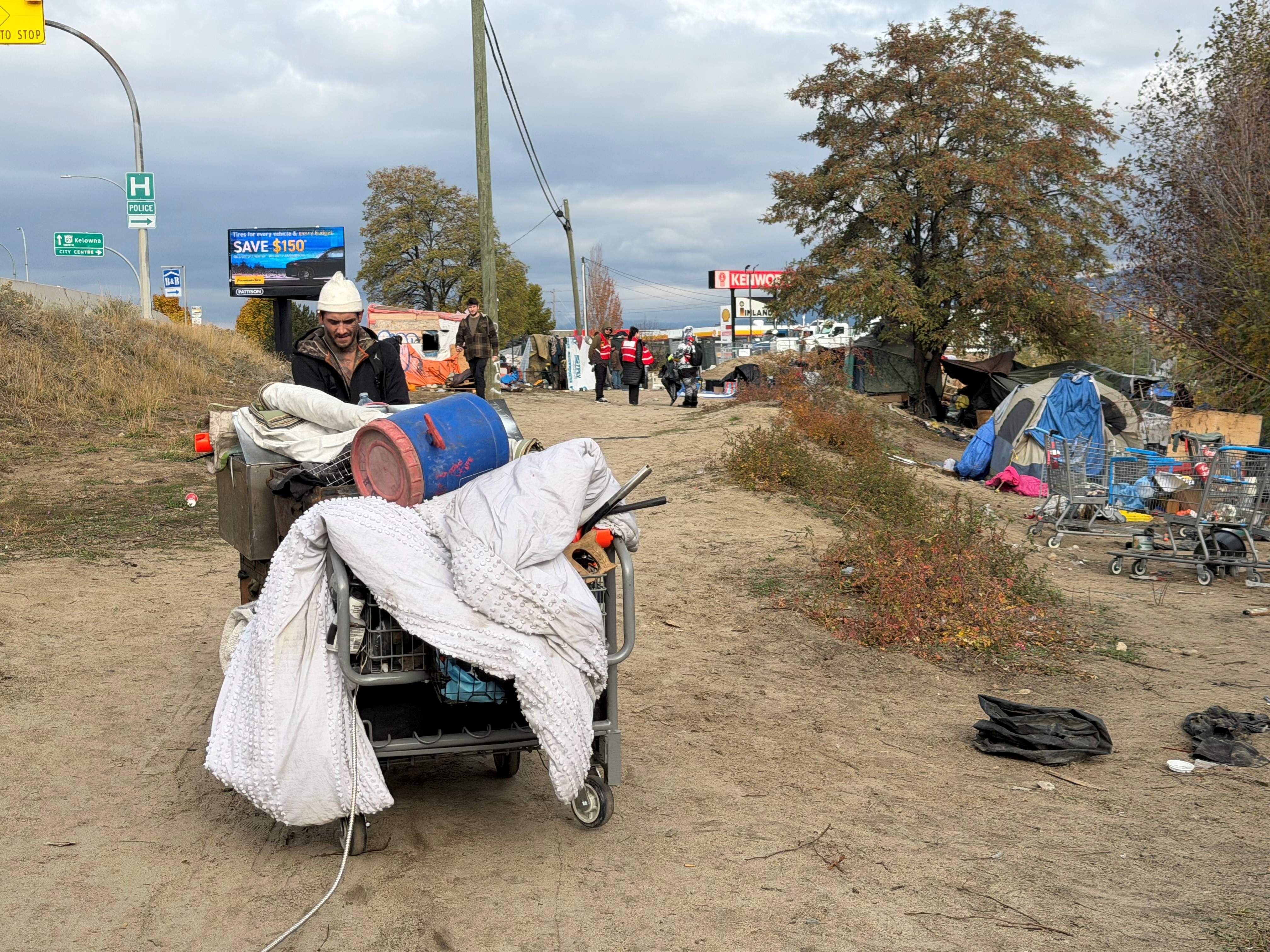
When municipal crews and bylaw officers move in to dismantle a contentious homeless encampment in Penticton, the immediate goal is straightforward. Clear the site, haul away the debris, and restore public or commercial access to the land. Yet decades of municipal enforcement across British Columbia show that eviction day rarely marks the end of an encampment. Instead, it triggers a predictable cycle of displacement, scattering vulnerable residents into neighboring alleys, parks, and industrial corridors while leaving the underlying housing shortage untouched.
The confrontation in Penticton mirrors a broader flashpoint playing out across mid-sized Canadian cities. Located between Okanagan and Skaha lakes, Penticton relies heavily on tourism, agriculture, and seasonal commerce. When visible tent cities form near business districts, highway corridors, or public parks, pressure on city hall escalates rapidly. Merchants report lost foot traffic and property damage. Residents voice frustration over safety and sanitation. Meanwhile, outreach workers and legal advocates warn that clearing a camp without permanent, low-barrier housing options simply moves the crisis out of sight for a few weeks.
The Anatomy of a Municipal Eviction
Clearing an established encampment is neither quick nor inexpensive. By the time a municipality issues an eviction notice, the site has usually evolved from a handful of scattered tents into a dense cluster of tarps, wooden pallets, propane tanks, and personal belongings.
Local governments must navigate a strict legal framework before heavy machinery rolls onto the property. Under Canadian constitutional law—specifically rulings rooted in Section 7 of the Charter of Rights and Freedoms—municipalities cannot enforce blanket bans on overnight sheltering in public parks when the number of unhoused residents exceeds available shelter beds. To execute a lawful sweep, city officials have to demonstrate either that adequate indoor shelter spaces exist or that the specific site poses an acute, unmanageable hazard such as fire risk, environmental contamination, or highway obstruction.
Notice comes first. Cities typically post eviction warnings 24 to 72 hours in advance, instructing occupants to pack their possessions and vacate. On eviction morning, a coordinated phalanx arrives. Bylaw enforcement officers, municipal works crews, contracted waste haulers, and often RCMP detachments establish a perimeter.
For the people living inside the tents, the timeline is unforgiving. Packing a life into a shopping cart or a few duffel bags takes time, especially when dealing with physical disabilities, untreated mental illness, or substance withdrawal. Items left behind after the deadline are routinely classified as abandoned waste and loaded into dump trucks, stripping individuals of identification, medications, survival gear, and family keepsakes.
Why Penticton Became a Flashpoint
Penticton's struggle with visible homelessness is driven by structural economics rather than sudden local anomaly. Over the past decade, housing costs across the Okanagan Valley have surged far beyond local wage growth. Vacancy rates for purpose-built rentals have repeatedly hovered near critical lows, pricing out low-income workers, seniors on fixed pensions, and people living on provincial disability assistance.
When the bottom rung of the private rental market disappears, any personal shock—an eviction, a medical emergency, a job loss—pushes residents directly onto the street.
Add to that the geography of the South Okanagan. Unlike larger metropolitan centers such as Vancouver or Kelowna, Penticton operates with a smaller tax base and fewer specialized social infrastructure assets. A single concentrated encampment of thirty or fifty people becomes immediately visible to the entire community. Every storefront affected and every park closed feels personal to local taxpayers.
Provincial housing agencies like BC Housing have funded supportive modular housing projects and temporary shelter beds in the city, yet demand consistently outpaces supply. Many unhoused individuals also avoid traditional congregate shelters due to strict curfews, bans on pets or partners, theft risks, or trauma associated with institutional environments. For these residents, an outdoor encampment—despite its exposure to winter cold, summer heat, and constant policing—offers autonomy and a fragile sense of community protection.
The Hidden Financial Cost of Sweeps
Taxpayers often assume clearing an encampment saves municipal money by restoring order. The accounting tells a different story.
A single large-scale encampment eviction consumes tens of thousands of dollars in direct operational expenses. Overtime pay for bylaw officers, police presence, biohazard remediation crews, heavy equipment rentals, and landfill tipping fees add up within hours. Once the site is cleared, cities frequently spend thousands more installing perimeter fencing, concrete Jersey barriers, or round-the-clock private security patrols to prevent immediate re-occupation.
Consider a hypothetical example of how this cycle drains municipal budgets over a single fiscal year. Suppose a city spends $45,000 to clear a 40-person encampment, haul away debris, and fence off the lot. Within ten days, those same 40 residents set up smaller camps across three different neighborhood parks and an industrial dead-end. Over the next six months, bylaw officers conduct dozens of smaller sweeps, paramedics respond to scattered overdose calls in isolated areas where peer intervention is harder, and emergency room visits spike due to exposure and untreated infections. By year's end, the city has spent well over $250,000 in enforcement and emergency response without creating a single permanent bed.
Public Safety and the Overdose Crisis
British Columbia remains in the grip of a toxic drug crisis driven by illicit fentanyl and synthetic additives. In this environment, where people sleep is directly tied to whether they survive.
Outreach workers and public health researchers point out a grim reality about encampment dispersals. When people live in a known, centralized location, peer networks and mobile outreach teams can monitor individuals, distribute naloxone, and respond within seconds to an overdose. When an eviction scatters residents into hidden ravines, wooded riverbanks, or behind industrial dumpsters, people use substances alone. Isolation turns a reversible overdose into a fatality.
At the same time, ignoring severe hazards inside dense encampments carries its own deadly risks. Unregulated propane heaters, open flames inside nylon tents, and accumulated debris create extreme fire hazards. Propane explosions and rapid tent fires have caused severe injuries and deaths in encampments across the province. Criminal elements also exploit lawless spaces, preying on vulnerable residents through extortion, violence, and drug trafficking.
Municipal leaders sit trapped between two competing duties: protecting the immediate physical safety of the broader community and avoiding actions that increase mortality among unhoused residents.
What Actually Reduces Street Encampments
Cities across North America that have successfully shrunk visible encampments rely on three coordinated mechanisms rather than enforcement alone.
Rapid Access to Non-Congregate Shelter
Traditional dormitory-style shelters fail to attract chronically unsheltered residents. Converting motels or deploying micro-shelters—small, lockable individual units with electricity and heat—dramatically increases acceptance rates. When people can lock a door, store their belongings safely, and keep their pets, they voluntarily leave tents.
Dedicated Sanctioned Sites With Basic Infrastructure
When indoor units are unavailable, designating a managed outdoor site equipped with potable water, portable toilets, garbage collection, and fire-safety spacing reduces neighborhood friction and lowers emergency response costs. Centralizing services allows outreach workers to connect residents with identification recovery, income assistance, and healthcare.
Permanent Supportive Housing Pipelines
Emergency shelter only pauses homelessness; permanent housing ends it. Supportive housing combines deeply subsidized studio apartments with on-site clinical staff, mental health care, and addiction recovery services. Without a steady pipeline of permanent units, shelters back up, people remain stuck in temporary beds for years, and new arrivals on the street have nowhere to go except back into tents.
The Illusion of the Clean Slate
By late afternoon on eviction day in Penticton, the excavators finish loading the last crushed tent poles into dump trucks. Chain-link fencing goes up around the perimeter. From the street, the lot looks clean, quiet, and resolved.
Two miles away, behind a strip mall or along a quiet stretch of creek, the first tarps are already going back up before sundown.