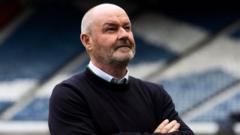
The headlines covering Steve Clarke’s squad announcement for the upcoming World Cup in North America look exactly like what the Scottish Football Association wanted. They paint a cozy picture of sentimentality, redemption, and plucky optimism. Media outlets are eagerly amplifying Clarke’s narrative that the surprise recall of Southampton striker Ross Stewart is a heartwarming football story.
But underneath the superficial romance of a forward overcoming a terrible run of injuries lies a much colder reality.
Scotland is entering its first World Cup tournament in 28 years with an alarming, systemic shortage of elite, top-tier attacking talent, forcing Clarke into a high-stakes gamble on unproven and newly recovered players.
Instead of operating from a position of strategic strength, the national team management is masking structural squad depth issues behind public relations optimism. The inclusion of Stewart, alongside teenage wildcards like Findlay Curtis and Ben Gannon-Doak, exposes a frantic scramble to assemble a competitive roster.
The Illusion of Striking Depth
To understand the vulnerability of the Scottish attack, look at the actual numbers rather than the emotional press conference quotes. Clarke has named five forward options for the tournament.
- Che Adams
- Lyndon Dykes
- Lawrence Shankland
- George Hirst
- Ross Stewart
On paper, it looks like a robust collection of distinct profiles. In practice, it is a fragile assembly.
Stewart’s selection is being heralded because he scored ten goals in his last 21 appearances for Southampton, guiding them to the Championship play-off final. While Clarke heavily emphasized the forward’s performance against Arsenal in the FA Cup as proof he can handle elite environments, the truth is far less secure. Before this late-season surge from January onward, Stewart had managed a meager two international caps, both earned way back in 2022.
Relying on a 29-year-old forward who has spent the vast majority of the last two seasons in the medical room is a massive gamble. The World Cup does not afford players the time to build up match fitness. The intensity of the group stage is unforgiving, and throwing a player with such a delicate recent injury history into that furnace risks wasting a precious squad spot.
The Championship Cap
The deeper issue is the pedigree of the entire striking department. With the exception of Lawrence Shankland’s domestic exploits, Scotland’s attacking contingent is overwhelmingly defined by the English second tier.
Competing in the modern World Cup requires a level of technical execution and tactical speed that the grueling, physical landscape of the EFL Championship simply does not cultivate. When up against elite European or South American central defenders, the direct, physical approach utilized by Dykes or the penalty-box reliance of Hirst can be neutralized.
Clarke spoke at Hampden about prioritizing characters and team chemistry for a tournament where the squad will be away together for up to five weeks. Harmony is essential, but dressing room camaraderie cannot manufacture a goal against a low block when technical inspiration is absent.
The Ibrox Exit and the Kilmarnock Blueprint
The inclusion of 19-year-old Rangers winger Findlay Curtis is another fascinating, telling symptom of Scotland's developmental crisis.
Curtis earned his spot after a successful loan spell at Kilmarnock, where he chose to leave the relative comfort of the Ibrox reserve structure in January to secure first-team minutes. Clarke praised the teenager, stating that young players must make big decisions if they want to improve.
"To make a decision to leave Rangers in January and go and play at Kilmarnock shows you that if you make the right choices at the right time and then you have the ability to back up that decision, then things can work in your favour."
While the manager frames this as a triumph of individual character, it reveals a damning indictment of Scotland’s two biggest clubs.
Rangers and Celtic remain thoroughly incapable of transitioning elite academy talent into their own first teams. Young Scottish players are forced to actively flee the Glasgow giants just to get the competitive minutes required to catch the national team manager's eye. Curtis had to fight in a relegation-threatened Kilmarnock side to prove his worth.
This structural failure places an unfair burden on Clarke. He is forced to scout lower-table Scottish Premiership teams or hope English Premier League academies produce someone with a Scottish grandmother, simply because the domestic powerhouse clubs prefer buying mid-tier foreign talent over blooding local youth.
The Midfield Burden and Injury Anxieties
Because the frontline lacks a certified, world-class talisman, the entire tactical weight of this World Cup campaign falls directly onto the midfield engine room. Scott McTominay remains the undisputed centerpiece of Clarke’s tactical identity, but the supporting framework is creaking under the weight of recent medical updates.
Ben Gannon-Doak’s inclusion is perhaps an even greater roll of the dice than Ross Stewart’s. The Bournemouth midfielder has made just three brief appearances off the bench since recovering from a severe hamstring injury sustained during Scotland’s victory over Denmark last November.
Medical staff can declare a player clinically fit, but tournament fit is an entirely different metric. If Gannon-Doak or the talismanic Billy Gilmour suffer a setback, the drop-off in tactical intelligence and ball retention is steep. Lewis Ferguson and John McGinn will be expected to cover incredible distances to compensate for a frontline that cannot reliably hold up the ball or stretch opposing defensive lines.
The Heavy Legacy of 1998
Every Scottish squad announcement is haunted by the ghosts of France 98, the last time the Tartan Army graced a World Cup. For nearly three decades, Scottish football has comforted itself with the romantic notion that simply qualifying is the ultimate achievement.
Clarke has done an extraordinary job breaking that psychological barrier, guiding the nation to consecutive European Championships and now the global stage.
But the era of being happy just to turn up must end if Scotland wants to avoid a quick, painful exit. The group stages in North America will feature expanded, highly athletic teams designed to exploit any lack of tactical depth.
Clarke’s emphasis on collective unity, defensive organization, and emotional resilience has served Scotland brilliantly over the past few years. It got them through a difficult qualification journey. But a major tournament is an elite, unforgiving environment where sentimentality goes to die.
Relying on a striker with a history of fragile hamstrings and teenagers who had to escape their parent clubs for game time might make for a comforting media narrative. On the pitch, it leaves Scotland walking a incredibly thin tightrope.