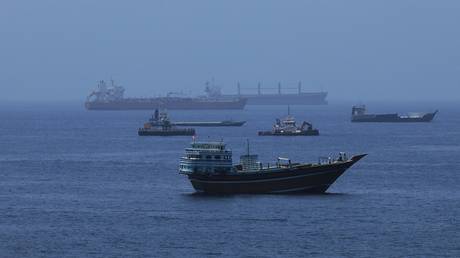
Tehran is preparing to formalize an expansion of its maritime footprint by declaring a restricted zone that stretches far beyond the traditional waters of the Strait of Hormuz. Announced by Mohsen Rezaei, the secretary of Iran's Supreme National Security Council, this forthcoming exclusion corridor will run from the outer edge of the United States naval blockade deep into the Persian Gulf. Commercial carriers entering this newly mapped operational space without direct coordination face immediate designation on Iran's domestic sanctions registries, upending traditional transit paradigms for global energy markets.
The move follows a sudden, violent rupture in maritime traffic patterns through the world's most critical oil choke point. Daily commodity transits through the strait have plunged to roughly ten vessels per day, a multi-month low. Washington maintains that naval escorts are successfully forcing upwards of nine million barrels of oil per day through the waterway, yet Iranian leadership dismisses those numbers as fiction, insisting the passage is locked down under the guns of the Islamic Revolutionary Guard Corps. You might also find this related story interesting: Why Southern Lebanon Reporting Is Broken And Why The Obvious Narrative Misses The Structural Trap.
The Anatomy of an Expanding Choke Point
Military analysts often misread Tehran's naval strategy as a static defense. It is instead an evolving campaign of asymmetrical legalism and kinetic deterrence. By drawing a restricted zone starting from the line of the U.S. naval blockade, Iran is effectively attempting to establish a counter-blockade zone.
This maneuver weaponizes maritime insurance and compliance. Commercial shipping lines operate on razor-thin margins dictated by underwriters in London and New York. If a coastal state places a vessel on an official sanctions or prohibited list, war-risk insurance underwriters immediately re-evaluate coverage. Premiums skyrocket or policies are canceled outright. Tehran does not need to physically sink every oil tanker to halt trade; it simply needs to weaponize the administrative architecture of global shipping. As discussed in latest reports by NPR, the effects are worth noting.
The timing of the announcement coincides with the total collapse of a summer memorandum of understanding mediated by regional powers like Oman, Qatar, and Pakistan. That diplomatic framework, designed to reopen the strait and ease sanctions, eroded within weeks as both Washington and Tehran accused each other of fundamental breaches. Rezaei explicitly cited frustration with regional mediators during his state television broadcast, signaling that Iran's hard-line security establishment has abandoned faith in third-party diplomatic guarantees.
Logistics, Sanctions Evasion, and the Shadow Fleet
Decades of economic isolation have taught Iranian planners how to absorb severe external shocks. While Washington relies on a dual-pronged approach of direct military escort operations and targeted financial pressure against foreign institutions, Iran has leaned heavily on its established shadow fleet. These older, unregistered tankers transport petroleum through murky channels, bypassing standard tracking metrics.
However, the physical infrastructure supporting this trade remains vulnerable. Kharg Island, the terminal handling the vast majority of Iran's crude exports, has absorbed hundreds of strikes over recent months. Despite satellite imagery and political posturing from Washington depicting severe damage, Iranian oil ministry officials maintain that loading operations continue under hardened protocols.
The friction point is no longer just about whether oil can leave Iranian ports. It is about who holds the authority to dictate terms of passage in international waters. By asserting control over approach corridors that merge with Omani transit lanes, Tehran is forcing shipowners into an impossible compliance bind. Comply with U.S. naval instructions, and risk Iranian sanctions and missile retaliation. Comply with Tehran's directives, and face interdiction or blacklisting by Western authorities.
The Broader Economic Toll
Energy markets have reacted to the volatility with predictable anxiety, though prices have occasionally stabilized due to alternate pipeline capacities functioning overland. Yet, the psychological impact on global supply chains is profound. Insurance companies are treating the Persian Gulf as an active combat zone rather than a commercial highway.
The U.S. Central Command continues to board, redirect, or disable vessels suspected of flouting its enforcement guidelines, turning the Gulf into a high-stakes tactical grid. Every intercepted ship and every retaliatory strike against a tanker pushes the baseline cost of global energy upward.
As the regional conflict grinds past its sixth month, the impending formalization of Iran's restricted zone closes the door on a quick return to pre-conflict maritime norms. The Strait of Hormuz is no longer just a geographical strait separating the Persian Gulf from the Gulf of Oman; it is a contested legal and military frontier where the rules of international transit are being rewritten through fire and administrative decree.