Texas Governor Greg Abbott recently sparked a high-stakes funding dispute by threatening to strip state grants from Dallas-Fort Worth International Airport and Houston's George Bush Intercontinental Airport over wudu washing facilities. These foot-washing stations, designed for Islamic ritual ablution prior to prayer, became the focal point of a fierce legal and political debate regarding government neutrality, constitutional boundaries, and the practical demands of modern international aviation.
The immediate trigger for the confrontation was an internal evaluation at Dallas-Fort Worth International Airport regarding a proposal to install new pre-security ablution basins in Terminal D. Governor Abbott moved swiftly, directing a comprehensive review of state grants for both major aviation hubs and referring the entities to the U.S. Department of Transportation for federal investigation. The core argument from the governor's office centers on the prohibition of religious favoritism in publicly owned infrastructure. If you liked this post, you might want to read: this related article.
This administrative collision exposes deeper questions about how public institutions balance statutory neutrality with the accommodation of an increasingly diverse traveling public. Aviation hubs are no longer mere transit sheds; they function as micro-cities serving millions of passengers from every corner of the global community. Managing the spatial and infrastructural needs of these travelers requires navigating a complex web of constitutional law, operational efficiency, and public relations.
The Anatomy of the Dispute
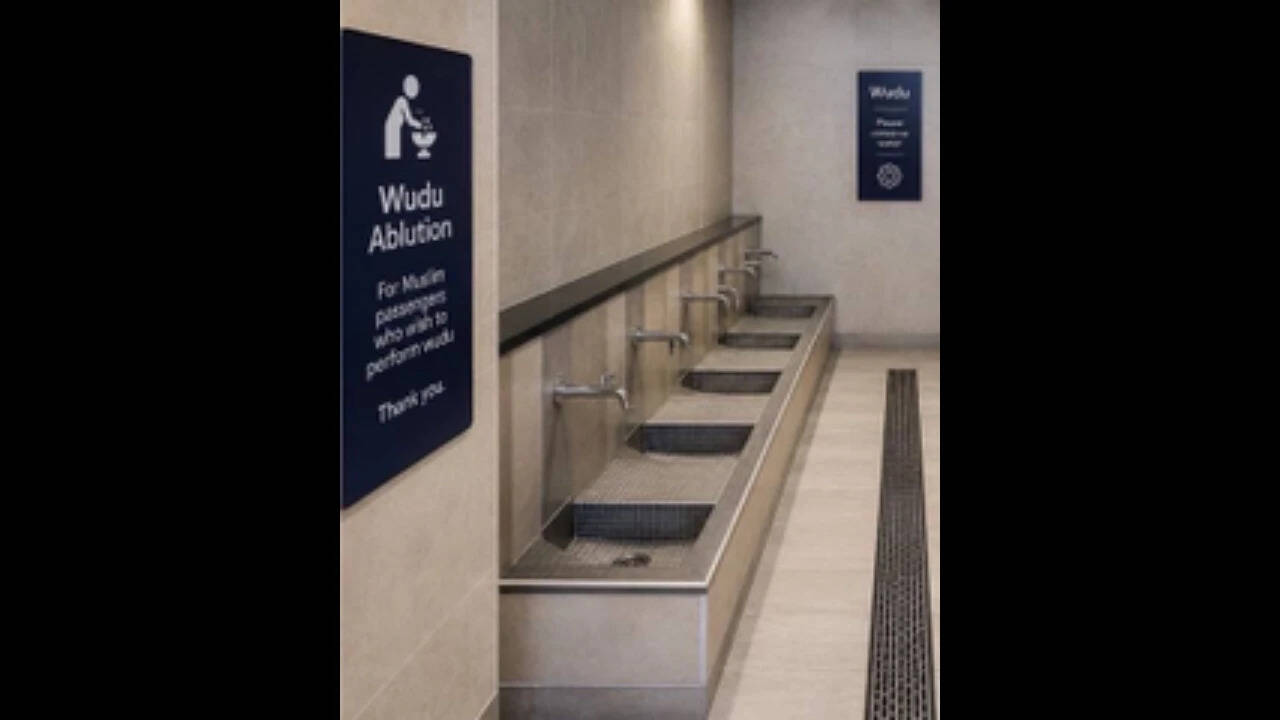
To understand the controversy, one must examine the specific mechanics of the facilities in question. Wudu is the Islamic ritual cleansing process involving the washing of hands, mouth, nose, arms, and feet before daily prayers. Performing this procedure in a standard airport restroom presents significant physical challenges. Travelers frequently attempt to wash their feet in conventional low sinks, creating wet floors, slipping hazards, and ADA compliance complications. For another perspective on this event, check out the latest coverage from NPR.
Airports have long grappled with the architectural reality of long-haul travel. International terminals process passengers who may spend upwards of twenty hours in transit. Providing dedicated washing stations is often viewed by airport facility managers as a pragmatic solution to maintenance and safety problems rather than a purely theological endorsement. Low-mounted basins with specific drainage reduce standing water on restroom floors and streamline custodial upkeep.
Yet, legal interpretation of public property use draws a sharp line between practical maintenance and specialized religious accommodation. Governor Abbott's directive argues that dedicating facilities specifically tailored to one religious ritual crosses that constitutional line.
"Both airports are government-owned facilities. The federal and state constitutions prohibit government from facilitating this sort of discrimination," Governor Abbott stated in official correspondence.
The friction arises from the dual identity of major airports. They are commercial economic engines that must compete globally for airline routes and international passengers, yet they remain political subdivisions bound by state and federal constraints. When an amenity designed for a specific religious practice is funded or hosted by a government entity, it invites immediate scrutiny under the Establishment Clause.
The Swift Retreat at DFW
The reaction from Dallas-Fort Worth International Airport was immediate. Following the governor's public warning and request for a federal probe, airport leadership announced that the proposed project for additional pre-security washing stations would not move forward.
Public statements from airport representatives emphasized that the plan was only in an internal evaluation phase. Officials noted that after accelerating their review due to intense public interest, they concluded the project would not deliver the anticipated operational benefits.
Behind the scenes, however, the paper trail revealed a tangled administrative process. Initial design permits contained conflicting details regarding whether the installation was slated for private funding or public expenditure. This bureaucratic confusion fueled speculation about transparency and oversight, turning a routine infrastructure proposal into a lightning rod for state-level intervention.
Despite the cancellation of the new project, the landscape across Texas aviation is not entirely uniform. Existing post-security ablution spaces have operated at DFW since 2019, and Houston's intercontinental hub has featured an interfaith prayer and ablution room since 2024. The presence of these older installations complicates the enforcement of any blanket prohibition, raising questions about whether historical accommodations will face retroactive challenges or if the state's scrutiny will remain limited to newly proposed expansions.
Navigating the Pluralistic Terminal
Modern airport management operates under a constant tension between universal design and targeted accommodation. Facilities routinely install nursing rooms for mothers, sensory-friendly spaces for neurodivergent passengers, and interfaith chapels to serve spiritual needs across a broad spectrum.
The legal distinction often hinges on exclusivity versus general accessibility. Proponents of multi-faith spaces argue that rooms equipped for quiet reflection or ritual cleansing can be designated for general use by any traveler seeking a moment of meditation or personal hygiene. For instance, Houston's existing room has been characterized as an interfaith space accessible to multiple communities.
Critics, however, contend that specific architectural features—such as low foot-basins or ritual cleansing aids—are inherently sectarian in design, regardless of any open-door policy. This legal argument leans heavily on the principle that government entities should remain strictly neutral, providing baseline accommodations that do not single out specific religious mandates.
The intervention by Texas leadership signals a hardening stance on how state-appropriated funds interact with identity-based accommodations. As international hubs strive to capture lucrative long-haul routes connecting North America to the Middle East, Asia, and beyond, the competition for global travelers often drives the expansion of passenger-friendly amenities. Airport directors now face a narrower path, forced to weigh the commercial advantages of global passenger comfort against the immediate threat of state funding revocation and federal oversight.
The fallout from this clash extends far beyond the terminal walls of Dallas and Houston. It establishes a clear precedent for how state governments may police local municipal authorities regarding cultural and religious accommodations in public infrastructure. As federal transport regulators review the referral, airport planners nationwide are taking a closer look at their capital improvement budgets and project justifications. The debate over who belongs in the public square is increasingly being fought at the baggage claim and the boarding gate, leaving administrators to balance the demands of global mobility with strict domestic legal parameters.