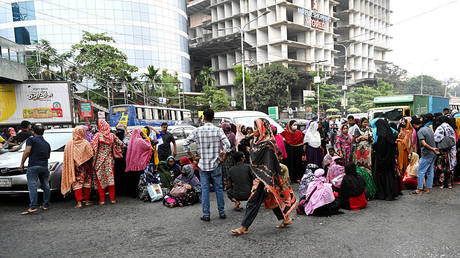
Violent demonstrations in Bangladesh’s industrial hubs are halting production across the country’s ready-made garment sector, an industry that accounts for over 80 percent of the nation’s export earnings and supplies major Western fashion retailers. Workers in Gazipur, Ashulia, and Savar have clashed with security forces over unpaid wages, inflation-eroded purchasing power, and disputed minimum wage revisions, forcing dozens of factories to shutter indefinitely. For global apparel brands relying on Dhaka’s low-cost manufacturing base, these disruptions expose severe vulnerabilities in just-in-time supply chains and raise urgent questions about labor stability, purchasing practices, and the true cost of cheap clothing.
The immediate spark is easy to trace. Wages have failed to keep pace with the soaring cost of living in Dhaka and its surrounding industrial belts. While the Bangladeshi government periodically adjusts the minimum wage for garment workers, inflation in food, housing, and healthcare routinely outstrips those increases before the first revised paycheck even clears. When factory owners delay monthly disbursements or withhold overtime pay during periods of tight liquidity, frustration boils over onto the highways.
Yet focusing solely on street clashes misses the deeper structural rot driving the unrest. Decades of covering global supply chains make one reality abundantly clear. Factories in Bangladesh do not operate in a vacuum; they sit at the bottom of a ruthless pricing pyramid controlled by multinational fashion conglomerates.
The Anatomy of a Broken Pricing Model
Walk through any industrial zone outside Dhaka during a labor dispute, and you will hear two completely different versions of the same financial crisis. Workers point out, rightly, that their monthly take-home pay barely covers rice, lentils, and a cramped concrete room shared with extended family. Factory owners, meanwhile, open their ledgers to show razor-thin operating margins squeezed between rising utility costs, high interest rates on local bank loans, and stagnant Free on Board (FOB) prices dictated by Western buyers.
Both sides are telling the truth. That is the core tragedy of the ready-made garment (RMG) sector.
For years, global apparel brands have demanded faster turnaround times, stricter compliance standards, and lower unit prices simultaneously. To illustrate how this squeeze works in practice, consider a hypothetical example of a basic cotton t-shirt ordered by a European fast-fashion retailer. Suppose the retailer demands a five percent price cut from the Bangladeshi supplier to protect its own quarterly retail margins against sluggish consumer spending in Berlin or London. The factory owner, terrified of losing a multi-million-dollar contract to a competitor in Vietnam or Cambodia, accepts the lower price. Because the costs of imported cotton, dyes, electricity, and shipping are fixed on global and state-regulated markets, the only variable expense left to compress is labor.
This dynamic creates a pressure cooker. Owners push production targets higher, cut corners on attendance bonuses, or delay wage payments to manage cash flow. When workers finally walk off the factory floor and blockade the Dhaka-Mymensingh highway, the resulting supply chain disruption is treated by international media as a sudden, isolated law-and-order problem rather than the predictable mathematical outcome of decades of downward price pressure.
Why Industrial Zones Become Flashpoints
Geography plays an underappreciated role in how quickly labor disputes escalate into violent demonstrations. Bangladesh’s garment manufacturing is heavily concentrated in dense industrial corridors like Ashulia, Gazipur, and Narayanganj. Hundreds of factories sit shoulder to shoulder along a few major arterial roads.
When workers at three or four factories walk out over unpaid dues, they spill directly onto the main transport arteries connecting Dhaka to the rest of the country. A localized labor grievance instantly becomes a national logistics blockade. Neighboring factories, fearing property damage or forced entry by protesters, pull down their steel shutters and declare an unscheduled holiday. Within hours, fifty thousand workers are out on the streets with nowhere to go, creating a volatile crowd dynamic where minor provocations trigger tear gas, rubber bullets, and factory vandalism.
Furthermore, the absence of independent, factory-level collective bargaining leaves workers without a functioning pressure valve. While Bangladesh has thousands of registered trade unions on paper, labor advocates and international monitors have long documented barriers to genuine unionization, including bureaucratic registration hurdles and retaliation against organizers. Without trusted workplace representatives to negotiate grievances before they escalate, street protests become the primary mechanism for workers to force management and government officials to the negotiating table.
The Banking Crisis Behind Delayed Paychecks
To understand why some factories suddenly fail to pay wages on time even when their order books look full, you have to look beyond the sewing floor and into Bangladesh’s troubled financial sector.
Local garment manufacturers rely heavily on domestic commercial banks for working capital—specifically through back-to-back letters of credit used to import yarn, fabric, and accessories. Over the past several years, Bangladesh’s banking system has struggled with surging non-performing loans, foreign exchange shortages, and liquidity crunches. When the central bank tightens monetary policy to curb inflation and stabilize the taka, borrowing costs spike for domestic businesses.
Small and medium-sized subcontracting factories are hit hardest. Unlike massive, vertically integrated conglomerates that deal directly with major Western brands and hold dollar-denominated reserves, smaller tier-two and tier-three factories operate on tight local currency cash flows. If a buyer delays payment by thirty days, or if a local bank freezes a credit line due to liquidity constraints, the factory owner literally lacks the physical cash on hand on the seventh working day of the month to pay five thousand workers.
Workers do not care about central bank reserve ratios or letter-of-credit bottlenecks. They care that their landlord is demanding rent and local grocers have cut off their credit. When paydays slip past the legal deadline, trust evaporates instantly.
How Global Brands Externalize the Risk
Whenever violent demonstrations erupt in Dhaka, major fashion brands issue remarkably similar statements. They express concern over the violence, urge restraint from authorities, reaffirm their commitment to worker safety, and remind the public of their corporate codes of conduct.
What those statements rarely mention is how brand purchasing practices directly undermine labor stability.
Consider the standard payment terms in international apparel sourcing. Many Western retailers routinely enforce payment windows of 60, 90, or even 120 days after goods are shipped. In effect, Bangladeshi factories—operating in a developing economy with double-digit borrowing rates—are forced to act as unsecured lenders to multi-billion-dollar corporations based in New York, Stockholm, or Madrid.
During periods of global economic uncertainty, brands also utilize flexible cancellation clauses or delay order pickups to avoid holding excess inventory in Western warehouses. When a brand postpones a shipment by three weeks, the finished garments sit in a Dhaka warehouse, unpaid for, while the factory owner still has to meet payroll at the end of the month.
There is a legitimate counter-argument from the retail side that deserves acknowledgment. Apparel retail is fiercely competitive, consumer demand is notoriously fickle, and brands themselves face rising freight costs, geopolitical instability in maritime chokepoints like the Red Sea, and inflationary pressures in their home markets. Brands argue that they cannot unilaterally subsidize inefficient factories or absorb unlimited cost increases without losing market share to ultra-fast-fashion competitors shipping direct-to-consumer from China.
That commercial reality is real, yet it does not absolve buyers of responsibility. You cannot demand First World compliance standards, zero-tolerance social audits, and uninterrupted delivery schedules while paying Third World prices that fail to cover a living wage. Something always breaks. In Bangladesh, what breaks is social peace in the industrial belts.
The Geopolitical and Economic Stakes for Dhaka
For Bangladesh, a prolonged disruption in the garment sector is an existential economic threat. Unlike economies diversified across heavy manufacturing, technology services, and natural resources, Bangladesh relies on apparel for the overwhelming majority of its foreign currency inflows.
Every day that factories in Gazipur and Savar remain closed carries compounding consequences:
- Missed Shipping Deadlines: Apparel is seasonal. Summer collections delayed by two weeks miss their retail window. Factories that miss vessel departures at Chattogram Port are often forced to ship goods by air freight at their own expense—a penalty that can wipe out an entire year's profit on a single order—or accept massive price discounts from buyers.
- Order Diversion: Global sourcing executives hate unpredictability. While Bangladesh offers unmatched scale and competitive pricing for basic knitwear and woven garments, prolonged unrest prompts buyers to quietly shift marginal capacity to Vietnam, India, Indonesia, or Pakistan. Once a buyer establishes a reliable vendor relationship elsewhere, that volume rarely returns in full.
- Foreign Exchange Pressure: Reduced export receipts directly strain Bangladesh’s foreign currency reserves, making it harder for the government to pay for essential imports like fuel, fertilizer, and industrial raw materials, which in turn feeds back into domestic inflation.
The Bangladeshi government faces a brutal balancing act. On one hand, authorities feel intense pressure from factory owners and foreign buyers to clear highways, protect industrial infrastructure, and keep export engines running. Heavy-handed policing, however, carries severe reputational and diplomatic costs. Footage of riot police clashing with female garment workers—who make up the backbone of the workforce—draws immediate scrutiny from labor rights groups, European Union trade regulators, and Washington lawmakers.
With Bangladesh preparing to graduate from the United Nations' Least Developed Country (LDC) status, its preferential tariff access to key markets like the European Union is already entering a critical transition phase. Maintaining duty-free access under future trade frameworks like the EU’s GSP+ scheme requires strict adherence to international labor and human rights conventions. Violent crackdowns on wage protesters directly jeopardize the very trade privileges that make Bangladeshi exports price-competitive in Europe.
Why Band-Aid Solutions Keep Failing
Historically, the cycle of unrest in Bangladesh follows a predictable script. Protests erupt, factories close, security forces intervene, the government convenes a tripartite wage board or emergency committee, a modest wage adjustment or promise of back-pay clearance is announced, and workers gradually return to their machines.
Six months later, inflation erodes the gain, factory margins tighten again, and the cycle resets.
Breaking this pattern requires structural changes that neither factory owners, the government, nor global brands have shown the political will to enforce simultaneously.
First, ring-fencing labor costs in purchasing contracts is essential. Several international labor initiatives have proposed mechanisms where brands explicitly separate labor costs from material and overhead negotiations, guaranteeing that unit prices automatically adjust upward whenever a producing country raises its legal minimum wage. Without this mechanism, every government-mandated wage hike simply triggers a fresh round of margin compression for suppliers.
Second, Bangladesh’s domestic industry must accelerate the shift away from high-volume, low-margin basic garments toward higher-value technical textiles, man-made fibers, and complex outerwear. A factory producing basic cotton tees at razor-thin margins will always struggle to absorb wage increases. Factories investing in automation, efficiency, and higher-tier product categories generate the surplus value required to pay competitive wages without going bankrupt.
Third, workplace grievance mechanisms must move beyond paper compliance. Social audits conducted by third-party firms have repeatedly failed to predict or prevent labor explosions because auditors check fire extinguishers and payroll logs on scheduled visits while missing the simmering resentment over abusive floor supervisors, unrealistic hourly piece-rate targets, and uncompensated overtime. Genuine worker representation on factory floors remains the single most reliable early-warning system against violent walkouts.
What Sourcing Executives and Investors Need to Watch
For supply chain managers, institutional investors, and trade analysts tracking South Asia, the headlines from Dhaka should not be read merely as temporary logistics delays. They are stress tests revealing which suppliers and brands have built resilient operations and which have built houses of cards.
Watch the Tier-1 conglomerates versus the Tier-2 subcontractors. Large, well-capitalized Bangladeshi groups with LEED-certified green factories, diversified buyer portfolios, and automated production lines generally weather these storms far better than undercapitalized smaller plants dependent on buying houses and spot orders. When unrest hits, brands inevitably consolidate their orders into the largest, most secure factories, accelerating a wave of domestic consolidation that will permanently reshape the industry.
Pay close attention to payment enforcement as well. If domestic banks continue restricting liquidity to smaller exporters while inflation keeps household food budgets stretched to the breaking point, no amount of highway policing will keep factory gates open. Until the price paid at the loading dock in Dhaka actually reflects the cost of keeping a worker fed, housed, and solvent, the next shutdown is never more than a missed payday away.