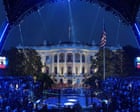
Federal prosecutors in Ohio handed down a sweeping indictment on July 9, 2026, charging eight men with terrorism and murder conspiracies linked to a thwarted attack on the White House mixed martial arts exhibition in June. The public narrative focuses entirely on the success of federal law enforcement. The real story is much grimmer. It reveals an intelligence apparatus caught flat-footed by amateur extremist groups using commercially available technology, and an administration that ignored blatant warning signs to pull off a political spectacle on the executive branch lawn.
The defendants allegedly spent months amassing a sophisticated arsenal of explosive-laden drones, body armor, and sniper equipment right under the nose of domestic intelligence. By the time the FBI disrupted the cell, the multi-state network had already coordinated logistics, assigned codenames, and mapped out a kill zone on the South Lawn. The plot was not thwarted by a complex, proactive intelligence operation. It was stopped by four days of frantic, reactive scrambling after a tip exposed a massive security vulnerability in the weaponization of civilian airspace. Read more on a similar subject: this related article.
The Illusion of Absolute Security
Hosting an event like UFC Freedom 250 on the South Lawn was an unprecedented security gamble. When the administration secured a judicial green light to host a cage-fighting show at the executive mansion, traditional security perimeters became instantly obsolete. Thousands of civilian spectators, corporate sponsors, and media personnel were granted access to the highly restricted grounds.
The physical threat matrix shifted from protecting a static building to securing an open-air sports arena surrounded by dense urban high-rises. According to the federal affidavit, the conspirators recognized this exact flaw. Their plan was brutal in its simplicity. They intended to exploit the chaos of a packed, high-profile sporting event by introducing threats from multiple domains simultaneously. Further journalism by Associated Press highlights related perspectives on this issue.
The indictment outlines how the eight men planned to deploy small, commercial drones modified to carry improvised explosive devices. These aerial threats were designed to detonate directly over the crowded stands, triggering an immediate and unmanageable stampede. As terrified spectators rushed toward the exit gates, snipers positioned outside the primary perimeter would open fire on the fleeing crowd.
The tactical plan reveals a sophisticated understanding of crowd dynamics and emergency response bottlenecks. By targeting the exits, the attackers aimed to maximize casualties while creating a physical barrier of panic that would prevent Secret Service counter-assault teams from identifying the source of the gunfire. The plotters were not tactical geniuses. They were simply reading the open architecture of a modern sporting event and applying standard asymmetric warfare principles to a symbol of national sovereignty.
Decentralized Radicalization and the SimpleX Network
The profiles of the eight indicted men shatter the outdated model of centralized, top-down terrorist networks. The defendants span the entire geographic expanse of the country, hailing from small towns and suburbs in Ohio, Missouri, Washington, Nebraska, West Virginia, and California. They did not meet in physical safehouses or train in hidden camps. Their operational base was a collection of encrypted message threads on platforms like Signal and SimpleX.
The group used a system of tactical call signs to coordinate their operations. Nineteen-year-old Tycen J. Proper of Ohio operated under the name Prox, while twenty-one-year-old Chandler D. Scaggs of West Virginia went by Viper of the S.O.G. Others adopted handles like Shepherd, Fulcrum, Pepsi, and Whiskey Six. This digital-first structure allowed individuals who had never met in person to build an insular, high-trust environment fueled by fringe conspiracy theories and a shared desire to destabilize the federal government.
The danger of this decentralized model is its complete lack of an operational footprint until the final stages of a plot. Traditional intelligence gathering relies heavily on tracking funding streams, international travel, or communications with known extremist leaders. None of those triggers existed here. The conspirators financed their operation independently, purchasing standard civilian equipment that only became dangerous when aggregated.
Weapon Procurement Patterns
The group did not rely on black-market arms dealers to build their tactical capability. They acquired their equipment through legal, distributed channels over several months.
- Commercial Drones: Purchased through standard online retail outlets, requiring no background checks or specialized licensing.
- Ammunition and Firearms: Acquired incrementally across multiple jurisdictions, avoiding bulk-purchase reporting thresholds.
- Tactical Gear: Body armor and encrypted communication tools bought legally from domestic survivalist suppliers.
- Medical Equipment: Advanced trauma kits sourced from standard medical supply companies to prepare for a prolonged firefight.
This distributed procurement strategy allowed the cell to build a functional paramilitary unit without raising immediate red flags within the national threat database. The system is designed to spot large anomalies. It is blind to a dozen small, parallel transactions happening across five different states.
The Snags in the Enforcement Net
The official narrative celebrates the arrest of five suspects during the weekend of the event, followed by three subsequent arrests over the following weeks. A closer look at the timeline reveals a much tighter margin of error. Law enforcement only learned of the conspiracy on June 10, exactly four days before the scheduled fights.
If the tip had arrived forty-eight hours later, the defensive response would have been entirely inadequate. The arrest of Chandler D. Scaggs illustrates the chaotic nature of the final disruption. Scaggs was scheduled to be picked up by Proper and transported directly to Washington to take up his sniper position. When Proper was arrested in Missouri, Scaggs lost contact with the core cell.
Instead of abandoning the operation, Scaggs signaled to remaining contacts that he was still operational and actively arranged alternative transportation to the nation's capital. He was not picked up during the initial sweep. It took federal investigators weeks to piece together the digital breadcrumbs and take him into custody in West Virginia. The fact that an active, armed participant was still trying to reach the venue while his co-conspirators were in federal custody exposes the limitations of the initial containment operation.
The reliance on encrypted platforms like SimpleX creates an asymmetrical advantage for small cells. These applications do not retain user profiles or centralized metadata, making it incredibly difficult for investigators to map the true boundaries of a network during a fast-moving crisis. When one node goes dark, the remaining actors can easily scatter or accelerate their timelines before the state can identify them.
The Commercially Available Sky Threat
The weaponization of small, consumer-grade drones represents the single greatest vulnerability in modern counter-terrorism operations. For decades, the Secret Service relied on controlling the physical ground and maintaining a sterile zone around high-value targets. That strategy is useless against a five-pound plastic quadcopter that can be launched from the bed of a pickup truck two miles away.
Defeating these systems requires sophisticated electronic warfare capabilities that are difficult to deploy safely in a dense urban environment. Signal jamming can disrupt local emergency communications, commercial aviation, and civilian infrastructure. Kinetic interceptors, such as nets or counter-drones, have a high failure rate against coordinated, multi-directional swarms.
The indictment notes that the group intended to use explosive-laden drones to target the crowd specifically. The psychological impact of an aerial attack on a domestic target cannot be overstated. It turns a venue's open-air design, usually marketed as a premium feature for television broadcasting, into its primary structural weakness. The sports industry has spent billions upgrading stadium security with metal detectors and facial recognition, yet the space directly above the playing field remains completely exposed.
Moving Beyond the Official Narrative
The federal prosecution of these eight individuals will likely end in lengthy prison sentences, but the structural vulnerabilities exposed by the plot remain unresolved. The intersection of major sporting events and high-level political operations creates an inherently unstable security profile. When the prestige of the state is leveraged to host commercial entertainment, the event becomes an attractive target for domestic actors seeking maximum visibility.
The solution is not more surveillance or heavier physical barriers. It requires a fundamental reassessment of what types of events are appropriate for high-value government venues. The rush to turn public architecture into a backdrop for commercial spectacles creates a permanent invitation for asymmetric disruption.
The internal security reviews following the June incident have remained strictly classified, but the policy implications are clear. The current defensive framework is built to fight the threats of the previous decade. Until the intelligence community adapts to the reality of decentralized, digitally native cells armed with commercial aviation technology, the line between a thwarted plot and a national tragedy will depend entirely on the luck of a timely tip.