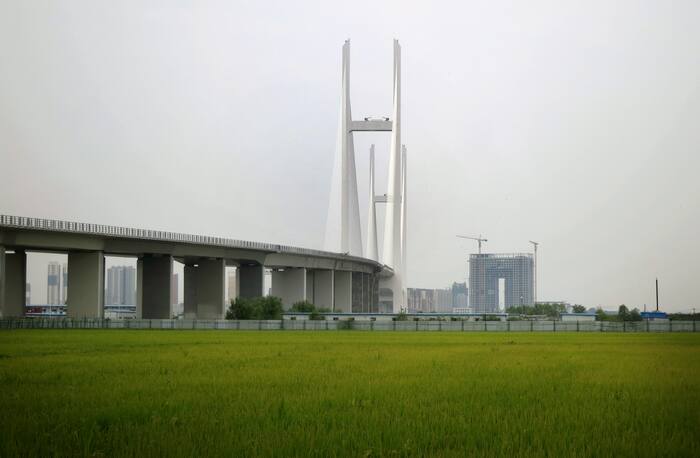
A major road and rail crossing linking China and North Korea across the Yalu River between Dandong and Sinuiju has been delayed by more than a decade, turning a flagship cross-border project into a monument to geopolitical friction, sanctions enforcement, and stalled infrastructure on the border. What was pitched years ago as a catalyst for bilateral trade and regional integration has spent years sitting in limbo, with the Chinese span largely built while matching approach roads and customs infrastructure on the North Korean side lagged far behind.
Anyone who has watched border infrastructure long enough knows that concrete and steel rarely fail on their own. They stall when politics shifts underneath the pilings.
For decades, the border between China and North Korea has looked deceptively straightforward on a map. Two neighbors separated by a river, one an industrial powerhouse with unmatched engineering speed, the other an isolated state tightly controlled from Pyongyang. A bridge connecting Dandong to Sinuiju seems like an obvious link. Yet building across an international frontier is never just a civil engineering exercise. It is an act of diplomacy, security calculation, and economic signaling rolled into one structure.
When Beijing and Pyongyang moved forward with the new Yalu River crossing, the official narrative emphasized modernization and trade capacity. Existing crossings were aging, congested, and ill-suited to heavy modern freight. A new span promised higher throughput and cleaner logistics. On paper, it made complete sense. In practice, physical construction moved faster than political alignment, and a decade of delays followed.
Why Concrete Stops Where Diplomacy Stalls
Engineering schedules assume a basic chain of events. Surveys finish, financing clears, materials arrive, crews pour concrete, and connecting roads meet at the midline. Cross-border projects add a layer of complexity that domestic highways never face, because both sides must synchronize not just timetables, but priorities.
On the Chinese side, Dandong has long functioned as the practical hub of China-North Korea trade. Even when political ties between Beijing and Pyongyang cooled or warmed, goods moved through Dandong's ports, rail yards, and truck corridors. Building a modern bridge deck and approach structure on the Chinese bank fit smoothly into China's broader pattern of large-scale infrastructure execution. Heavy cranes, deep foundations, and rapid assembly are routine for Chinese contractors.
Across the water in Sinuiju, the calculus looks very different. Infrastructure inside North Korea operates under severe resource constraints, centralized planning, and competing state priorities. A grand bridge leading into Sinuiju only delivers economic value if the surrounding road network, customs facilities, power supply, and administrative systems can absorb the traffic. Without those connecting pieces, a bridge can end up looking less like a bustling trade artery and more like a road to nowhere.
Timing also worked against the project. Over the past decade, North Korea's nuclear and ballistic missile programs triggered sweeping international sanctions and heightened scrutiny from Washington and its allies. Beijing found itself balancing its traditional role as Pyongyang's primary economic lifeline against international pressure to curb illicit trade and enforce sanctions compliance. Opening a shiny new crossing at the exact moment border oversight became politically sensitive created a classic dilemma. High-visibility infrastructure carries symbolic weight that quiet, incremental border trade does not.
Even when bilateral rhetoric sounded warm at summit meetings, follow-through on the ground often lagged. Diplomatic gestures in Beijing or Pyongyang do not automatically translate into paved feeder highways, staffed inspection lanes, or clear customs rules on a cold morning by the river.
The Myth of Pure Economic Logic
Observers outside the region frequently fall into a predictable trap. They assume that two neighboring economies will naturally build infrastructure whenever trade demand justifies it. That assumption works well in integrated markets with open borders and predictable tariffs. Along the Yalu River, it breaks down quickly.
Trade with North Korea has never followed purely commercial rules. State trading companies, tight foreign-exchange controls, shifting import bans, and sudden border closures shape what moves and when. A bridge increases physical capacity, yet physical capacity alone cannot create legal, financial, or political permission for goods to cross. If sanctions restrict key commodities or banks hesitate to clear transactions, extra lanes of asphalt sit underused.
Consider a hypothetical example to see how capacity and reality diverge. Suppose a regional planner designs a four-lane crossing capable of handling thousands of trucks a day, assuming steady growth in light manufacturing and raw materials. If new restrictions bar certain machinery or minerals, and customs inspections slow every vehicle to a crawl, the physical bottleneck disappears while the practical bottleneck remains firmly in place. Adding more concrete does not solve a policy freeze.
There is also a security angle that receives less attention than trade figures. Border crossings are points of entry and exit for people, smuggling networks, information, and contraband. Both governments care deeply about control along the frontier. For Pyongyang, tighter external connections carry risks of outside influence and economic dependence on a single giant neighbor. For Beijing, instability or uncontrolled flows across the border create headaches for northeastern provinces. A slow-moving or half-open crossing can sometimes feel safer to decision-makers than a wide-open gate.
What Dandong Reveals About Border Realities
Spend enough time looking at border towns around the world, and a pattern emerges. Local economies adapt to whatever rules exist, often in ways distant capitals never anticipated. Dandong is no exception.
For years, businesses in Dandong rode the ups and downs of cross-border commerce. Warehouses, logistics firms, and trading companies adjusted to tightening enforcement, fluctuating demand, and periodic clampdowns. When formal channels tightened, informal workarounds and shifting product mixes often emerged, though never without friction or risk. Local actors learned that promises of rapid expansion could stall for years at a time.
A decade-long delay changes expectations. When a project slips by months, contractors adjust schedules and keep momentum. When it slips by more than ten years, it becomes part of the local furniture. People stop treating the opening date as imminent and start treating it as a political barometer. Every rumor of progress or inspection visit gets read for clues about what Beijing and Pyongyang are actually willing to do next.
At the same time, infrastructure delays rarely erase the underlying geography. The Yalu River still separates Dandong and Sinuiju by a narrow stretch of water. Demand for basic goods, industrial inputs, and regional connectivity does not vanish just because a ribbon-cutting is postponed. What changes is the pace, cost, and predictability of moving anything across the line.
Sanctions, Sovereignty, and the Long Game
To understand why a crossing can sit unfinished or underutilized for over a decade, you have to look at how leverage works in Northeast Asia. Infrastructure is often treated as a bargaining chip or a signal of intent rather than a standalone utility.
When international pressure on Pyongyang intensifies, every visible link between China and North Korea draws scrutiny. Even lawful trade faces reputational and compliance hurdles when global financial systems watch closely. Pushing ahead aggressively with a major new border gateway can send the wrong signal diplomatically, while quietly letting timelines drift allows leaders to avoid a sharp public break without rushing into politically awkward moves.
Sovereignty plays its part too. Neither side wants to look like it is being dragged along on the other's timetable. North Korea guards its autonomy jealously, especially toward a neighbor vastly larger in population and economic weight. China, for its part, has little appetite to pour endless resources into downstream works on the other side of the river unless the broader strategic environment makes sense.
That leaves both sides in a familiar stalemate. Neither wants to declare the project dead, because abandoning it admits failure and forfeits future leverage. Yet neither has found the exact combination of political will, sanctions relief, and practical readiness needed to bring the entire crossing cleanly into full, uninterrupted service.
Reading Between the Pilings
Anyone tracking China-North Korea relations should treat bridge news with healthy skepticism. A completed span or a fresh round of talks does not automatically mean a surge in normal commerce. Real progress requires alignment across four unglamorous areas:
- Approach infrastructure on both banks capable of handling real freight volumes without choking local roads.
- Customs and inspection systems staffed and equipped to process cargo consistently rather than sporadically.
- Sanctions and compliance clarity that gives traders and logistics operators a workable legal footing.
- Political stability between Beijing and Pyongyang that holds up through leadership shifts, regional tensions, and economic headwinds.
Without those pieces in place, a bridge remains what it has been for more than a decade—a massive steel-and-concrete mirror reflecting every hesitation between two neighbors. Watch the connecting roads and customs gates, not the speeches, if you want to know whether the crossing is truly open for business.


