A single shipment of dried coriander seeds sits in a rusted shipping container at a northern European port. To the customs inspector checking the manifest, it is just cargo. To the family farming a few acres of sun-baked earth in Rajasthan, it is their daughter’s university tuition.
The inspector pulls a sample. He tests it against local, fragmented regulations. If the moisture level is a fraction of a percentage off, or if a trace of dust exceeds an arbitrary regional threshold, the entire container is rejected. It gets sent back or destroyed. The family in India never sees the money. They do not understand what went wrong. The broker tells them the market was bad, or that the quality failed some unspoken, shifting metric across the ocean.
This is the silent war fought inside the global spice trade. It is not a war of armies, but of definitions. For decades, the global trade of culinary staples like cardamom, coriander, and vanilla has been governed by an chaotic patchwork of regional rules. What passed as premium quality in New Delhi could be labeled contaminated in Frankfurt or substandard in New York.
But a profound shift just occurred in Geneva. It received no breaking-news alerts on your phone, yet it changes everything for the people who grow what we eat.
The Tyranny of the Undefined
To understand why this matters, consider a hypothetical farmer named Rajesh. He grows large cardamom in the misty, high-altitude ridges of Sikkim. It is an exhausting, hyper-local craft. Large cardamom is indigenous to the North-Eastern Himalayan region, meaning the world’s best supply relies on families who have dried these smoky, dark pods over open wood fires for generations.
When Rajesh sells his harvest to a local middleman, the price he receives is dictated by a chain of assumptions. Because there has never been a single, globally recognized definition of what constitutes perfect "large cardamom," international buyers bake risk into their pricing. They pay less because they are gambling. They worry that a shipment will be blocked at a western border because a foreign bureaucrat confuses the smoky aroma with chemical contamination.
The exact same problem has plagued coriander and vanilla. India is a titan in the coriander market, exporting massive quantities of the seed globally. Yet, without a universal benchmark, Indian exporters frequently found themselves at the mercy of arbitrary technical barriers.
Vanilla presents the inverse headache. India imports a massive amount of its vanilla requirement to satisfy a growing domestic appetite for premium baking and confectionery. Without an ironclad international standard, Indian buyers were vulnerable to receiving adulterated, low-grade pods from unscrupulous global brokers.
When everything is subjective, the small player always loses.
The Breakthrough in Geneva
The chaotic status quo dissolved during the 49th Session of the Codex Alimentarius Commission in Geneva. The Codex Commission, run jointly by the Food and Agriculture Organization (FAO) and the World Health Organization (WHO), is the ultimate global court for food safety and trade quality.
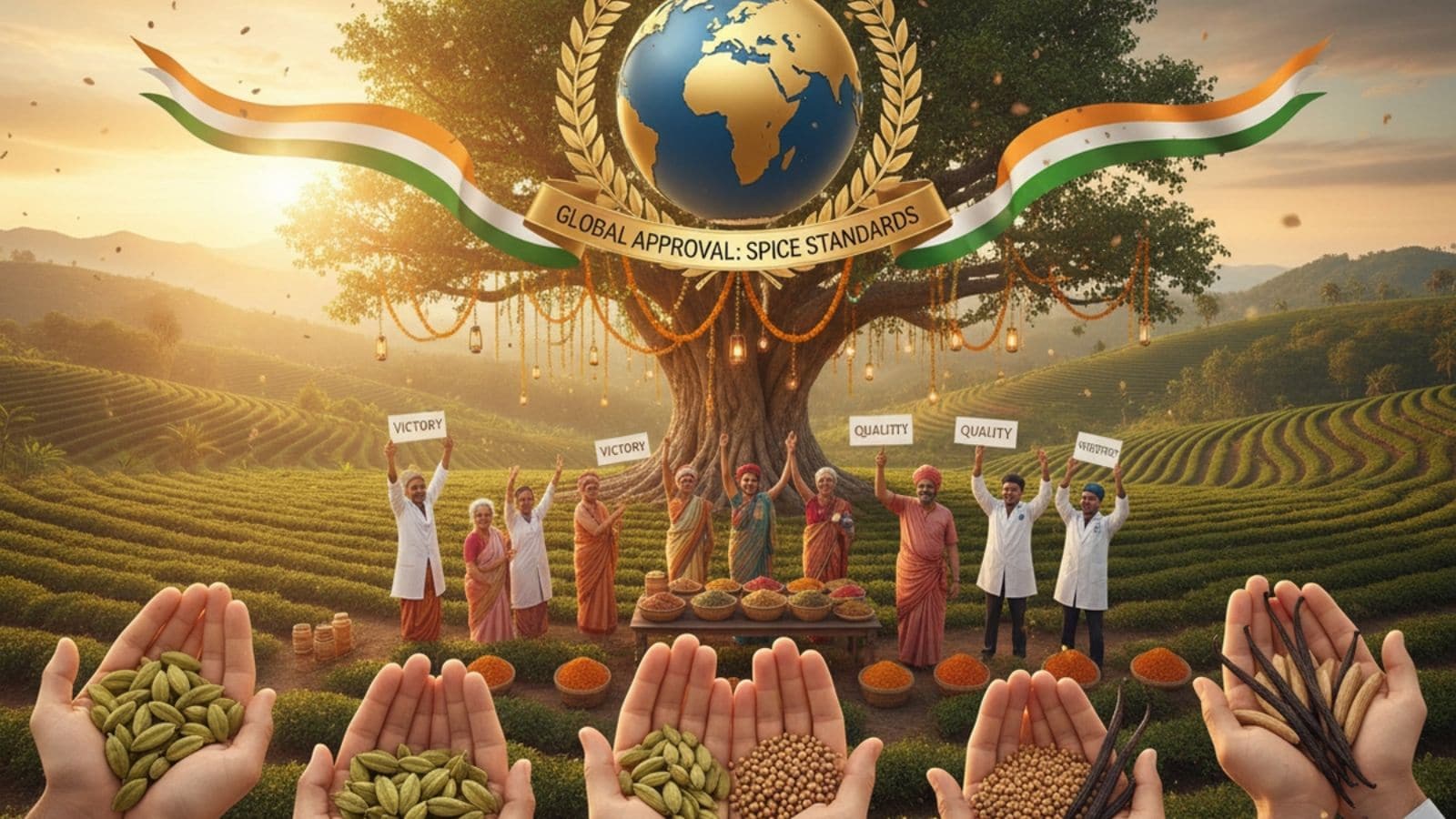
India did not just sit at the table; it shaped the room. Serving as the host and secretariat for the Codex Committee on Spices and Culinary Herbs, India successfully drove the finalization of standalone international quality benchmarks for dried coriander seeds, large cardamom, and vanilla.
This means that a bureaucrat in Rotterdam, a buyer in Tokyo, and a farmer in Kerala are finally reading from the exact same script. The newly adopted Codex standards explicitly lay down the science-based metrics for moisture content, purity, labeling, and additive limits.
The immediate result? Friction evaporates.
When a standard is harmonized across global markets, a shipment tested and approved at an Indian port cannot easily be rejected on a whim when it lands in Europe. It legitimizes the indigenous agricultural heritage of places like the North-Eastern Himalayas. It turns a volatile gamble into a predictable business.
The Expanding Frontier
The victory in Switzerland went beyond the spice rack. The Indian delegation, led by Food Safety and Standards Authority of India Chief Executive Rajit Punhani, secured a mandate to develop a brand-new global standard for cashew kernels.
Cashews are one of the most widely traded tree nuts on Earth, yet they currently lack a dedicated Codex framework. By taking the lead on this, India is positioning itself to dictate the quality and safety terms for a multi-billion-dollar global commodity, systematically dismantling the technical trade barriers that have historically squeezed domestic processors.
Simultaneously, India was appointed to co-chair a new electronic working group focused on risk analysis for entirely new food products and production systems. This is where the future gets messy. As lab-grown proteins, alternative milks, and novel agricultural technologies enter the market, someone has to write the safety rules. India is ensuring its hands are on the pen.
A New Reality at the Roots
The next time you unscrew a jar of coriander to season a meal, or slice open a smoky pod of large cardamom, realize you are holding a tiny piece of economic diplomacy.
The technical jargon published in Geneva documents will never be read by the farmers walking the terraced hills of the Northeast or the fields of Madhya Pradesh. They will not know the names of the committees that debated moisture percentages and sampling methods.
But they will notice when the local buyers stop slashing prices based on the vague threat of international rejection. They will notice the stability. The invisible borders that once threatened to ruin a harvest have been replaced by a common language, written in black and white, recognized by the world.