The grass at the Swope Soccer Village is mathematically perfect, clipped to the precise millimeter required by modern tactical architecture. Under the burning midwestern sun, twenty-four men move in synchronized rhythm, the sharp, rhythmic slap of leather against synthetic leather echoing across the training complex.
Among them is Declan Rice.
To the untrained eye, he looks indestructible. He jogs, he pivots, he sprays twenty-yard passes with the casual indifference of a man practicing in his garden. Only the slight, heavy bandage wrapped around his left calf betrays the truth. Just twenty-four hours earlier, he was locked away in the medical room, a ghost absent from the team sheet, grounded by a heavy knock sustained during a grueling, goalless battle against Ghana. He told the coaching staff he was fine. He always says he is fine. But beneath the stoic bravado lies the terrifying reality of a man who has played over sixty matches this season, dragging a body burdened by neural hamstring pain since Christmas across two different continents.
He is back on the pitch because he has to be. The engine room demands a pulse.
But thirty yards away, sitting on the cooler boxes with a look of quiet resignation etched across his face, is Reece James.
Pain is the great separator in professional sport. It creates two distinct worlds: the world of the collective, moving forward toward a World Cup knockout stage, and the world of the isolated individual, trapped in the tedious purgatory of resistance bands and ice packs. James will not play against Panama in New Jersey. His hamstring, tight and rebellious after the Boston stalemate, has failed him again. For a player whose talent is generational, his career has become a tragic loop of hope and hamstring tears.
Consider the cruelty of this specific moment. This is a World Cup scaled up to an unprecedented, terrifying size. The domestic season did not end; it merely dissolved into an American summer of endless flights, shifting time zones, and unforgiving pitches.
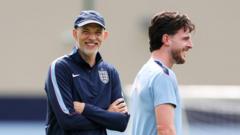
Thomas Tuchel knows the math. He understands that a football squad is not a machine, but a fragile ecosystem of soft tissue and bone. The German manager wants to win Group L, but he cannot afford to burn his house down to heat the living room. Losing Tino Livramento to a tournament-ending injury before a ball was even kicked in anger was a warning shot. Now, with James sidelined, the right side of England's defense is a structural puzzle missing its most expensive pieces.
Imagine the psychological weight of standing in those boots. A player like James doesn’t just feel the physical pain of a muscle fibers tearing; he hears the collective sigh of a nation. He feels the quiet, unspoken frustration of a manager who built a tactical system around his unique ability to defend like a center-back and attack like a winger. When that engine stalls, the entire machine stutters.
Tuchel will likely turn to makeshift solutions for the Panama fixture. Trevoh Chalobah or Jarell Quansah might be asked to stretch outside their natural comfort zones. It will probably be enough. Panama sits at the bottom of the group, bloodied and pointless. But the tournament doesn't end in New Jersey. The real monsters are waiting in the knockout rounds, and you cannot hunt monsters with a depleted infantry.
The contrast between Rice and James is the defining narrative of modern football. One man pushes through the red line, masking chronic pain with tape and adrenaline, while the other is forced to watch from the sidelines, his body refusing to match the ambition of his mind. We demand brilliance from these athletes every three days, forgetting that the line between a triumphant interception and a career-altering tear is thinner than a blade of grass.
As the training session winds down, Rice walks off the pitch, laughing with Jude Bellingham, shaking off the stiffness in his leg. He has survived another day.
Behind them, James stands up slowly, adjusting the strap on his training gear, walking toward the team bus alone. The sun is still shining, the tournament is moving forward, but for some, the grandest stage in the world is reduced to the distance between a treatment table and a bench.