We live our digital lives under the illusion of the sky. We picture our messages, our market trades, our family video calls and state secrets leaping effortlessly through the air, carried by invisible wings of satellite light. It is a comforting fiction. It helps us forget that the heavy, beating heart of global communication does not float in the heavens at all.
It rests on the crushing, pitch-black floor of the ocean.
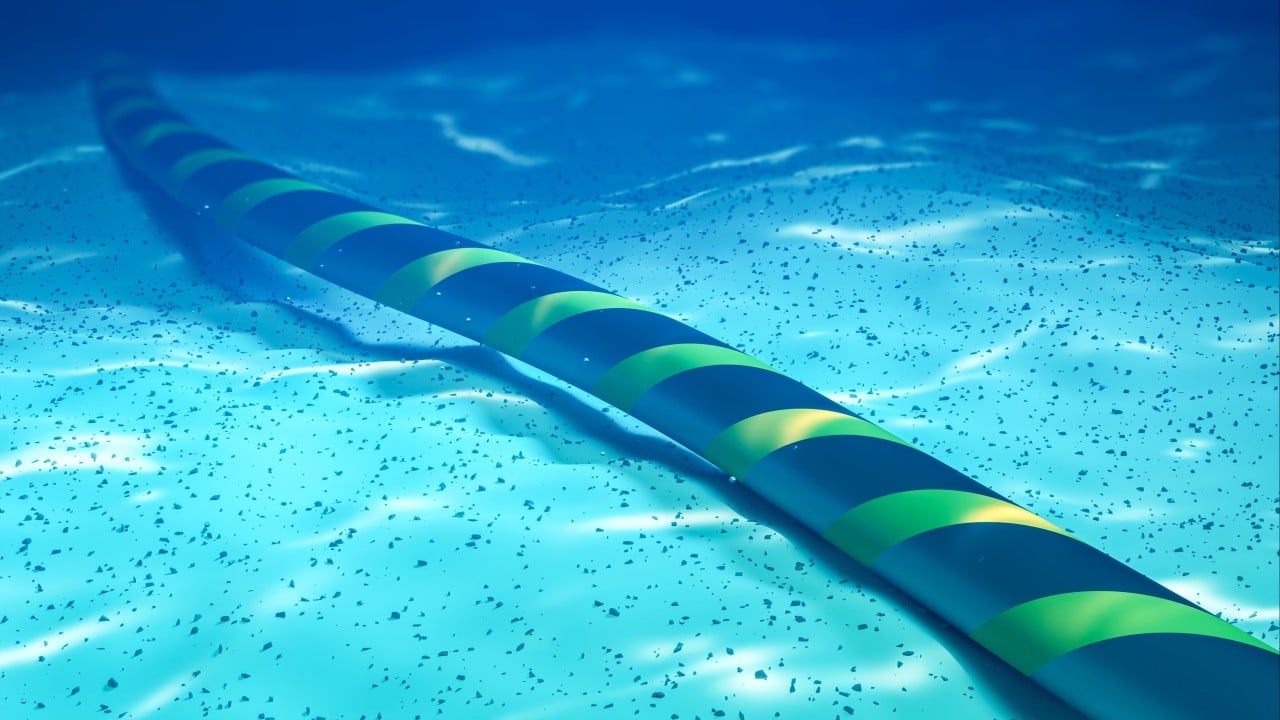
Imagine standing on a damp beach anywhere in the world. Look out at the horizon where the sun dips into the brine. Two miles beneath that glittering surface, resting in the freezing mud alongside ancient wrecks and blind, pale leviathans, lie hair-thin strands of glass. They are wrapped in copper, armored in steel, and coated in polyethylene. They stretch for thousands of miles across abyssal plains and scale jagged underwater mountains. These are submarine communication cables. They are the true nervous system of our species. Nearly all international data—every financial transaction, every diplomatic cable, every byte of our collective consciousness—flows through these fragile threads.
For decades, the map of these underwater highways was drawn by geography and historical convenience. If you wanted to connect Southeast Asia to the wider world, your cables hugged the continental shelves, slipped through narrow maritime bottlenecks, and squeezed through the South China Sea.
It seemed efficient. It was also a geopolitical trap.
Consider the predicament of a telecommunications engineer sitting in Bangkok or Singapore, staring at a monitoring screen. That engineer knows a terrifying truth: the South China Sea is one of the most contested patches of water on planet Earth. Sovereignty claims overlap like jagged broken glass. Naval patrols cross paths with aggressive maritime militias. When cables are routed through these volatile shallows, they are vulnerable not just to the routine hazards of passing ship anchors and fishing trawlers, but to the deliberate leverage of great power competition. A fiber-optic line resting in contested waters is not merely infrastructure. It is a hostage.
This is the backdrop against which a quiet, high-stakes rerouting of the global internet is currently unfolding.
The United States has recently thrown its diplomatic and financial weight behind a transformative alternative: a Thai submarine cable project designed to bypass the South China Sea entirely. To understand why this matters, you have to look past the dry trade announcements and understand the human fear of vulnerability.
Think about how a nation feels when its voice can be muted by a neighbor's naval blockade. In an interconnected economy, a severed cable is a financial heart attack. When regional tensions spike, the threat of physical tampering or strategic interference hangs over every shallow-water data pipeline. Businesses hesitate. Governments panic. Innovation slows down because the foundation beneath it feels rotten with risk.
By backing a route that avoids these treacherous maritime flashpoints—steering instead toward safer oceanic corridors—the United States and its regional partners are doing something much deeper than laying glass. They are redrawing the geography of trust.
Let us walk through a hypothetical scenario to feel the weight of this change.
Picture a young software entrepreneur in Chiang Mai launching a platform that connects rural farmers with global commodity markets. Her entire livelihood depends on milliseconds. One morning, a geopolitical dispute erupts hundreds of miles away in the contested South China Sea. A cable suffers an "accidental" disruption near a disputed reef. Suddenly, her server latency spikes into the unusable red zone. Her foreign buyers cannot connect. Her transactions fail. The dreams she built over five years curdle into debt overnight, not because her product was flawed, but because the invisible river carrying her data ran through hostile territory.
Now, shift the scenario. Imagine that same entrepreneur operating on a network backed by a secure, bypass route. The cable she relies on dips south into deeper, calmer, internationally neutral waters, far away from the shouting matches of competing naval patrols. A crisis erupts on the surface, but deep below, in the eternal silence of the abyss, her data packets continue their silent, unbroken journey at the speed of light.
That is what infrastructure security actually means. It is the peace of mind that allows human ambition to take risks without fearing that the ground beneath our digital feet can be pulled away on a tyrant's whim.
The mechanics of laying these modern marvels border on the miraculous. Picture a specialized cable-laying ship creeping across the ocean at walking speed, its stern heavy with a spool of glass thinner than a garden hose. Onboard, technicians monitor real-time sonar maps of the seabed, searching for flat, stable paths to avoid jagged underwater canyons and active seismic faults. They pay out the cable with microscopic precision, burying it beneath the sediment where continental shelves are shallow, and letting it drape gracefully across flat abyssal plains where the crushing pressure of the water column keeps it anchored against ocean currents.
Yet, physical safety from nature is only half the battle. The modern struggle is keeping these digital veins safe from human ambition.
When great powers compete, infrastructure becomes a chessboard. By supporting projects that diversify routes and sidestep geopolitical chokepoints, nations are attempting to build an open internet that resists fragmentation. It is an acknowledgment that security cannot be achieved by building walls alone, but by creating alternative paths that render those walls obsolete.
We rarely think about the physical reality of the internet until it breaks. We swipe our screens, we stream our music, we send our messages across the void, blissfully unaware of the immense engineering and delicate geopolitics required to keep the lights on.
As these new underwater pathways take shape in the coming years, the map of human connectivity will subtly shift. The noise at the surface will continue—the diplomatic rows, the territorial claims, the posturing of fleets. But deep beneath the waves, wrapped in steel and silence, the real work of the future will keep moving forward, carrying our collective voice through the dark.