The air inside the cleanroom at the Hong Kong University of Science and Technology always carried a faint, mechanical hum. It was the sound of air filtration systems working overtime to ensure that not a single speck of dust could settle on a mirror the size of a coin. For two years, a small team of engineers lived in this hyper-sterile bubble. They were not building a rocket. They were building a scale. A scale meant to weigh the invisible ghosts of our industrial world.
When we talk about climate change, we usually talk about abstracts. We look at graphs with jagged red lines, or we read policy documents filled with distant target years. But to the scientists working on a project code-named MUSICO, climate change was a local, tactile problem. It was a question of how to catch a thief that leaves no footprints.
The thief is methane and carbon dioxide. They leak from fractured coal mines in Shanxi, escape from unlined landfills outside sprawling megacities, and billow from the smokestacks of coastal power plants. For decades, tracking these emissions was largely a game of bureaucratic guesswork. A factory owner filled out a form. A local agency checked a box. The numbers were calculated on clipboards, leaving massive margins for error.
The team in Hong Kong wanted to end the guesswork. They wanted an eye in the sky that could look at a hundred-meter patch of dirt from orbit and say, exactly, how much poison was rising from it.
The Problem of Weight
Space hardware is notoriously heavy. If you want to look at the Earth with high-resolution clarity, traditional engineering dictates that you need a massive satellite. You need heavy glass lenses, thick protective shielding, and a budget that can sustain the crushing gravity of a rocket launch. Industrial carbon monitors are usually the size of delivery vans.
But the Hong Kong team, co-led by professors Su Hui and Zhang Limin, did not have a delivery van. They had a strict weight limit dictated by the logistics of cargo resupply missions to the Tiangong space station.
They had to shrink a sprawling laboratory into something that could fit inside a domestic washing machine.
Every gram mattered. If an optical lens was too thick, the instrument would be rejected. If the bracing structure was too heavy, it would never leave the ground. The engineers spent months shaving fractions of a millimeter off aluminum casings. They debated the placement of every wire. The result was a box measuring roughly sixty centimeters long and weighing just under eighty kilograms.
Inside that modest box sat three gas detection optical lenses capable of a spectral resolution of 0.2 nanometers. To put that in perspective, they were building a device that could read the optical signature of sunlight passing through a gas cloud with enough precision to identify the specific molecule blocking the light.
Every gas has a fingerprint. When sunlight hits the Earth and bounces back up into space, the gases in the atmosphere absorb very specific wavelengths. By analyzing the light that makes it through, the instrument can see what the human eye cannot.
The Hainan Horizon
In May 2026, the hum of the cleanroom was replaced by the wet, heavy heat of the Wenchang Space Launch Center in Hainan. The box, officially dubbed the Multi-Spectral Imaging Carbon Observatory but affectionately called the "Eye for Space," was bolted inside the nose cone of a Long March 7 rocket.
Standing on the beach a few kilometers from the pad, the scientists could feel the vibration of the engines before they heard the sound. The rocket tore through the low tropical clouds, carrying the first-ever major scientific payload designed and led by Hong Kong into the upper atmosphere.
It was a strange moment of transition. For years, Hong Kong had contributed components or offered theoretical assistance to larger national space efforts. But this was different. This was an instrument conceived, designed, and managed from the laboratories of Clear Water Bay, riding a pillar of fire into low Earth orbit.
The rocket was carrying the device to Tiangong, China’s permanently occupied space laboratory. But reaching orbit was only the first half of the journey. A piece of precision glass is useless if it remains tucked inside a cargo crate. It needed to be installed on the outside of the station, exposed to the raw vacuum and violent temperature swings of space.
The Hands in the Vacuum
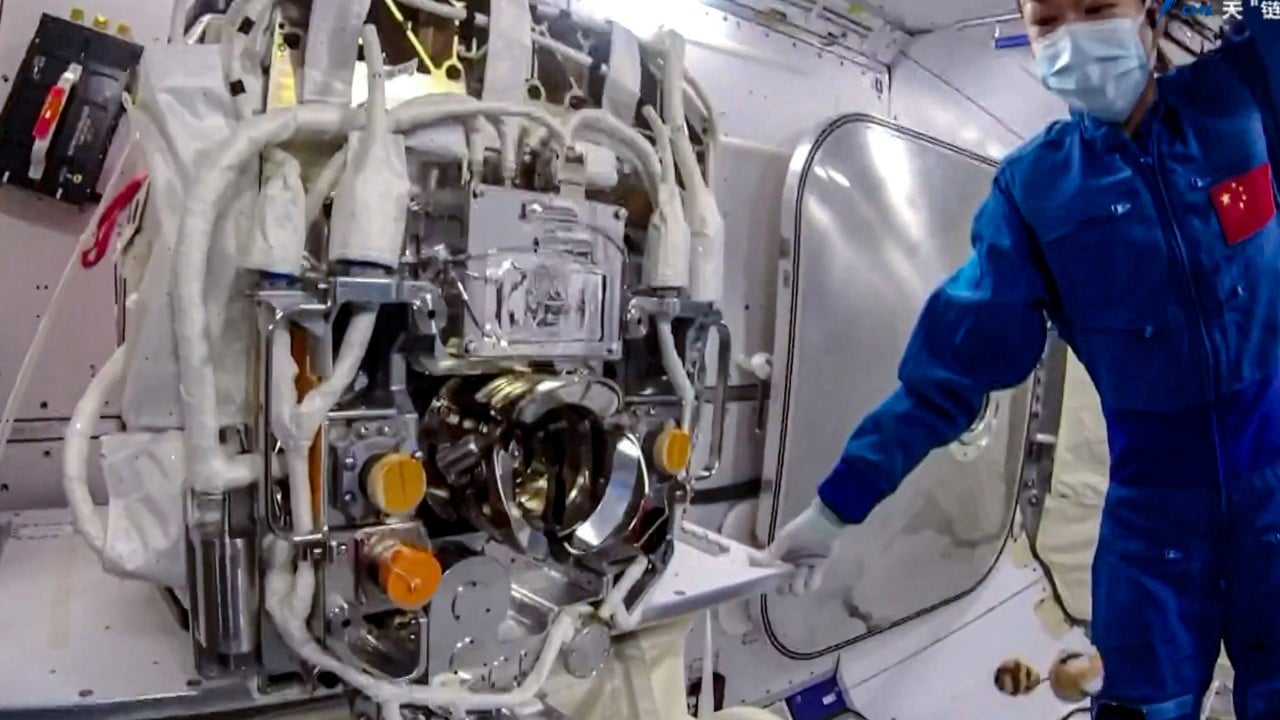
A few weeks later, four hundred kilometers above the Pacific, Dr. Lai Ka-ying floated inside the Tianhe core module. As Hong Kong's first astronaut, her presence aboard the Shenzhou XXIII mission carried its own weight of expectation back home. But in orbit, sentimentality is a hazard. Survival and success depend on a checklist.
The installation of the Eye for Space was not a simple matter of clicking a module into place. Working alongside mission commander Zhu Yangzhu and pilot Zhang Zhiyuan, Lai had to coordinate with ground controllers in Beijing and engineers back in Hong Kong to prepare the instrument for its life outside the hull.
Consider what happens to an object in low Earth orbit. Every ninety minutes, the station cycles between blistering solar radiation and the absolute cold of Earth's shadow. The metal expands and contracts. The delicate optical alignment, calibrated to the nanometer in a peaceful Hong Kong lab, faces a constant thermal beating.
Using the station's massive robotic arm, the crew maneuvered the eighty-kilogram box out into the void, securing it to an external adapter on the Wentian laboratory module. The latches clicked. Power flowed into the instrument. Deep within its chassis, the optical sensors cooled to their operating temperatures.
The eye opened.
The Grid
From its vantage point, the instrument does not see borders. It sees a massive, swirling column of air that spans from forty-two degrees north latitude to forty-two degrees south. This geographical band contains the vast majority of the world’s heavy industry, its most crowded cities, and its most vulnerable ecosystems.
As Tiangong races over the planet at seven and a half kilometers per second, the Eye for Space sweeps the terrain below in a continuous, high-definition glance. The data arriving at ground stations isn't a picture in the traditional sense. It is a dense matrix of numbers, a map of light intensities that tells a stark story.
When the station passes over a coal-burning power plant, the 0.2-nanometer resolution registers a sudden, sharp drop in specific infrared wavelengths. The software maps this drop to a hundred-meter grid on the ground. There is no anonymity at that scale. The system can isolate a single leaking valve on a natural gas pipeline or an unmanaged trench in a rural landfill. It covers roughly ninety-nine percent of the point-source carbon dioxide and methane emissions across the industrial heartland.
This data is not intended to be a secret. Under established data management frameworks, the readings are routed not just to environmental ministries domestically, but also to the United Nations Environment Programme. The atmosphere is a shared bank account; if someone is making an unauthorized withdrawal or deposit, everyone needs to see the ledger.
Beyond the Glass
Back in Hong Kong, the cleanroom is quiet now, but the computers in the adjoining labs are humming with a different kind of energy. The raw optical fingerprints from orbit are translated into real-time maps of human activity.
The true test of the instrument will not be found in the precision of its lenses, but in what happens to the data it collects. Having an undeniable, unalterable record of who is emitting what changes the nature of environmental accountability. It removes the luxury of denial from factory floors and council rooms alike.
High above, the small washing-machine-sized box continues its silent patrol. It rides the outer skin of a space station through the quiet dark, catching the reflection of a rising sun, waiting to see what we do with the truth it uncovers.