In a laboratory tucked away from the neon glare of Shenzhen, a thirty-year-old software engineer named Li stares at a flickering monitor at three in the morning. His eyes are bloodshot, reflecting lines of code that look less like instructions and more like sheet music for an engine that was never supposed to exist.
For years, the story of artificial intelligence was written in English, typed on American keyboards, and powered by silicon forged in a handful of factories across the globe. A single company in California held the keys to the kingdom. Their graphics processing units were the undisputed sun around which the entire technological cosmos orbited. To build a modern model of intelligence, you needed their hardware. If you could not buy it, you simply did not play.
Then came the embargoes.
Doors slammed. Supply chains tightened into wire. The message from across the Pacific was explicit and absolute: you will not have the chips, you will not have the architecture, and you will therefore stop.
Li takes a slow sip of cold, bitter tea. He is not thinking about geopolitics. He is thinking about latency. He is thinking about how to make a processor built for a different era dance to the complex choreography of modern deep learning.
DeepSeek just dropped its open-source tools onto the global stage.
It is a quiet earthquake. In the open-source repositories of the world, engineers are pulling apart software libraries designed to do something audacious: take the raw, stubborn metal of Huawei Ascend chips and bridge the chasm that separates them from Nvidia dominance.
To understand why this matters, you have to understand how a computer chip actually thinks. Imagine a vast, sprawling warehouse filled with boxes. An Nvidia processor is like an army of millions of hyper-fast couriers who can open any box instantly, regardless of where it is in the warehouse. They speak a universal language. Every piece of software written for the last decade assumes these couriers exist.
Huawei chips are different. They are immensely powerful, packed with raw computational muscle, but their couriers speak a distinct dialect. They are built on a different architectural philosophy. Software written for Western hardware runs on them like a foreign tourist trying to navigate a dense maze using a map written in hieroglyphics. It stumbles. It hesitates. Much of that raw power bleeds away into heat and friction.
For a long time, bridging that gap meant writing custom translation layers by hand, line by grueling line. It was the digital equivalent of translating Shakespeare into Swahili word by word, by candlelight.
What DeepSeek did was build a bridge.
By releasing these optimization tools to the public, they have essentially handed every domestic laboratory in China a universal translator. These toolkits reorganize how data flows through the neural network, mapping complex training workloads onto Huawei’s hardware without demanding that the hardware suddenly become something it is not.
Consider what happens next in places like the foundry floor.
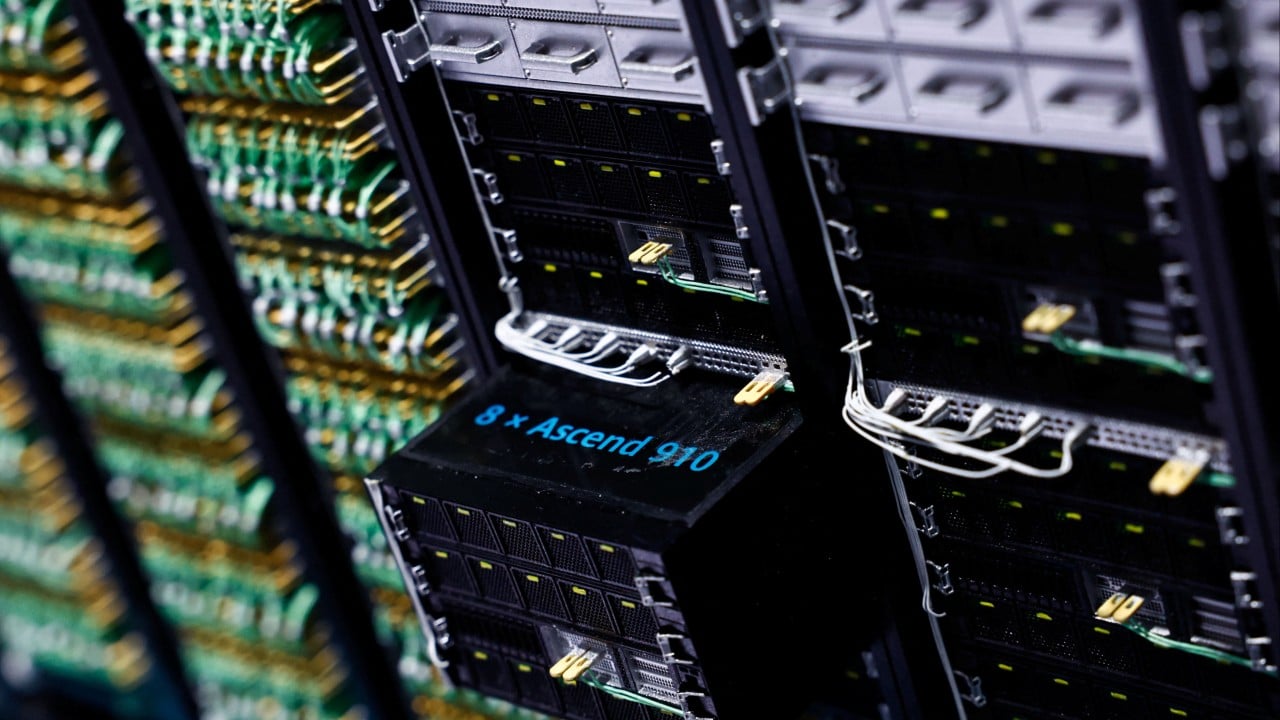
Walk into a server farm in Guizhou. The air is sub-zero, roaring with the deafening white noise of thousands of industrial fans. Rows of black server chassis stretch into the dim distance, blinking with green and amber status lights. Inside those racks sit stacks of Ascend processors. Until recently, they were powerful engines sitting in chassis with no steering wheel.
Now, the software is catching up to the metal.
This is not merely a technical adjustment. It is an exercise in pressure-cooking innovation. When you deny a nation access to the best tools on earth, you do not stop its ambition. You merely redirect it toward the stubborn art of making do, which eventually becomes the art of making better.
In Silicon Valley, executives often talk about ecosystems as if they are natural phenomena, like coral reefs or redwood forests. They built an empire on the assumption that their ecosystem was too sticky, too complex, and too deeply integrated for anyone to replicate. Developers grow up on their programming languages. Libraries are optimized for their silicon. The moat is deep, wide, and filled with alligators.
But software is infinitely malleable. Hardware is stubborn, but code is pure thought rendered into logic. When you give thousands of brilliant, desperate engineers a common problem and a set of open-source keys, they do not look at the moat. They start building bridges out of scrap wood.
Li compiles the script. The screen freezes for a fraction of a second. The fans in the server rack beside his desk whine, pitching up an octave as the workload hits the silicon.
On the monitor, a validation test flashes green.
It works. The training job is running on domestic silicon, utilizing software frameworks that bypass the Western monopoly entirely. It is not quite as fast as the reigning hardware champion yet. Not quite. But the gap is shrinking by the week, measured not in light years anymore, but in software patches.
We are witnessing the fracturing of the technological world into parallel universes. In one universe, development continues along the familiar, comfortable tracks paved by decades of accumulated capital and unhindered access. In the other, a parallel ecosystem is being hammered together out of necessity, backed by state-sized budgets and driven by the fierce urgency of self-reliance.
The irony of the current moment is profound. The restrictions meant to lock a superpower out of the future have instead locked it into a relentless campaign of invention. By forcing engineers to abandon imported luxuries, the policy has
The Iron Wall and the Midnight Code
technology
category
In a quiet room in Shenzhen, a cooling fan hums a steady, anxious rhythm. A young engineer named Lin stares at a terminal screen. Outside, the city is slick with rain, neon bleeding into the asphalt. Inside, the air smells of ozone and stale green tea. Lin is not looking at a spreadsheet. He is watching a war.
It is a war fought not with bullets, but with silicon and sand.
For years, the rules of this war were written in California. If you wanted to build artificial intelligence, you bowed to an American crown. You bought high-end graphic processing units, amber-glowing monoliths of computing power that cost small fortunes and arrived in guarded crates. The architects of this system built a moat so wide and deep that entire empires gave up before they even started. They assumed nobody could ever jump it.
They forgot what happens when you lock a door against people who know how to pick locks.
DeepSeek, an upstart name that once caused ripples, has now sent tidal waves across the global tech grid. They did something radical, something quiet, and something devastatingly practical. They open-sourced the tools. Not the trinkets or the marketing decks, but the hard, grinding software architecture designed to make Huawei chips do what only Nvidia silicon was supposed to do.
To understand why this matters, you have to look past the stock tickers and the panicked headlines in financial journals. You have to look at the metal.
Imagine a kitchen designed for a Michelin-starred chef. Every knife is imported steel from Japan. Every stove burns with precise, calibrated blue fire. The ingredients are flown in daily. That was the Nvidia ecosystem. It was magnificent. It was also fragile. When export controls dropped like iron shutters, that kitchen suddenly found itself locked out. The imported stoves vanished.
Lin and thousands of engineers like him faced a stark choice. Pack up their knives, or learn to cook with local wood over an open fire.
The Huawei Ascend chips were that local wood. They were powerful, certainly, but they were notoriously difficult to handle. Software written for one ecosystem feels like trying to write poetry with your non-dominant hand when forced onto another. The architecture clashed. The pipelines choked. Without a translator, the hardware was just expensive glass and copper.
This is where the midnight code comes in.
DeepSeek’s recent release acts as a universal adapter for the digital age. By open-sourcing optimization tools tailored to bridge the gap between their training frameworks and Huawei’s domestic accelerators, they bypassed years of proprietary engineering bottlenecks. They didn't just give away software. They handed out a lifeline.
Let us be entirely clear about the mechanics here. This is not magic. It is an exercise in brutal, relentless software engineering. When you cannot rely on brute-force hardware superiority—because the best hardware is locked behind geopolitical borders—you have to get smart. You optimize the memory access. You rewrite the matrix multiplication kernels. You squeeze every single drop of performance out of every single transistor available on the domestic assembly line.
(Note: When I speak of a bridge here, I am using a physical metaphor for software translation layers—compilers and runtime libraries that map high-level neural network operations directly to unfamiliar instruction sets.)
The implications stretch far beyond corporate balance sheets. We are watching the fracturing of the digital universe into parallel dimensions. For the past decade, the tech world operated on a unified global standard. Code written in Seattle could run in Shanghai, which could feed into data centers in Frankfurt. It was messy, but it was connected.
Now, the walls are going up.
When a company like DeepSeek opens the source code for chip adaptation, they are cementing a self-sufficient ecosystem. They are telling the world that innovation does not stop at a trade restriction. In fact, restrictions are often just a very rude invitation to build your own tools.
Consider what happens next. Thousands of developers across Asia who previously could not afford or access Western hardware now have a viable, open pathway to train massive models on local silicon. The talent pool is vast, hungry, and no longer waiting for permission. They are iterating in real-time, testing theories, and pushing the boundaries of efficiency because efficiency is their only option.
There is a vulnerability in this new world, however. Autonomy is expensive. Building parallel tracks means duplicating effort, fragmenting standards, and creating compatibility chasms that may take generations to bridge again. It is a messy, exhausting way to build the future.
Yet, standing there in the Shenzhen night, watching the compilation progress bar crawl across his screen, Lin does not look worried. He takes a sip of his cold tea. The terminal flashes green. The compilation succeeds.
A domestic chip, running a native framework, powered by open-source ingenuity.
The room is quiet again, save for the hum of the fan. But out there, beyond the rain-streaked window, the ground has shifted just a fraction of an inch. And an inch is all it takes to start an avalanche.