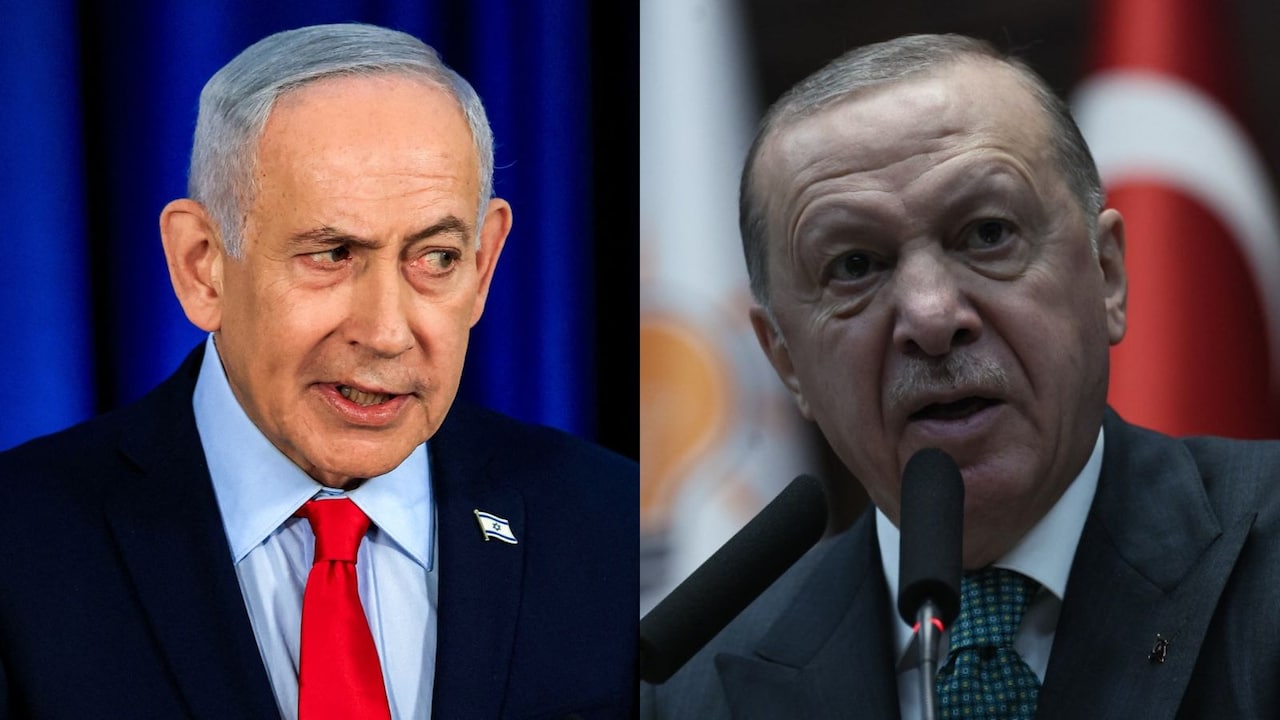
The friction between Jerusalem and Ankara has long moved past diplomatic coldness. Right now, it's an open geopolitical collision. When Israeli warplanes target infrastructure inside Syria near the Turkish border, things escalate fast. Turkish President Recep Tayyip Erdogan and Israeli Prime Minister Benjamin Netanyahu aren't just exchanging harsh words. They are fighting a proxy and positional war over who fills the power vacuum in the Levant.
If you're wondering why two of the region's heaviest militaries are ready to trade blows over a ruined Syrian air base, you have to look at the ground realities changing by the day. Turkey's footprint in northern Syria is expanding, and Israel has made it clear it will not tolerate a hostile military buffer right on its doorstep.
The Spark Behind the Latest Border Clashes
The immediate flashpoint centers on the Abu al-Duhur military air base in northwestern Syria. Israeli jets struck the disused facility, which sits a short drive from the Turkish border. Jerusalem claimed that a Turkish military delegation had recently visited the site to help reactivate it, posing a direct security challenge.
Ankara flatly denied any plans to station troops at that specific base. Even so, the airstrike exposed a deeper strategic paranoia. Turkey has positioned itself as the primary external patron of Syria's transitional government under Ahmed al-Sharaa, who took power after the fall of Bashar al-Assad.
Israel views this alignment with deep suspicion. From the Israeli perspective, an emboldened Turkish military presence helping rebuild the Syrian state means Iran-style proxies or hostile forces could eventually hem them in from the north. Erdogan, meanwhile, has publicly declared that Turkish security begins in Aleppo, Damascus, and Beirut. That's an explicit warning to Israel to back off its military campaigns in neighboring territories.
Dictator and Genocide Rhetoric Reaches a Boiling Point
Diplomacy has completely broken down. Turkey's judiciary recently moved to seek an Interpol red notice and international arrest warrants for Netanyahu, accusing him of genocide over the interception of a Gaza-bound aid flotilla.
Netanyahu's office fired back immediately, labeling Erdogan an antisemitic dictator. The Israeli statement didn't hold back, accusing Ankara of domestic oppression, campaigns against the Kurds, and supporting militant networks. Turkey responded by comparing Israeli leadership to historical tyrants, ensuring the diplomatic floor drops out entirely.
This toxic rhetoric reflects a fundamental incompatibility. Turkey has suspended bilateral trade, severed normal diplomatic ties, and thrown its full weight behind international legal actions against Israeli officials. Israel treats these moves not as standard political posturing, but as an active campaign to isolate the Jewish state globally while destabilizing its immediate security zone.
What This Means for the Wider Middle East
You cannot look at the Israel-Turkey feud in isolation. It ties directly into a broader realignment across the Middle East. Turkey maintains military infrastructure abroad, from Qatar to Somalia, and its ambition to project power into the Eastern Mediterranean and Syria makes it a formidable actor.
For Israel, keeping freedom of movement in Syrian airspace is an existential necessity. As long as Israeli jets keep pounding targets to prevent the buildup of hostile capabilities near its borders, and as long as Turkey vows to protect Syrian sovereignty against those exact strikes, the risk of a miscalculation remains dangerously high.
The friction won't cool down anytime soon. Both leaders find domestic utility in projecting strength against each other, and their strategic objectives in post-Assad Syria are completely contradictory. Watch the northern Syrian border closely. That is where the next major regional confrontation is quietly taking shape.