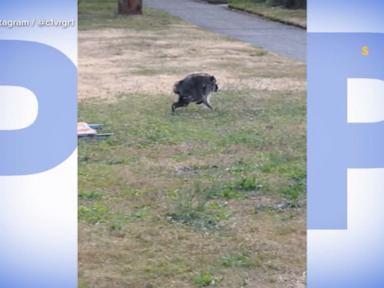
Jimothy the raccoon blew up on social media because algorithms favor unpredictable, hyper-specific animal chaos over polished studio content. The trash-panda celebrity amassed millions of views overnight across short-form video platforms by performing chaotic, unscripted antics that digital media companies spend millions attempting to replicate. Behind the viral sensation lies a stark commercial reality: traditional media outfits are hemorrhaging audience engagement to accidental internet celebrities, completely restructuring how digital media agencies assign production budgets.
It started with a fifteen-second clip recorded on a grainy phone camera. A raccoon, later christened Jimothy by an audience of millions, managed to break into a residential kitchen, steal an entire box of dry cereal, and pull off a dexterous escape through an open window while staring directly into the lens. Within forty-eight hours, the video spawned thousands of remixes, merch lines, and endless commentary streams. Read more on a related issue: this related article.
Viral moments used to be rare anomalies. Now, they are the primary currency of internet real estate.
When an animal goes viral on this scale, the immediate public reaction is passive amusement. Viewers laugh, tag three friends, and swipe to the next stream of content. Yet beneath that passive scroll lies a ruthless ecosystem of talent managers, platform engineers, and brand strategists scrambling to monetize a moment that has zero institutional friction. Jimothy did not sign a contract, pitch a pilot, or go through a writers' room. He simply acted out an instinctive behavior in front of an active sensor, rendering traditional content production pipelines obsolete in an afternoon. Additional journalism by The Hollywood Reporter delves into comparable perspectives on the subject.
The Financial Mechanics of Accidental Stardom
Modern entertainment executives spend decades attempting to engineer audience retention. They hire focus groups, test concept trailers, and analyze demographic heat maps to figure out what captures public imagination. Then a wild mammal enters a pantry and completely resets the benchmark for cost-effective reach.
Consider the math behind conventional digital programming versus algorithmic serendipity. A standard mid-tier digital production team spends roughly twenty thousand dollars to produce a single episode of high-definition web content. That includes camera operators, editors, lighting technicians, sound engineers, and social media strategists tasked with optimizing the final cut. The average yield for that level of investment hovers around fifty thousand organic views, supplemented by paid distribution campaigns to artificially pump the metrics.
The creator who uploaded the original Jimothy footage spent zero dollars on production. The hardware was an old smartphone already in their pocket. The lighting was ambient overhead fluorescent. The script was absolute chance.
The engagement metrics tell a brutal story:
- Production Cost: $0 vs $20,000+
- Organic Reach: 45 Million views in 72 hours vs 50,000 views in 30 days
- User Retention Rate: 84% complete watch-through vs 22% industry average for branded clips
- Derivative Content Creation: Over 12,000 user-generated remakes within a week
Digital strategy groups refer to this as asymmetric viral leverage. When an unscripted, zero-cost asset outperforms a heavily funded campaign by several orders of magnitude, corporate sponsors take notice. Within days of the initial video explosion, major retail brands were dropping comment-section banter under the clip, desperate to leech off the organic momentum.
The migration of ad spend follows audience attention without emotion. When a wild animal pulls in higher engagement than a prime-time commercial slot, marketing directors shift their quarterly allocations away from polished ad spots and toward micro-licensing deals for viral clips.
The Algorithmic Bias for Organic Friction
Why did the feed pick Jimothy over millions of other pet videos uploaded every single minute? Platform algorithms do not possess a sense of humor, but they possess a highly refined tracking system for human behavioral cues.
Short-form platforms prioritize two metrics above all else: watch duration and re-watch frequency.
When a video features a professional actor, the human eye reads the scene as staged. The brain recognizes the lighting setup, the scripted pacing, and the artificial framing. We expect the outcome. There is no tension.
An unscripted animal, however, introduces immediate narrative unpredictability. Viewers hold their breath because they genuine do not know if the raccoon will drop the box, attack the camera, or perform a bizarre physical maneuver. That micro-tension forces the brain to stick around for the resolution. People watch the loop three or four times just to process the physical details of the act.
The Physics of the Micro-Loop
- Unpredictable Motion: The subject moves without visual cues, preventing the viewer's brain from predicting the next frame.
- High-Density Visual Detail: Small physical actions—like raccoon claws grasping a cardboard edge—demand closer visual scrutiny.
- Accidental Narrative Arc: A setup, a obstacle, and a clear resolution occur naturally within a tight fifteen-second window.
Platform feeds interpret those repeated viewings as a signal of high-value retention. The distribution engine immediately pushes the clip out of its testing bucket and dumps it straight into millions of main feeds worldwide.
This mechanism exposes a growing rift between what corporate content teams build and what human audiences actually want to consume. Corporate media favors control, predictability, and brand safety. The audience favors raw authenticity, unexpected failure, and chaotic humor. Jimothy succeeded precisely because no corporate producer was present to edit out the messiness.
Exploitation and the Legal Gray Zone of Viral Fauna
The moment an animal becomes a commercial asset, a legal and ethical battleground opens up behind the scenes.
Unlike human influencers, animals cannot sign talent agreements, manage licensing rights, or consent to public exposure. The human behind the camera becomes the de facto business manager, suddenly tasked with managing IP rights, trademark filings, and press inquiries while navigating aggressive outreach from talent agencies.
This creates a high-stakes environment where wild or non-traditional pets are suddenly treated as continuous content engines.
"When an account explodes off a single animal interaction, the owner faces immense pressure to manufacture a repeat hit," explains one veteran media lawyer who manages viral talent rights. "If the original video was an accident, trying to force a second act often leads to staged scenarios that compromise the animal's welfare just to feed the platform's appetite for daily uploads."
In the case of urban wildlife like raccoons, the legal landscape is even more complex. In many jurisdictions, keeping, feeding, or harboring wild raccoons is a direct violation of local wildlife rehabilitation laws. A viral video that brings fame to a human-raccoon interaction can easily trigger an investigation by state wildlife officers, putting the animal at risk of removal or euthanasia if it is deemed habituated to human environments.
The internet demands more content, but nature does not operate on a daily posting schedule.
When creators attempt to force lightning to strike twice, the audience usually detects the fraud. Staged animal videos often suffer a massive backlash as soon as viewers sense the spontaneity has been replaced by calculated manipulation. The line between capturing an authentic moment and exploiting an animal for ad revenue is razor-thin.
What the Jimothy Phenomenon Proves About Modern Media
The legacy entertainment industry is built on the belief that talent can be cultivated, packaged, and distributed on a schedule. Jimothy demolished that premise in less than a week.
We are living through an era of media hyper-fragmentation. Audiences no longer gather around a single television broadcast or wait for a weekend blockbuster to share a cultural touchstone. Instead, millions of isolated individuals share a hyper-specific, fleeting moment centered around a trash-sorting mammal on their phones during their morning commute.
This shift highlights a fundamental truth about modern digital culture: hyper-polished production value is no longer a moat. It might actually be a liability.
The more expensive a piece of media looks, the more suspicious the modern audience becomes. Consumers have developed an acute resistance to traditional advertising cues. They skip ads, block pop-ups, and tune out rehearsed PR pitches. But an authentic, raw, unscripted moment bypassing the entire corporate apparatus? That cuts straight through the noise.
Entertainment studios are attempting to adapt by buying up viral clip libraries and launching in-house teams dedicated to making content look deliberately low-budget and accidental. They spend millions trying to buy the exact feel of a lucky smartphone recording.
They are losing that race. You cannot script a raccoon stealing cereal, and you cannot force an algorithm to fake human delight.
The sudden rise of an accidental mascot proves that audience connection cannot be engineered through production budgets alone. As long as platforms prioritize genuine human attention over corporate strategy, a lone creature causing chaos in a kitchen will always have the power to out-pull a multi-million-dollar studio campaign, disrupting an entire industry without ever knowing what an algorithm is.


