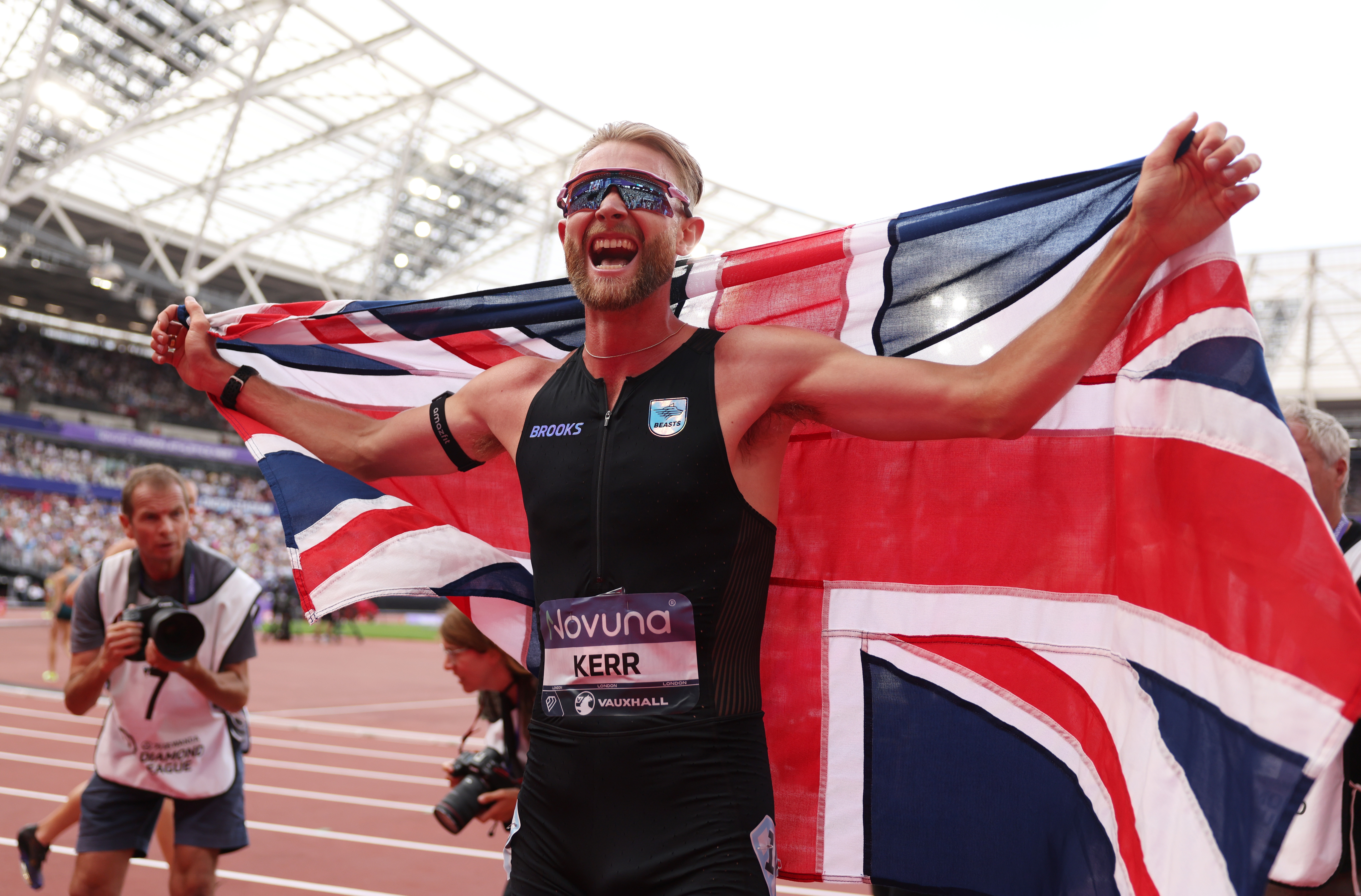
On July 18, 2026, British runner Josh Kerr destroyed a world record that had resisted every elite middle-distance runner for twenty-seven years. Crossing the finish line at the London Diamond League meet in 3:42.66, Kerr erased the 1999 mark of 3:43.13 established by Moroccan runner Hicham El Guerrouj. This feat did not happen by accident or through a sudden burst of tactical luck during the final lap. It was the result of a cold, calculated engineering project that reduced four laps of a track into exactly 222 seconds of absolute, unwavering physical violence against the watch.
The feat answers the long-standing question of whether El Guerrouj’s historic mark could ever be beaten in the modern era of athletics without relying on complex championship tactics. Kerr proved it could be done by removing tactics entirely from the equation, substituting raw pacing, biomechanical customization, and a brutal training regimen designed for a single race on a single afternoon.
The Anatomy of Project 222
Traditional middle-distance racing relies on a dramatic change of gears. Runners bide their time, draft behind opponents, and unleash a punishing sprint in the final two hundred meters. That approach does not break world records that have stood since the previous century.
Kerr recognized that to run 3:42, he had to eliminate the traditional acceleration phase. His campaign, dubbed Project 222, targeted an average of 55.5 seconds per lap from the gun to the tape. To achieve this, his training group structured every waking hour around that specific number. He wrote his target time in his training journal every single day. Even his post-workout ice baths were timed to last precisely three minutes and 42 seconds to hardwire the duration into his psychological routine.
This absolute focus meant abandoning the typical Diamond League circuit appearances that provide athletes with appearance fees and easy victories. Kerr spent months isolated at altitude in Albuquerque, New Mexico, away from the media spotlight, focusing entirely on sustained cadence under extreme oxygen deficit.
Human Sacrifice on the Backstretch
A solo runner cannot break a record of this magnitude alone. The attempt required sacrificial help from training partners who actively compromised their own competitive seasons to act as human shields against the wind.
American runner Brannon Kidder served as the primary pacemaker for the attempt. Kidder took the field through the first 400 meters in 54.75 seconds, maintaining a relentless tempo that kept Kerr exactly where he needed to be. Alongside Žan Rudolf, Kidder pulled Kerr through 800 meters in 1:51.1 before stepping off the track, completely spent.
When the pacemakers dropped out with a little over a lap and a half remaining, Kerr was left exposed to the heavy air of the London Stadium. American rival Yared Nuguse attempted to latch onto Kerr’s shoulder, providing a momentary competitive threat, but the sheer velocity of the pace broke Nuguse over the final 300 meters. Kerr crossed the 1200-meter mark in 2:46.39 and passed the 1500-meter split in 3:27.62, eclipsing his own British record for that distance before finishing his final sprint.
The Weaponization of Footwear
Behind the physiological engine was a highly specialized technological intervention. Footwear sponsor Brooks spent five months building a hyper-specialized spike called the Hyperion 222, designed specifically for Kerr's exact stride mechanics at a velocity of 16 miles per hour.
Unlike standard commercial racing shoes that accommodate changing speeds and foot strikes, this footwear was built to be actively uncomfortable at any pace slower than world-record tempo. The shoe featured an ultra-aggressive curved carbon fiber plate and custom titanium pins permanently fixed to the sole. The stiffness of the plate was tuned precisely to the exact force Kerr exerts when running on a curve.
If a runner lands on their heel in this spike, the geometry actively fights the foot, creating a sensation akin to running uphill. For Kerr, who remains strictly on his midfoot and forefoot at maximum velocity, the stiffness provided immediate energy return, reducing the metabolic cost of every single stride over the 5,280-foot distance.
The Problem With Modern Records
Sports purists often question the validity of modern track records due to the introduction of advanced carbon-plated footwear and wave-light pacing technology. There is a legitimate argument that comparing a runner in 2026 to a runner in 1999 is fundamentally unfair. El Guerrouj ran his 3:43.13 on standard foam and traditional metal track spikes, relying entirely on raw human lung capacity and grit.
However, the track surface in London presents its own challenges, and the pressure of a self-created media campaign introduces a massive psychological burden. Kerr openly created the hype himself months in advance, leaving no room for excuses if he failed. He entered the stadium knowing that anything less than history would be labeled a public failure.
The achievement repositions the mile as a relevant testing ground for human limits rather than a forgotten historical artifact. By refusing to treat a non-championship year as a period of rest, Kerr forced the sport to look directly at the clock rather than settling for tactical championship medals. The 27-year barrier did not fall because of a change in the weather or a sudden stroke of luck. It fell because an elite athlete treated a running race like an elite laboratory experiment and executed the plan without a single missed step.