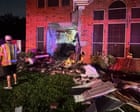
A quiet Friday night in Katy, Texas turned into a nightmare that exposes the massive friction between marketing hype and real-world automotive automation. On June 19, 2026, a Tesla Model 3 left the asphalt, tore across a front lawn at terrifying speed, and plowed straight through the brick facade of a suburban home. Inside, 76-year-old Martha Avila was standing in her front room. She never stood a chance. Pinning her inside her own home, the impact inflicted fatal injuries. She died later at a nearby hospital, leaving behind a devastated family and a scene of scattered plaster, shattered support beams, and splintered furniture.
The driver, Michael Butler, was sober, alert, and immediately cooperative with the Harris County Sheriff’s Office. He told deputies a detail that instantly transformed a local tragedy into a national flashpoint. He claimed he had Tesla’s driver-assistance tech active when the car veered off the road.
Now, the federal government is swarming. Within days, both the National Highway Traffic Safety Administration (NHTSA) and the National Transportation Safety Board (NTSB) launched independent investigations. It is exceedingly rare for both agencies to descend on a single crash so quickly. At the same time, Avila’s family hit Tesla with a million-dollar wrongful death lawsuit. This isn't just another car accident. It is a fundamental reckoning for how we regulate cars that try to think for themselves.
The Dual Federal Crackdown
Most people don't realize how significant it is when both NHTSA and the NTSB open books on the same incident. NHTSA is the regulator. They have the teeth to force recalls, levy fines, and write safety rules. They kicked off a Special Crash Investigation almost immediately, which is their deepest form of inquiry.
Then the NTSB stepped in. The NTSB doesn't have enforcement power. Instead, they act as independent crash detectives. They investigate major aviation disasters, train derailments, and highly complex highway accidents to figure out the systemic issues behind why things go wrong. When the NTSB opens a file alongside NHTSA, it means the federal government views the incident as a symptom of a much broader, deep-seated risk to the public.
This brings the total number of special crash investigations into automated-driving Teslas to nearly 50 over the past decade. Think about that number. Nearly fifty times, the federal government has had to deploy specialized teams to figure out why a single brand of car suddenly behaved in a way that resulted in severe injury or death. This specific Texas crash represents a growing tipping point where federal patience has entirely run out.
The Data War and the Pedal Override Defense
Tesla didn't release an official corporate statement to the press. Instead, the company did what it always does. It took to social media to play defense. Ashok Elluswamy, the head of Tesla’s artificial intelligence software efforts, posted a highly specific defense on X, the platform owned by Tesla CEO Elon Musk.
Elluswamy claimed that company logs show the driver manually overrode the system. According to his post, the driver pressed the accelerator pedal all the way to 100% in the middle of this residential zone. The car reportedly surged to 73 mph before hitting the brick house. Elluswamy even alleged that the driver kept the pedal pinned down after the impact occurred. Elon Musk chimed in too, arguing that Full Self-Driving software is programmed to navigate neighborhood streets slowly, meaning a high-speed sprint makes no sense as a software error.
Case closed, right? Human error. Pedal misapplication. Not so fast.
Anyone who has spent time studying human-machine interfaces knows that this explanation leaves out a massive piece of psychological reality. When a driver has a semi-autonomous system engaged, a phenomenon known as automation surprise can occur. If the software suddenly panics, steers violently, or behaves unexpectedly, a human driver has milliseconds to react. In those frantic moments of panic, drivers frequently slam their foot down on what they think is the brake pedal, only to accidentally hit the gas.
By simply saying the driver pressed the gas pedal to 100%, Tesla is trying to absolve its software of blame. But the real question federal investigators are asking is what happened in the seconds before that panic. Did the system make a sudden, erratic maneuver that caused the driver to freak out and misapply the pedal? We don't know yet, and Tesla’s public logs don't tell the whole story.
The Legal Avalanche and the Deceptive Marketing Claims
While Washington looks for data, the local courts are already moving. Martha Avila’s daughter, Jennifer Barbour, alongside her husband Justin, filed a sweeping civil complaint in Texas state court. The lawsuit seeks more than $1 million in damages, plus punitive penalties, alleging gross negligence and a blatant failure to warn consumers about the inherent defects in Tesla’s Autopilot and Full Self-Driving suites.
The core of the legal argument targets how these systems are sold to the public. For years, safety advocates have warned that naming software "Autopilot" or "Full Self-Driving" creates a dangerous illusion of capability. It encourages drivers to let their guard down.
When you tell someone a car can drive itself, they believe you. They trust it. Then, when a edge case pops up—a weird shadow, an unmarked curb, an unusual residential road layout—the car hands control back to the human with virtually zero warning. The lawsuit claims Tesla knows its systems are fundamentally defective at handling these sudden transitions but continues to market them as highly advanced autonomous solutions.
The Vision Only Engineering Flaw
This accident shines a bright light on a controversial engineering decision Musk made years ago. Tesla stripped radar and lidar sensors out of its vehicles, opting instead for a vision-only approach. The cars rely entirely on a suite of optical cameras and neural networks to see the world.
Most of the autonomous vehicle industry thinks this is crazy. Competitors use a multi-sensor setup, layering cameras with radar and lidar to create a redundant, three-dimensional map of the environment. If a camera gets blinded by sun glare, dark shadows, or heavy rain, the radar or lidar can still detect a brick wall or a pedestrian.
Missy Cummings, a former NHTSA adviser and the director of the Mason Autonomy and Robotics Center at George Mason University, has been highly vocal about this exact flaw. She points out that relying strictly on cameras means the vehicle lacks the core capability to handle actual autonomous driving safely. Cameras get confused by high-contrast environments, like a bright Texas sun casting deep shadows across a residential lawn. If the vision system misinterprets a physical barrier as an open roadway, it can cause catastrophic routing failures.
This isn't a theoretical issue. Just late last year, NHTSA launched an investigation into 58 distinct incidents where Teslas allegedly blew right through red lights, ignored traffic signs, or veered sharply into oncoming traffic while operating on automated systems. A separate federal probe is currently digging into why these vision-only cars struggle so heavily in low-visibility conditions like thick fog, heavy dust, or intense solar glare.
Moving Beyond Blame to Real Consumer Safety
If you own an electric vehicle or a modern car equipped with advanced driver assistance features, you cannot afford to treat this as just another news story. The regulatory framework is shifting, and you need to protect yourself and your passengers immediately.
First, stop treating your vehicle's driving assistance features like a backup driver. Systems like Autopilot, Super Cruise, or ProPilot are convenience features designed exclusively for clear, well-marked highways. They are completely ill-suited for complex residential areas where kids play, dogs run out, and houses sit close to the curb. Turn them off when you leave the highway.
Second, understand the mechanics of pedal misapplication. If your car ever makes an unexpected swerve or a sudden brake tap while an automated feature is running, do not panic-slam your feet. Practice keeping your right foot hovering strictly over the brake pedal whenever driver assist is active. This muscle memory stops you from accidentally stomping on the accelerator during an automation surprise event.
Finally, keep a close eye on the outcome of this dual-agency investigation. If federal regulators conclude that Tesla’s software or its vision-only hardware design contributed directly to the driver’s confusion in Katy, it could trigger an unprecedented mandatory safety recall. Consumers need to hold automotive manufacturers to strict engineering standards, rather than accepting social media deflections as gospel truth. The days of treating public residential streets as an unmonitored testing ground for beta software are quickly drawing to a close.