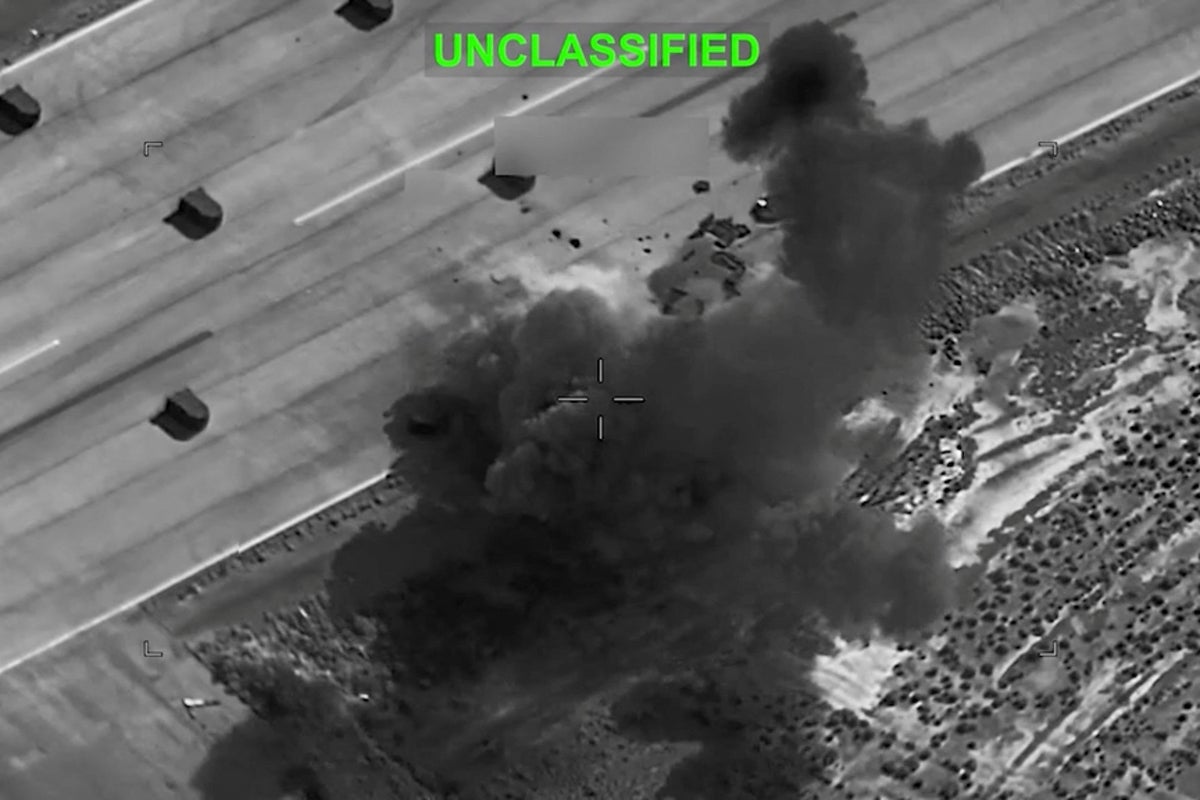
The collapse of the June interim Memorandum of Understanding (MoU) between Washington and Tehran exposes a critical divergence in asymmetric deterrence strategies. When US Central Command (CENTCOM) executed precision cruise missile strikes against 90 distinct entities within mainland Iran—specifically targeting the Gorgan-Incheh Borun international rail bridge in Aqqala county and the domestic transit arteries heading toward Mashhad—the operations moved beyond traditional tactical retaliation. They signaled a structural pivot from maritime counter-interference toward the systemic disruption of Iran's critical macroeconomic and geopolitical lifelines.
This kinetic realignment occurred precisely as regional friction points converged. By choosing a window synchronized with the final burial ceremonies of the late Supreme Leader Ayatollah Ali Khamenei, the US administration applied simultaneous psychological pressure and material disruption. To evaluate the strategic trajectory of this unravelling ceasefire, the situation must be parsed through three distinct operational vectors: cross-theater maritime dynamics, supply chain interdiction mechanics, and the structural vulnerabilities of the regional security architecture.
The Asymmetric Maritime Bottleneck: Strait of Hormuz Economics
The fundamental catalyst for the current hostilities resides in an unresolved dispute over transit pricing and sovereign jurisdictional limits within the Strait of Hormuz. The baseline parameters of the June MoU established a 60-day fee-free navigation window for international commercial shipping. However, the structural failure of this agreement stems from two conflicting interpretations of maritime sovereignty under international law.
- The Tehran Position: The Islamic Revolutionary Guard Corps (IRGC) asserts administrative routing authority over the waterway, intending to transition the interim free passage period into a permanent, tariff-backed regulatory regime. This approach attempts to codify the strait not as an international transit corridor, but as a sovereign economic lever.
- The Washington Position: The US and its Gulf Cooperation Council (GCC) partners operate under strict adherence to the UN Convention on the Law of the Sea (UNCLOS) transit passage provisions, which forbid the unilateral imposition of financial charges or forced route modifications on international flag vessels.
[Iran Interdiction Strategy] -> [Enforces Alternative Routing / Fees] -> [Commercial Non-Compliance (Oman Coast)]
                                                                                  |
[US CENTCOM Response]      <- [90+ Target Kinetic Package]           <- [IRGC Kinetic Interdiction (Boats/Drones)]
When commercial tankers altered their positioning matrices to utilize transit tracks closer to the Omani coast—thereby bypassing unilateral Iranian routing directives—the IRGC deployed small-craft interception divisions and loitering munitions to enforce compliance. The resulting US kinetic response reveals a clear strategic objective: rather than engaging in a protracted cat-and-mouse naval containment strategy, CENTCOM opted to degrade the logistical infrastructure feeding the coastal operational units. The targeting matrix focused on the primary physical assets required to sustain asymmetric naval operations, including coastal surveillance assets, mobile anti-ship missile launchers, drone manufacturing hubs, and the fast-attack craft fleets operated by the IRGC.
Infrastructure Interdiction: The Strategic Cost Function of Rail Disruption
The deployment of cruise missiles deep into northern and northeastern Iranian territory represents a major escalation in target selection. By striking the railway bridge in Golestan province and the transport networks leading toward Mashhad, the US military introduced an infrastructure degradation cost function that disrupts both domestic political stability and transnational supply lines.
The strategic rationale behind these specific targets involves two primary logistics pipelines:
The Transnational Logistics Pipeline
The Gorgan-Incheh Borun line forms a critical node of the eastern branch of the International North-South Transport Corridor (INSTC) and the broader China-Turkmenistan-Iran trade network. Due to previous naval blockades and maritime trade restrictions, Tehran has increasingly relied on land-based networks to maintain its trade relationships with Moscow and Beijing. Freight volume data confirms that Chinese rail transit through this specific northeastern node had tripled over the preceding 12 months, serving as a primary alternative to disrupted maritime shipping lines. By taking out the Aqqala rail bridge, the US imposed an immediate logistical bottleneck. This action directly reduces the velocity of overland trade and forces a costly reassessment of transit risk for Eurasian supply lines.
The Domestic Logistics Pipeline
The dual strikes on the rail corridors feeding Mashhad severed the primary high-capacity passenger and cargo artery linking the capital city of Tehran to the country’s northeastern interior. Executed hours before the final burial rituals for Khamenei, this interdiction had an immediate operational effect: it halted state-sponsored passenger transport networks, directly limiting the regime’s ability to mobilize large crowds for institutional solidarity displays.
The immediate economic reality of this infrastructure degradation is a highly constrained domestic supply network. While Iranian civil engineering assets can initiate rapid patch repairs on track beds, repairing structural concrete and steel railway bridges requires specialized components and extended timelines. This delay creates a prolonged drop in internal distribution capabilities, rendering the country's transport infrastructure a high-liability vulnerability in any prolonged conflict.
Regional Air Defense Dynamics and Asymmetric Contagion
Tehran's tactical response to the mainland strikes confirms its reliance on asymmetric theater contagion to balance out its conventional military disadvantages. By bypassing direct maritime engagement with the US Navy's Fifth Fleet assets, the IRGC launched coordinated drone and missile strikes against forward-deployed US installations in neighboring Gulf states. This counter-escalation tests the physical limits and saturation thresholds of regional air defense networks.
The operational results of the multi-axis counter-strike highlight the specific capabilities and limits of current theater missile defense systems:
| Theater Target | Weapon Composition | Interception System | Operational Outcome |
|---|---|---|---|
| Kuwait (Forward Positions) | 3 Ballistic Missiles, 1 Cruise Missile, 10 Loitering Munitions | MIM-104 Patriot Block PAC-3 | 100% Interception efficiency; minor civilian casualties caused by falling kinetic debris fields. |
| Bahrain (Fuel Storage Infrastructure) | Integrated Drone/Missile Salvo | National Air Defense Network / Maritime Elements | Successful engagement of incoming targets; no catastrophic infrastructure breaches reported. |
| Qatar (Al Udeid Early Warning Node) | Mixed Loitering Munition Package | Integrated Air and Missile Defense (IAMD) | Interception verified; minimal localized satellite antenna asset degradation. |
This multi-axis response uncovers a major strategic vulnerability: the high economic and material cost of air defense asymmetry. Defending against these strikes requires launching advanced air defense interceptors—frequently costing between $2 million and $4 million per unit—to neutralize low-cost, mass-produced loitering munitions and ballistic platforms. While the defensive coverage successfully prevented catastrophic damage to primary US logistics and early-warning nodes, the engagement rates show that a sustained, high-volume saturation campaign could eventually deplete regional interceptor inventories.
Institutional Friction and Strategic Forecasts
The collapse of the ceasefire highlights a deep structural rift within the Iranian state apparatus, directly complicating the prospects for future diplomatic negotiations. The internal political dynamics are currently shaped by a volatile struggle for control between two primary factions:
- The Hardline Ideological Faction: Led by senior IRGC commanders and parliamentary leadership, this group views absolute control over the Strait of Hormuz and continuous pushback against Western maritime deployment as vital to the survival of the regime. They see tactical compromise as an existential threat to their authority.
- The Pragmatic Bureaucratic Faction: Anchored by President Masoud Pezeshkian and formal diplomatic ministries, this faction seeks a comprehensive sanction-relief mechanism to stabilize an economy burdened by high inflation and degraded industrial capacity.
The latest US target package deliberately exploited this institutional divide. By avoiding the direct destruction of critical oil-export platforms on Kharg Island or the core containment facilities of the Bushehr nuclear power plant, Washington refrained from crossing the threshold into a full-scale regional war. Instead, the focus on transport infrastructure targets the economic and logistical lifelines favored by the pragmatic faction, while the direct destruction of IRGC fast-attack fleets undermines the operational tools of the hardline faction.
The US administration's current strategy relies on a high-velocity, maximum-leverage approach. The objective is to force Iran back to the negotiating table in a weakened position by demonstrating a willingness to systematically dismantle its domestic transport and energy infrastructure. However, this strategy assumes that the pragmatic bureaucratic faction can maintain political control despite intense internal opposition from hardliners. If the IRGC high command responds to the destruction of its infrastructure by launching larger, more disruptive saturation attacks against commercial shipping or regional energy facilities, the conflict will quickly move past the point where a structured diplomatic solution is possible.



