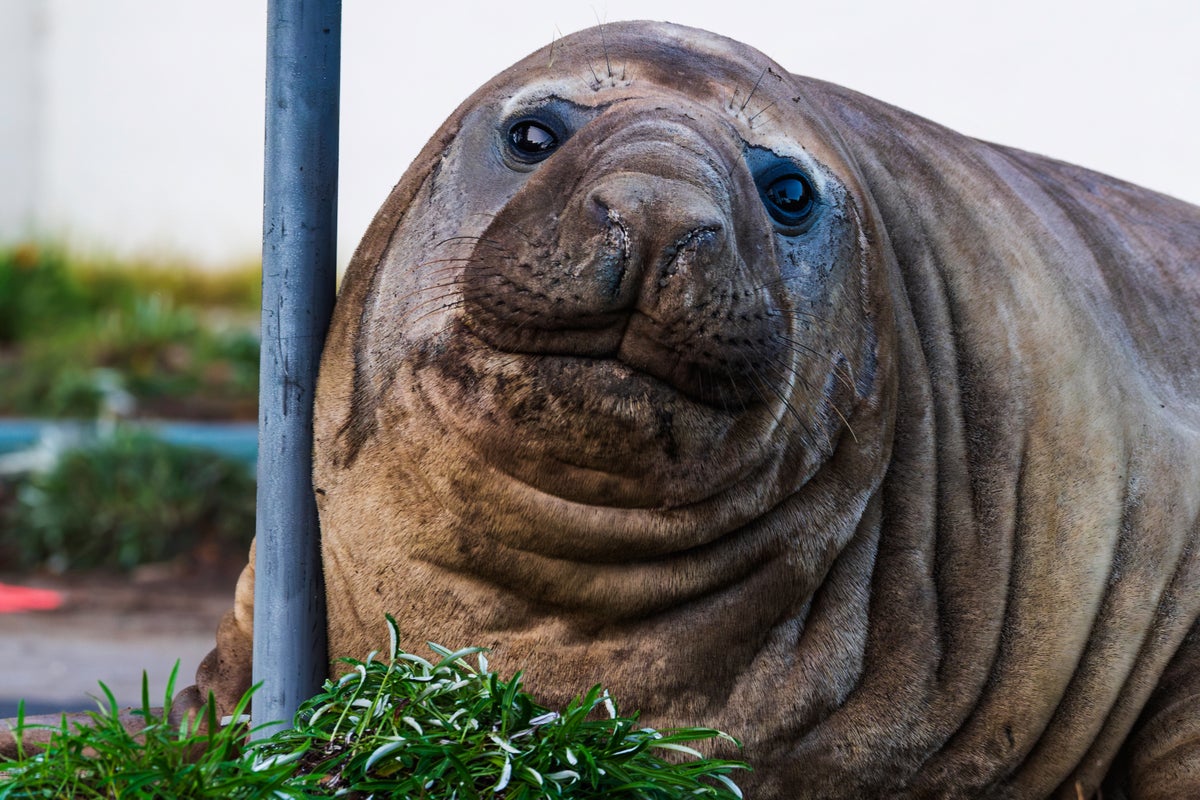
The global viral consumption of a one-tonne southern elephant seal (Mirounga leonina) navigating suburban infrastructure in Tasmania is not a narrative of play. It is a study in metabolic constraints, competitive displacement, and the severe friction that occurs when an apex marine predator operates within human geometry. Anthropomorphic interpretation labels these interactions as mischievous antics or deliberate rebellion. Biologically, the organism is executing an essential, time-delimited survival protocol on highly suboptimal terrain.
To optimize wildlife management frameworks and understand the physiological realities driving this behavior, we must strip away the narrative of celebrity and analyze the mechanical and evolutionary drivers behind urban megafauna displacement.
The Tri-Phasic Life Cycle and Natal Philopatry
The presence of an elephant seal on a suburban lawn or blocking a public roadway is dictated by a rigid biological imperative. Southern elephant seals function under a tri-phasic terrestrial life cycle, spending roughly 80% of their existence in pelagic foraging zones within the Southern Ocean before returning to land for three distinct operational windows:
- The Breeding Season: High-energy, combative periods where mature bulls establish harems.
- The Molting Window: A catastrophic physiological event where the organism sheds its entire pelagic fur layer and underlying epidermis.
- The Rest Phase: Intermittent haul-out periods designed to replenish oxygen stores and mitigate the profound exhaustion of deep-sea foraging.
The geographical precision of these haul-outs is governed by natal philopatry—an evolutionary homing mechanism that drives individuals to return directly to their precise beach of birth. While the vast majority of the regional population is localized to sub-Antarctic islands such as Macquarie Island, rare deviations occur. When a pregnant female fails to reach the primary colony due to shifting pelagic currents or late-stage energetic depletion, births occur on peripheral coastlines like the Tasmanian Peninsula.
The young male known as Neil represents one of fewer than ten documented births on the Tasmanian mainland. Consequently, his localized urban return is not a chosen preference for human environments; it is the mechanical execution of an unyielding instinctual map. The infrastructure of human settlement has merely been superimposed over his biological coordinate system.
The Energetics of Catastrophic Molting
The public frequently misinterprets a stationary seal on asphalt as a passive tourist attraction. In reality, the molting period is a state of severe physiological stress and metabolic hyper-drive.
Unlike terrestrial mammals that shed hair continuously or in micro-stages, Mirounga leonina undergoes a catastrophic molt. To grow a new, blood-perfused epidermal layer, the seal must divert massive volumes of warm blood from its core to its peripheral skin layers. If the organism remains in the sub-Antarctic ocean during this process, the thermal conductivity of water would induce rapid, fatal hypothermia. Land is a thermal necessity.
During this month-long terrestrial residency, the seal undergoes absolute fasting. It possesses zero caloric intake while simultaneously enduring two major energy drains:
$$\text{Total Caloric Deficit} = \text{Basal Metabolic Rate} + \text{Epidermal Regeneration Cost}$$
Every movement on land incurs an exponential energetic penalty compared to aquatic locomotion. The skeletal structure of a southern elephant seal is optimized for neutral buoyancy and hydrodynamic efficiency, not for resisting gravity against solid surfaces. Dragging a 1,000-kilogram mass across roads, lawns, and fences demands extreme muscular exertion, burning critical blubber reserves that cannot be replenished until the molt concludes and the seal returns to sea.
Displacement Agonism and Infrastructure Friction
The viral footage of the organism interacting with traffic cones, crushing fences, and pressing against parked vehicles is routinely framed as playful or curious. Biologically, this behavior is classified as displaced agonistic development.
[Innate Dominance Drive] ──> [Absence of Conspecific Rivals] ──> [Target Substitution: Infrastructure]
Male elephant seals achieve reproductive access purely through physical dominance, engaging in violent, high-impact chest-bumping and biting contests to assert hierarchy. These behaviors do not manifest suddenly at sexual maturity; they require years of adolescent practice. Young males must constantly test their physical boundaries, evaluate their mass against resisting objects, and project vocal dominance through their developing proboscis.
In a natural sub-Antarctic colony, this behavior is directed at peer-level adolescent males. In an urbanized coastal environment, there are no conspecific rivals. The organism's internal hormonal and behavioral programming does not pause due to a lack of peers. Instead, it undergoes target substitution.
A heavy rubber traffic cone, a rigid plastic bollard, or the side panel of a stationary vehicle represents an unyielding physical mass. When the seal shoves, mounts, or strikes these objects, it is executing critical, hardwired dominance testing. The infrastructure is not a toy; it is a mechanical proxy for a rival bull.
The Habituation Trajectory and Public Safety Risks
The central operational challenge for wildlife authorities is managing the human-wildlife feedback loop. Public proximity drives a dangerous behavioral shift known as habituation—the progressive waning of an animal's natural defensive responses to repeated non-threatening human stimuli.
When crowds assemble within the recommended 20-to-35-meter exclusion zones to capture imagery, they introduce distinct ecological pressures. The immediate threat is tactical. While seemingly slow and unwieldy, an elephant seal can execute brief, highly explosive bursts of speed over short distances, utilizing its massive core musculature to lunge forward defensively if startled.
The long-term threat is systemic. The organism is currently a five-year-old adolescent weighing approximately one tonne. At full physical maturity, which occurs around age 12, a dominant male southern elephant seal can reach lengths of 5 meters and weights approaching 4,000 kilograms.
Adolescent (Current State)             Adult (Target State)
Weight: ~1,000 kg                      Weight: ~4,000 kg
Behavior: Testing boundaries           Behavior: Territorial defense
Risk: Moderate property damage         Risk: Fatal structural/human crushing
If the animal becomes fully habituated to human presence and continues to view urban streets as an unthreatened haul-out zone into adulthood, the potential for catastrophic failure escalates exponentially. A 4,000-kilogram territorial bull asserting dominance over a vehicle or a suburban driveway cannot be managed with simple plastic barriers or public education campaigns.
Historical precedents with other large marine mammals, such as Freya the walrus in Norway, demonstrate that when public pressure and habituation converge to create an imminent safety risk, conservation authorities are frequently forced to resort to euthanasia.
Strategic Coexistence Management
Managing an urban-hauling megafauna requires shifting public engagement from passive, amused observation to rigorous spatial isolation. The baseline requirement is strict enforcement of geographic anonymity during active haul-out periods. Media blackouts regarding the exact coordinates of the seal's terrestrial landings are highly effective at preventing the formation of localized crowds.
Physical mitigation must focus on deploying dense, heavy-duty physical barriers rather than lightweight markers that invite target substitution. When the organism chooses a high-traffic urban roadway or private property, rapid deployment of specialized acoustic or visual deterrents must be utilized to nudge the animal back toward adjacent, lower-risk coastal reserves before it settles into a deep, multi-day fasting state.
Coexistence relies on acknowledging that the coastlines we inhabit remain active, primitive ecological corridors. The infrastructure we build must occasionally yield to the immutable biological timelines of the apex species that came before them.