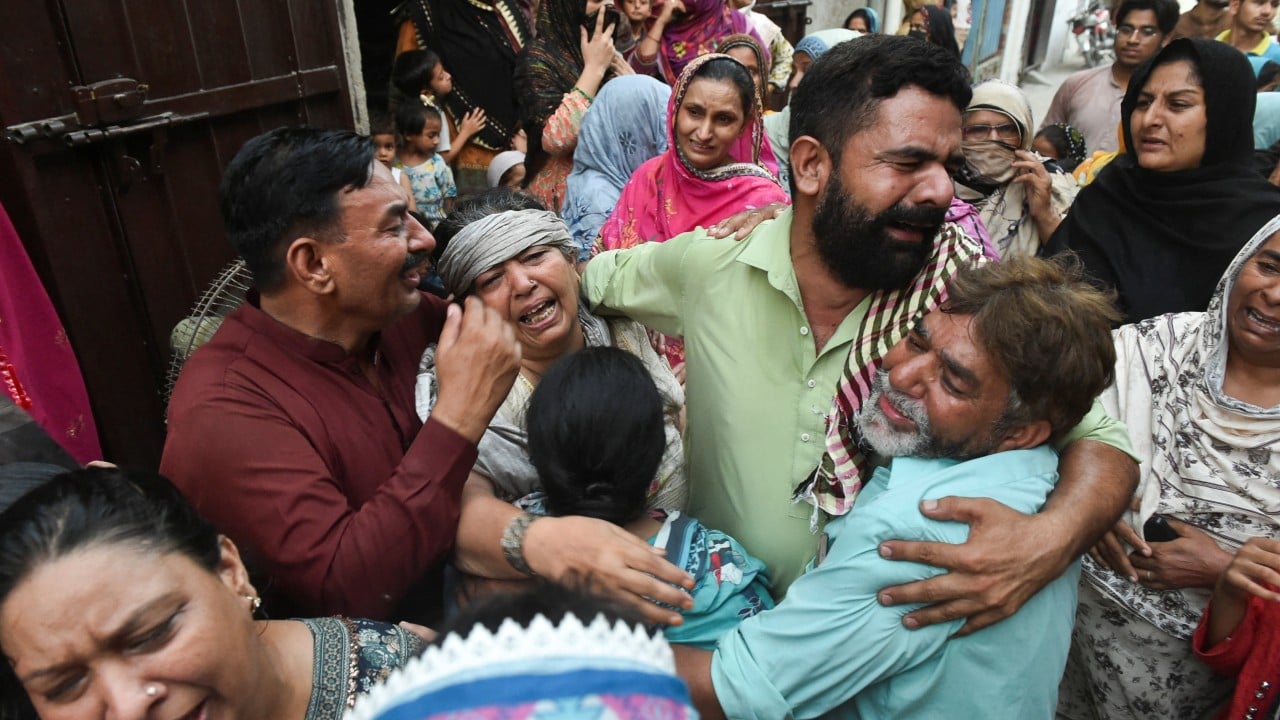
The headlines coming out of Lahore follow a script so well-rehearsed it borders on performance art. A roof collapses. Fourteen children at a tutoring center lose their lives. The media screams about corrupt bureaucrats, greedy landlords, and substandard concrete. The government announces a high-level inquiry, promises swift retribution, and vows to "seal all illegal commercial operations" within forty-eight hours.
It is a comforting narrative. It suggests that the tragedy was a localized anomaly—a single, broken cog in an otherwise functional machine. It implies that if we just hire better inspectors, enforce tougher penalties, or pass stricter building codes, the problem disappears.
That is a dangerous lie.
The tragedy in Lahore is not a failure of enforcement. It is the logical, mathematically inevitable result of an economic and regulatory framework designed to fail. When you impose Western-style building codes on an economy operating on developing-world margins, you do not create safety. You create a black market for structural survival.
The Fatal Flaw of the Building Code Crusade
Every structural engineer who has spent time on the ground in Punjab knows the open secret of the construction industry: the official building regulations are a work of fiction.
When a disaster like this occurs, the immediate reaction from international observers and local elites is to demand compliance with updated international building standards. They want adherence to modern concrete grading, seismic detailing, and rigorous load-bearing calculations.
Here is the economic reality they refuse to acknowledge.
- The Compliance Tax: Strict adherence to formal building codes increases construction costs by an estimated 30% to 50% in developing markets.
- The Capital Chasm: The tutoring centers, low-tier schools, and small businesses serving the working-class districts of Lahore operate on razor-thin cash flows. They cannot afford formal commercial real estate because the formal market has been priced out of existence by regulatory inflation.
- The Shadow Pivot: When you make legal construction unaffordable, you do not stop construction. You drive it completely underground, out of sight of even basic, common-sense oversight.
I have spent years analyzing urban development failures across South Asia. When a government increases the bureaucratic barrier to entry for safe buildings, it effectively mandates the use of informal, untrained contractors. The local raj (mason) becomes the structural engineer, architect, and inspector all rolled into one. He is not reading localized stress-strain curves or calculating the bending moment of a reinforced concrete slab under a live load of thirty students. He is building based on intuition, historical anecdote, and whatever materials the client can afford that week.
By demanding a standard that the local economy cannot support, the state guarantees the proliferation of death traps. The "lazy consensus" blames the lack of inspectors. The brutal truth is that more inspectors simply mean more hands out for a bribe to overlook the inevitable.
The Mathematics of the Collapse
To understand why this happens, we have to look past the emotional reporting and examine the physical and economic mechanics of a structural failure in a dense urban environment like Lahore's old periphery.
Most of these commercial conversions involve older residential structures built using traditional methods—often load-bearing brick masonry with poorly tied reinforced concrete (RCC) or traditional girder-t-iron roofs.
[Traditional Brick Masonry] ---> [Unapproved Commercial Conversion] ---> [Concentrated Live Load] ---> [Sudden Shear Failure]
When a residential space is converted into a tutoring center, the loading profile changes instantly.
$$\text{Design Load (Residential)} \approx 1.5 \text{ kN/m}^2 \ll \text{Actual Load (Packed Classroom)} \approx 3.0\text{--}4.0 \text{ kN/m}^2$$
A residential room designed to hold a family of five is suddenly packed with forty students, heavy wooden benches, and teaching podiums. The live load doubles or triples overnight.
Worse, these structures are frequently subjected to illegal vertical expansions. A landlord sees an opportunity to increase rental yield, so they add a third or fourth story onto a foundation that was barely calculated to hold two. They use low-grade cement mixed with contaminated river sand, which compromises the compressive strength of the concrete. Over time, moisture ingress from poorly managed roof drainage oxidizes the internal rebar. The steel expands, the concrete spalls, and the structural integrity degrades silently until a trigger event—often a heavy monsoon downpour or the vibration of a passing truck—causes a catastrophic shear failure.
The media calls this an accident. An engineer calls it a predictable sequence of material fatigue under uncalculated stress.
Dismantling the Myth of the "Illegal" Facility
The immediate bureaucratic response to the Lahore collapse was to label the tutoring center "illegal" and "unauthorized." This terminology is a shield used by municipal authorities to absolve themselves of systemic complicity.
Let’s answer the question the public should be asking, rather than the ones the media feeds them.
Why do these centers exist in residential zones to begin with?
They exist because the formal educational infrastructure in Pakistan is broken, and the formal commercial zoning laws are elitist. High-quality, safe commercial spaces are concentrated in wealthy enclaves like Defense (DHAs) or Gulberg. The working-class populations of areas like Lahore's outer rings cannot commute to these zones, nor can local entrepreneurs afford the rent.
If a tutoring center operator were to attempt to legally zone a commercial facility in a safe, modern building, they would face a multi-year gauntlet of rent-seeking behavior from agencies like the Lahore Development Authority (LDA).
- Step 1: Commercialization fees that exceed the annual revenue of the business.
- Step 2: Architectural approvals requiring signatures from certified professionals who charge premium rates.
- Step 3: Structural stability certificates that are frequently withheld until a specific series of informal payments are processed.
The system is rigged to ensure that legality is a luxury good. Therefore, operating "illegally" is not a choice made by reckless criminals; it is the baseline requirement for providing affordable services to the public.
When you shut down these informal centers without addressing the underlying lack of affordable, safely constructed commercial spaces, you don't save lives. You simply force the next generation of students into even more obscured, dangerous environments—basements, hidden alleyways, and industrial zones.
Stop Trying to Fix the Inspection System
The universal policy recommendation following every disaster is to "strengthen the inspection regime." This advice is worse than useless; it is actively harmful.
The assumption is that an army of honest, highly trained inspectors can walk into every building in Lahore and accurately assess structural integrity. This ignores both the scale of the problem and the fundamental physics of built environments.
- The Scale Problem: Lahore has millions of informal or semi-formal structures. It would require an administrative state larger than the entire municipal government just to log them, let alone inspect them.
- The Concealment Problem: You cannot assess the structural integrity of a reinforced concrete slab or a foundation simply by looking at it. Once the concrete is poured and the plaster is applied, the fatal flaws—missing rebar, insufficient lap lengths, rusted steel, low-grade aggregate—are completely invisible to the naked eye. Short of destructive testing (taking core samples) on every single building in the city, an inspector’s visit is nothing more than expensive theater.
If you incentivize inspections in an environment characterized by low bureaucratic salaries and high economic pressure, you do not buy safety. You buy a system where the landlord pays a recurring safety tax directly into the pocket of the inspector, who then signs off on a death trap with a clean conscience. The paperwork becomes perfect, while the concrete remains lethal.
A Brutal, Practical Blueprint for Survival
If we want to stop roofs from collapsing on children, we must stop designing policies for the Lahore we wish we had, and start designing them for the Lahore that actually exists. We must trade the unattainable perfection of Western codes for pragmatic, low-tech risk mitigation.
1. Decouple Basic Safety from Total Commercial Legality
The state must offer a pathway to amnesty that focuses exclusively on catastrophic failure vectors. Forget parking requirements, setbacks, sign sizes, or formal commercialization fees. The municipal government should offer free, no-penalty structural audits focused on exactly three things:
- Clear signs of structural distress (excessive deflection, major diagonal cracking in load-bearing walls).
- Total live-load estimation vs. structural type.
- Roof drainage and moisture protection.
If a landlord steps forward, they should receive technical assistance to install cheap, external structural retrofits—such as steel jacketing or carbon-fiber wrapping—rather than a fine and a shutdown notice.
2. Standardize the Informal Construction Sector
Since the raj (informal mason) is going to build the majority of these structures regardless of what the law says, we must upskill the informal sector directly.
Instead of hosting seminars for certified engineers in five-star hotels, international development agencies and local governments need to run hands-on, localized workshops in construction material markets (like those along Ferozepur Road or Ravi Road). Teach the actual builders how to properly clean sand, the critical importance of water-cement ratios, and standard rebar placement patterns for simple spans.
3. Emphasize Overt Structural Redundancy over Optimization
Modern Western building codes are designed to optimize materials—using the least amount of concrete and steel necessary to safely carry a load, thereby saving money. This requires precision execution.
In a low-skill, high-corruption environment, we must advocate for the exact opposite: massive structural over-design. We need to encourage the use of thick, traditional load-bearing walls and over-dimensioned beams that can tolerate terrible workmanship, poor concrete mixing, and unexpected over-loading without collapsing instantly.
The downside to this approach is obvious: it acknowledges defeat. It requires the state to admit it cannot enforce its own laws. It requires purists to accept buildings that are technically non-compliant, aesthetically ugly, and structurally crude.
But a crude, over-built structure stays standing. A pristine, unachievable code exists only on paper, and paper cannot hold up a ceiling when the rain starts to fall. Stop looking for corrupt scapegoats and stop writing useless regulations. The children of Lahore are not dying because of a lack of rules; they are dying because our rules refuse to acknowledge reality.


