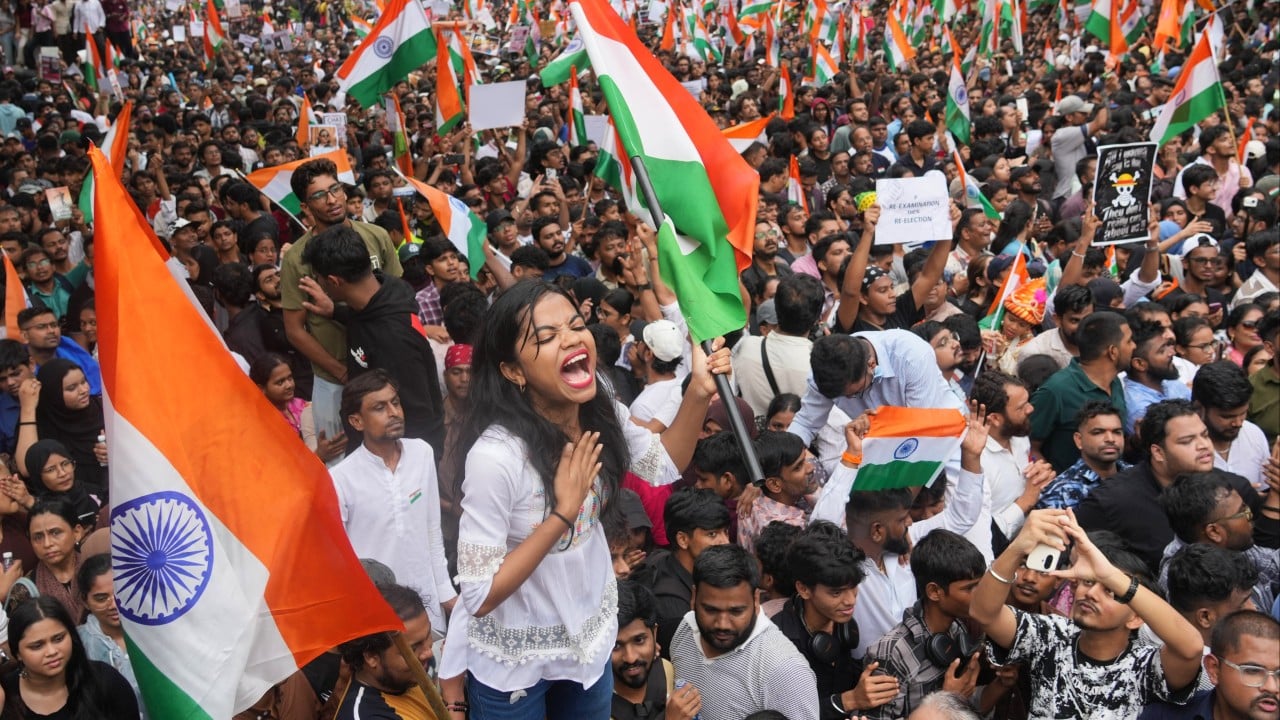
The tea stalls in the alleyways of Mumbai open before the sun clears the concrete awnings. Steam rises from brass kettles, mixing with the heavy exhaust of diesel engines and the scent of frying dough. Here, conversation is a contact sport. Voices rise over the din of traffic, arguing about cricket, politics, and the relentless creep of rent prices. When people take to the streets to protest, they do not whisper. They shout. They wave banners. They flood the avenues until the asphalt disappears beneath a sea of bodies.
Critics look at these massive demonstrations and reach for a dismissive label. They call them a nuisance. They call them an infestation. They use the word cockroach. In other updates, we also covered: Why Youth Voices Must Drive Climate Action Right Now.
It is a deliberate choice of vocabulary designed to strip away humanity, to reduce citizens demanding their rights to pests that merely scatter when the kitchen light snaps on.
Listen closely to the noise of those crowds, though. Beneath the slogans and the megaphones, something vital is missing. A precise, structural vocabulary for economic survival. To find that missing lexicon, you have to look across the Himalayas, past the high-altitude borders, into the humming, smoke-choked manufacturing belts of southern China. There, workers do not just shout in the streets. They speak a language written in labor disputes, legal code translations, and calculated factory walkouts that target the exact pressure points of global supply chains. USA Today has also covered this critical issue in great detail.
Consider a hypothetical worker named Rajesh, standing on a corner in an industrial suburb of New Delhi. He holds a slip of paper detailing his delayed wages. He knows he has been cheated. His landlord knows it. His neighbors know it. But when Rajesh tries to articulate the systemic theft of his labor, the legal terminology fails him. The laws are written in a dense, inaccessible jargon that feels purposefully engineered to protect the ledger entries of conglomerates rather than the calloused hands of the people who build things.
Now, cross the border into Shenzhen or Dongguan. Imagine a worker on an assembly line producing circuit boards. When grievances arise there, the response is rarely an unstructured explosion of public anger. Instead, workers pull out smartphones, consult digital translations of labor laws, calculate their precise overtime discrepancies down to the fen, and coordinate silent slowdowns that ripple through corporate boardrooms in Tokyo, Cupertino, and Frankfurt.
This is the contrast between noise and leverage.
India’s protests are passionate, loud, and deeply rooted in the democratic tradition of public disruption. They demand to be seen. Yet, visibility alone does not alter the balance of power. A million people marching down a boulevard can be cleared by evening, their footprints washed away by municipal water trucks. But a quiet, synchronized stoppage of logistics nodes in a manufacturing hub? That freezes capital. That forces executives to fly in on red-eye flights to negotiate.
The disparity comes down to the architecture of dissent.
In India, civil disobedience has a glorious history. It brought down an empire. Mahatma Gandhi understood the power of walking to the sea to make salt, turning an everyday act into a moral indictment of colonial rule. But modern global capitalism has evolved past simple moral indictments. Corporations do not care about moral shame. They care about velocity. They care about inventory turnover ratios. When protests fail to engage with the mechanical reality of modern commerce, they remain trapped in a loop of cyclical outrage.
China’s industrial engine operates on a different frequency. The state tightly controls public gatherings, driving labor resistance underground or into narrow, highly technical legal channels. Because mass political protests are swiftly crushed, workers who dare to fight back have learned to weaponize the system's own rules. They master the micro-regulations of factory contracts. They understand how a single missing component from a sub-supplier can halt an entire global product launch.
This is what the fiery street demonstrations of South Asia often miss. Rage without mechanics is just smoke. It stings the eyes, but it eventually dissipates into the wind.
To understand why this gap exists, we have to look at the diverging paths of two demographic giants. Both nations house over a billion souls. Both nations feature a staggering gulf between the ultra-wealthy and the daily wage earner. But the nature of their economic integration shapes how their people fight.
India integrated into the global economy primarily through services, software, and consumption, while retaining a massive, informal domestic labor sector where over eighty percent of workers toil without written contracts, social security, or legal recourse. How do you unionize a ghost? How do you strike against an employer who pays you in cash at the end of the day and denies your very existence on a ledger?
In that informal vacuum, street protest becomes the only tool left. It is the weapon of the invisible. When the state and corporate entities pretend you do not exist, making a massive, undeniable physical spectacle is the only way to force them to turn their heads.
China, conversely, built its economic might on the factory floor. It gathered hundreds of millions of peasants into dense urban manufacturing centers, placing them shoulder-to-shoulder on assembly lines and in massive concrete dormitories. That physical concentration created a collective consciousness. It bred a specific kind of industrial literacy. Workers learned the rhythm of the machine, and in learning it, they learned how to break it.
When a Chinese worker files a complaint about social insurance contributions, they are engaging with a state apparatus that prides itself on administrative precision. It is a terrifying apparatus, make no mistake. Dissent in China carries severe personal risks. Yet, within the steel cage of that bureaucracy, workers have carved out a dialect of resistance based on compliance failures and legal technicalities.
They use the master's tools, or at least the master's rulebook, to demand their due.
Back in the lanes of Mumbai, the tea is cooling. Rajesh folds his slip of paper and tucks it into his pocket. He will join the march tomorrow. He will raise his voice until his throat is raw. He has to. It is his voice, and it is his body, and it is the only proof he has that he is alive in a system that would gladly turn him into a statistic.
We must be honest about the limitations of this struggle. Moral righteousness does not automatically translate into economic leverage. Without structural integration into the pressure points of production and distribution, protests risk becoming permanent fixtures of the landscape—managed, ignored, and swept aside.
The future belongs to those who can bridge the gap. The raw, unyielding courage of the street demonstrator must somehow fuse with the cold, calculating precision of the supply chain analyst.
Until that fusion happens, the engines of global capital will keep humming, insulated by oceans of paperwork and miles of concrete, while the people who built the world stand outside the gates, shouting into the wind.
The sun dips below the horizon, painting the smog above the city in shades of bruised purple and industrial orange. In the quiet moments between shifts, the lights in the dormitories flicker on, casting long shadows against the walls. Somewhere, a ledger is being updated. Somewhere, a machine is still running. And somewhere, in the dark, a new vocabulary is being forged, syllable by syllable, in the language of concrete and smoke.


