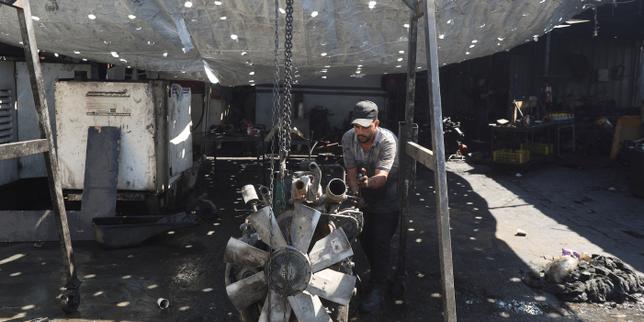
The generator does not roar when it dies. It stutters.
A heavy, metallic cough rattles the rusted chassis in the basement of Al-Shifa Hospital, a momentary shudder of the piston, and then the dark takes over. Not a metaphorical dark. A thick, suffocating blackness that swallows the pale green tiles, the terrified eyes of children clutching torn blankets, and the frantic hands of surgeons working by the meager glow of a cracked smartphone screen. Meanwhile, you can explore other stories here: Sentencing Architecture And Driver Negligence The Hong Kong Case Breakdown.
Outside, the Mediterranean air smells of sulfur and dust. Inside, the air tastes of carbon and copper.
We talk about healthcare systems in boardrooms and policy papers. We debate budgets, supply chains, and bureaucratic red tape as if medicine were a cold mathematical equation on a dry-erase board. We speak of "infrastructure vulnerability" and "logistical friction." But numbers do not bleed. Percentages do not gasp for oxygen. To explore the full picture, we recommend the excellent analysis by NPR.
To understand what is happening in Gaza right now, you have to strip away the sanitizing vocabulary of modern journalism. You have to stand inside an intensive care unit where the life support machine is not a marvel of modern engineering anymore, but a ticking clock counting down the final seconds of a human life.
Let us be entirely honest about what fuel means in a modern hospital. It is not an auxiliary expense. It is not a secondary line item on a spreadsheet. Fuel is oxygen. Fuel is the rhythmic pulse of the mechanical ventilator breathing for a premature infant whose lungs are too fragile to face the world alone. Fuel is the centrifugal force of the centrifuge spinning blood bags in the laboratory. Without diesel to feed the iron lungs of these sprawling medical complexes, a hospital ceases to be a sanctuary of healing. It becomes a tomb with whitewashed walls.
Consider what happens when the last drop is consumed.
Imagine, for a moment, a hypothetical physician named Dr. Tariq. He is real in the way that thousands of exhausted, unshaven men and women are real across this besieged strip of land. He has not slept in forty-eight hours. His scrubs are stained with dried plasma and the gray dust of collapsed concrete. He stands over a table in the emergency ward, holding a manual resuscitation bag—an ambu bag—squeezing it rhythmically, compress, release, compress, release, because the electric ventilator gave up its ghost three hours ago when the final fuel reserves ran dry.
His arm begins to cramp. Sweat stings his eyes. The room is silent except for the mechanical squeak of the rubber bulb and the shallow, ragged wheeze of the patient beneath his palms. He knows—and the patient's mother, sitting quietly in the corner clutching the hem of her hijab, knows—that human muscle cannot replace an electrical motor forever. Flesh fails. Arms grow tired.
And then, the hands stop.
That is the reality behind the administrative phrase: systemic paralysis due to fuel and spare parts shortages.
It is not just about fuel, of course. It is about the invisible anatomy of a hospital. A modern medical facility is a nervous system of delicate components. A circuit board burns out in an X-ray machine. A valve cracks in an oxygen manifold. A dialysis filter reaches the end of its operational lifespan. In normal times, a procurement officer places an order, a shipping container arrives at a port, a courier drops a brown cardboard box at the loading dock, and a technician with a Phillips-head screwdriver restores sight to a blind diagnostic scanner.
Today, those borders are steel walls. Those ports are locked. The spare parts that could fix a dialysis machine are sitting in warehouses a few miles away, blocked by administrative labyrinths, security clearances, and closed gates.
So the dialysis machines sit silent.
Think about the chronic kidney failure patient. Let us call him Mahmoud. Twice a week, Mahmoud's blood needs to be pulled from his body, filtered of the poisons his failing kidneys can no longer flush, and returned to him warm and clean. It is a quiet, mechanical ritual of survival. Without it, toxins build in the bloodstream like rising floodwaters. The mind clouds. The heart stumbles. Fluid fills the chest until every breath feels like drowning in dry air.
Mahmoud walks into the clinic, his legs swollen, his skin taking on a yellowish, bruised hue. He looks at the rows of artificial kidney units. Their indicator lights are dead. The screens are black.
The nurse does not look him in the eye when she tells him the news. She doesn't need to. They both know the arithmetic. Without the filter, without the electricity, without the imported rubber tubing and saline bags, the countdown has begun. Mahmoud walks back out into the sun, carrying his own mortality inside his veins, wondering how many days remain before his body turns against itself.
This is what scarcity looks like when it is weaponized by circumstance and geography. It is slow. It is administrative. It does not always arrive with the thunder of an explosion; sometimes, it arrives with the quiet click of a breaker switch being thrown in an empty basement because there is nothing left to burn.
We must confront the profound moral vertigo of watching an entire medical apparatus suffocate in slow motion. We have engineered a world where global logistics can deliver a pair of sneakers across continents in forty-eight hours, yet a truck carrying vital surgical pins, antibiotics, and generator filters can sit idling at a crossing for weeks while infections rot the bone of a twelve-year-old child's shattered leg.
When antiseptics run out, surgeons wash wounds with tap water that smells of rust and salt. When anesthesia is rationed, operations that should be performed in deep, painless sleep are done with the patient biting down on a rolled-up piece of gauze, their knuckles turning white as the scalpel meets the flesh.
This is not a failure of medical skill. The doctors and nurses here are among the most resilient professionals on earth, performing miracles with shoestrings and duct tape. It is a failure of humanity's basic plumbing—the breakdown of the systems that allow civilization to care for its weakest members.
We look away because the scale of it is too vast, because the terminology—fuel deficits, logistical blockades, supply chain friction—feels clinical and distant. We prefer our tragedies neat and cinematic, wrapped in clear narratives with obvious beginnings and ends. But this tragedy has no tidy resolution. It is grinding, persistent, and entirely man-made.
The generator in the basement remains cold. The surgical light flickers, stabilizes for a fraction of a second, and then dies for good. In the dark, Dr. Tariq reaches for his flashlight, checks his watch, and turns back to the table, where another life is waiting in the quiet room.