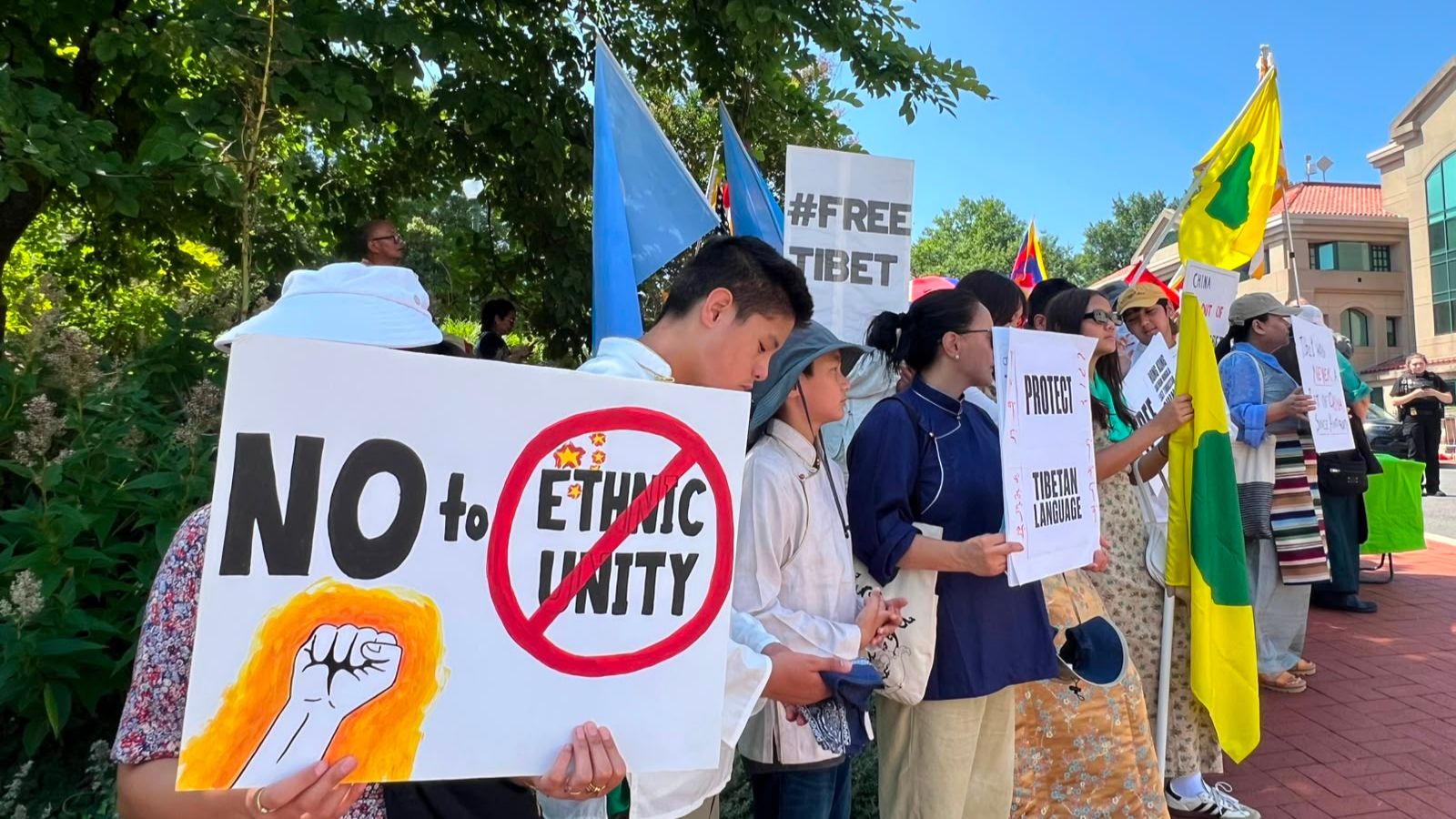
The ink on a piece of legislation is dry, but its consequences bleed directly into the living rooms of ordinary families. In northwestern China, a legal framework designed to enforce national unity has transformed the most intimate aspects of daily life into matters of state security. It is one thing to read a headline about diplomatic friction between global superpowers. It is quite another to understand what happens when a government decides that your traditional customs, your language, and your heritage are barriers to progress.
Consider a hypothetical family living in Urumqi, the capital of the Xinjiang Uyghur Autonomous Region. Let us call the father Alim. Under the banner of "ethnic unity" laws, Alim’s daily routine is no longer entirely his own. The language he speaks to his children at the breakfast table, the books on his shelf, and even the way he greets his neighbors are subject to a standard of harmony defined thousands of miles away in Beijing. When a state mandates unity by law, compliance is not just about obeying traffic signals; it is about reshaping your identity to fit a specific national mold.
This is the reality behind the sharp diplomatic exchanges currently fracturing relations between China and the West. When the European Union and the United States issue formal criticisms demanding the repeal of these sweeping ethnic unity laws, they are not just arguing over legal jargon. They are contesting the boundaries of human autonomy.
The Machinery of Enforced Harmony
To understand why this issue has ignited such fierce international debate, one must look at what these laws actually do. On paper, the legislation sounds noble. It purports to foster mutual respect, prevent discrimination, and integrate minority regions into the broader economic success of the nation. China’s government defends these measures as essential tools for poverty alleviation and national security, pointing to billions of dollars invested in infrastructure, modern housing, and schools across Xinjiang and Tibet.
But the friction arises from how this integration is achieved.
The mechanism is assimilation. In practice, the laws criminalize behaviors that the state deems "separatist" or "extremist"—definitions that international human rights observers argue are dangerously broad. Under these statutes, traditional Islamic veils, long beards, fasting during Ramadan, or possessing independent religious literature can be flagged as signs of radicalism.
Statistics reveal the scale of this campaign. Human rights organizations, backed by satellite imagery and leaked internal documents, estimate that since 2017, more than one million Uyghurs, Kazakhs, and other Muslim minorities have been detained in a network of high-security camps. The government calls them vocational training centers designed to eradicate extremism and teach useful job skills. Former detainees, however, describe a system of intense political indoctrination, forced renunciation of faith, and mandatory Mandarin language instruction.
Imagine walking into a classroom where adults are forced to chant patriotic slogans and erase their native tongue. The psychological weight of that room is heavy. It is an environment where safety is bought at the price of self-obliteration.
The Diplomatic Counter-Offensive
When Western nations confront Beijing over these policies, the response is swift and unyielding. China’s Ministry of Foreign Affairs consistently rejects all criticism, labeling it as a violation of sovereignty and an unwarranted interference in its internal affairs.
The official narrative is unshakeable: China is a unified, multi-ethnic state where all groups enjoy equal rights, and the measures in Xinjiang are purely counter-terrorism and developmental strategies. To Beijing, Western concern is not born of genuine humanitarian impulse, but is rather a calculated political maneuver designed to contain China's rise on the global stage.
This creates a profound geopolitical deadlock. On one side, the US and the EU enforce sanctions on Chinese officials, ban goods produced with suspected forced labor, and issue scathing reports at the United Nations. On the other side, Beijing doubles down, passing counter-sanctions and asserting that its sovereign right to maintain social stability overrides any external moral judgment.
But while diplomats trade barbs in polished conference rooms, the human cost compounds.
The Invisible Stakes of Cultural Erasure
The true gravity of the situation lies in the slow, quiet erasure of a culture’s distinct flavor. Think of a historic neighborhood, vibrant with unique architecture, local dialects, and centuries-old traditions. Now imagine a policy that systematically replaces those ancient alleyways with standardized apartment blocks, replaces local signage with uniform script, and penalizes the use of the local language in schools.
The physical landscape changes, and with it, the collective memory of the people.
This is not a metaphor. In cities across Xinjiang, historic Uyghur neighborhoods have been demolished under urban renewal projects. While the new buildings are undoubtedly safer and more modern, the social fabric that existed within the old walls is shattered. Community elders lose their gathering spaces. Children grow up speaking Mandarin as their primary language, losing the ability to fully communicate with their grandparents or understand the nuances of their own ancestral poetry.
The state views this as a triumph of modernization and unity. For the people experiencing it, it feels like a profound, ambiguous loss. They are told they are being lifted up, but they must leave their history behind to make the climb.
The Limits of Coercion
History suggests that true unity cannot be manufactured through legislative decrees or surveillance apparatuses. When a state attempts to homogenize a diverse population by force, it often breeds deep-seated resentment beneath a superficial surface of calm.
Consider what happens next when the pressure continues to mount. Security cameras equipped with facial recognition software line the streets of Xinjiang, monitoring every move. Biometric data, from DNA samples to voice prints, is collected systematically. Neighbors are encouraged to watch one another, and state officials are deployed to live inside minority households to monitor family dynamics and ensure political loyalty.
This level of total oversight can certainly suppress overt unrest. It can produce peaceful statistics and orderly streets. But it cannot cultivate genuine loyalty or a shared sense of national belonging. It creates a silence born of fear, not harmony.
The international community's calls for the repeal of these laws are unlikely to change Beijing's trajectory in the near term. The Chinese leadership views its policies as a resounding success that has stabilized a volatile region and paved the way for economic development. The economic and military power of the state ensures it can withstand Western sanctions and diplomatic isolation without altering its core strategies.
The standoff remains unresolved, a stark reminder of a changing world order where universal human rights standards are openly challenged by sovereign power.
Away from the grand theatres of geopolitics, the quiet struggle continues in small, daily moments. It lives in the whispered lullaby a mother sings to her child in a forbidden tongue, the secret preservation of a traditional recipe, and the stubborn persistence of memory against a system designed to make it forget. A government can control the laws, the architecture, and the public squares, but the final, impenetrable frontier remains the human heart.


