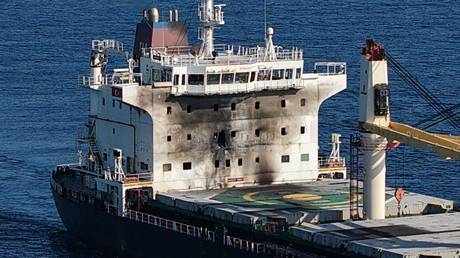
When civilian maritime operators navigate littoral zones contiguous to active armed conflict, the convergence of international humanitarian law, maritime admiralty codes, and corporate liability creates an unstable operational vacuum. The reported legal action initiated by Turkish merchant mariners against Ukrainian authorities following a drone strike on a commercial vessel operating in the Black Sea represents a critical stress test for modern maritime risk allocation. This case transcends a routine tort dispute; it exposes structural friction points in how liability is assigned when state-sponsored kinetic operations intersect with commercial shipping lanes during active hostilities.
To deconstruct the event, analysts must examine the operational parameters governing commercial shipping under blockade conditions, the legal thresholds of military necessity versus civilian protection, and the systemic failure modes of maritime insurance and risk-mitigation frameworks. Don't forget to check out our recent post on this related article.
The Jurisdictional Matrix
The core structural challenge in maritime litigation arising from armed conflict involves conflicting legal frameworks. Plaintiffs seeking compensation must navigate three distinct overlapping domains:
- Public International Law: Governed by the Law of Naval Warfare, the Geneva Conventions, and customary international humanitarian law regarding the distinction between military objectives and civilian assets.
- Admiralty and Maritime Law: Governed by international conventions on safety of life at sea, maritime liens, and jurisdictional rights of flag states and coastal states.
- Domestic Tort and Contract Law: Governed by the municipal courts of the forum state where jurisdiction can be established over the defending party or its assets.
When a commercial vessel sustains kinetic damage within an exclusion zone or an active combat theater, the primary liability vector depends on establishing negligence, recklessness, or an intentional disregard for civilian immunity. However, sovereign immunity doctrines frequently erect formidable barriers to prosecuting claims against state military actors in foreign municipal courts. If you want more about the background of this, USA Today offers an informative summary.
The Economics of Risk and Operational Exposure
Commercial shipping companies operate on tight profit margins dictated by tonnage, transit times, and fuel efficiency. When traditional maritime routes are compromised by naval blockades, minefields, or aerial interdiction campaigns, operators face a binary optimization problem: absorb the catastrophic tail risk of transit through a combat zone or accept the prohibitive opportunity cost of circumnavigation or idling.
[Operational Choice]
  ├── Route A: Transit Active Combat Zone ──> High Tail Risk (Kinetic Strike) ──> Litigious Exposure
  └── Route B: Extended Circumnavigation ──> High Opportunity Cost (Fuel/Time) ──> Margin Compression
In many instances, charterers and vessel owners miscalculate the cost function. They rely on historical marine war risk insurance provisions that were designed for conventional state-on-state naval conflicts rather than asymmetric, low-cost drone warfare and high-precision loitering munitions. As long-range reconnaissance and autonomous targeting systems proliferate, the reaction time for civilian crews to identify and respond to incoming vectors approaches zero, rendering traditional defensive maneuvering obsolete.
The Attribution Problem in Asymmetric Naval Warfare
Assigning legal fault in drone strikes involving commercial shipping requires establishing clear lines of command, control, and target verification. Unlike traditional surface combatants operating under strict rules of engagement, autonomous or remotely piloted systems introduce layers of technical ambiguity:
- Sensor and Identification Failures: Commercial vessels are required by international law to broadcast their positions via Automatic Identification System (AIS) transponders. However, in contested zones, transponders are frequently turned off for operational security by military actors or spoofed by hostile electronic warfare units, leading to misidentification.
- Chain of Command Indeterminacy: When state military apparatuses delegate targeting authority to tactical units operating near busy commercial shipping corridors, the threshold for actionable intelligence necessary to justify an attack on a suspected dual-use vessel becomes blurred.
- The Burden of Proof: Plaintiffs bear the evidentiary burden of proving that the attacking state failed to take feasible precautions to verify the civilian status of the target, a standard that is exceptionally difficult to meet when relevant military logs, telemetry data, and radar feeds remain classified state secrets.
Systemic Vulnerabilities in Maritime Supply Chain Protection
The Turkish sailors' legal challenge highlights a systemic breakdown in how littoral states coordinate maritime safety. Commercial entities operating in proximity to the Black Sea basin have long functioned in an environment of ambiguous warnings and fluctuating exclusion zones.
When navies declare operational zones without providing verifiable real-time tracking data or secure communication channels for commercial traffic, they shift the burden of risk entirely onto civilian masters who lack the radar assets and intelligence feeds required to assess threat levels accurately. This creates a systemic market failure where the cost of military engagement is externalized onto private labor and capital.
Strategic Operational Forecast
The legal proceedings initiated by the crew will likely face severe jurisdictional roadblocks, but the secondary effects on the maritime industry will be profound. Underwriters will reprice war risk premiums to account for unmitigated asymmetric threats, forcing a permanent recalculation of transit viability in contested waters.
Maritime operators can no longer treat regional conflicts as temporary disruptions with standard insurance workarounds. Future operating models in littoral combat zones will demand real-time military-commercial data integration, advanced kinetic hardening for superstructures, and contractual force majeure clauses that explicitly reallocate state-inflicted kinetic liability away from the operating crew and onto charterers and sovereign insurers.