The human body possesses a terrifyingly resilient memory. You can change your name, cross three continents, swap the dust of the Levant for the crisp, alpine air of Central Europe, and wrap yourself in the quiet safety of a suburban asylum claim. But the skin remembers.
For more than a decade, a man lived quietly in Austria. To his neighbors, he was just another face in the crowd of displaced souls who fled the catastrophic unraveling of Syria. He carried the mundane look of middle age. But back in Raqqa, between the bloody spring of 2011 and the chaotic spring of 2013, his name carried the weight of absolute decree. He was Brigadier General Khaled al-Halabi, the head of the General Intelligence Directorate. Alongside him was Musab Abu Rukbah, a police lieutenant colonel whom terrified locals allegedly nicknamed the Angel of Death.
In those early days of the Syrian uprising, the world watched a nation break on the evening news. We saw wide-angle footage of crowds, smoke, and tanks. What we did not see was the interior of the intelligence buildings.
Inside those walls, the state security apparatus did not just fight a rebellion; they attempted to dismantle the human spirit. The methods were systematic. They were clinical. Survivors would later stand in a brightly lit Viennese courtroom and describe cells packed so tightly with thirty or forty people that breathing felt like a luxury. They described being stripped naked. They described being doused in freezing water, not just to shock the nervous system, but to ensure that when the green plastic garden hoses struck their flesh, the impact would sting with a sharper, more agonizing precision.
Consider the "magic carpet." It sounds like folklore, but it is a bureaucratic reality of steel and wood—hinged planks designed to fold a human being backward at the waist, pinning the spine while the heavy cables descend onto the soles of the feet.
For years, the men who ordered these things believed the geography of international law would protect them. The regime collapsed, the Islamic State overran Raqqa, and the generals scattered. Halabi found his way to France, and later, under circumstances that read like a cold war thriller involving the Israeli Mossad and Austrian intelligence, he settled into the quiet rhythms of Vienna.
He almost made it to the finish line of anonymity.
But international justice is a patient hunter. It relies on a legal doctrine known as universal jurisdiction. It is a deceptively simple concept: certain crimes are so heinous, so utterly offensive to the concept of humanity, that they do not belong to a single nation. They are crimes against everyone. Therefore, any court, anywhere, has the right—and the obligation—to try them.
When the trial opened in June, Halabi stood before the judge and shook his head. He was a member of the Druze minority, he argued. He was a man of culture. "Impossible," he said through an interpreter when asked about the violence. "That would not be in my interest. It is also not how I was raised." He claimed his unit merely took down personal details. No one stayed overnight. The torture devices? He had never seen them.
The defense tried to frame the trial as a matter of lost paperwork and chaotic wartime administration. But then the victims began to speak.
They were not abstract statistics from a human rights report. They were men and women who had to sit in the same room as their former tormentor, looking at the hands that once signed their detention orders. One survivor recounted the exact sensation of the electric cables hitting his feet while Halabi questioned him. "I'm still afraid to this day," the man told the court. The terror does not evaporate when the uniform is taken off.
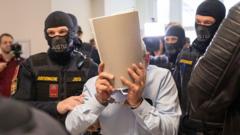
A Viennese criminal court looked past the geopolitical noise, the intelligence cover-ups, and the decades of distance. On a warm July Monday, the gavel fell.
Both Khaled al-Halabi and Musab Abu Rukbah were found guilty. They were convicted of torture, aggravated coercion, and severe sexual abuse. The court sentenced them each to eight years in prison. They were also ordered to pay 130,000 euros in compensation to the people they broke.
Eight years may feel small when measured against the scale of what occurred in Raqqa. It will not erase the nightmares. It will not heal the scars on the soles of those feet. But the sentence carries a resonance that travels far beyond the borders of Austria.
It sends a cold shudder through every luxury villa and safe haven currently occupied by the ghosts of old regimes. It means that the passage of time is no longer a shield. The world is shrinking for those who trade in human suffering, and sometimes, the long walk to justice ends in a ordinary courtroom, under a gray European sky.