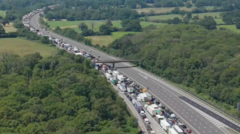
The media narrative surrounding the recent M25 gridlock during the heat alert is completely backward. Headlines scream about rising temperatures and vulnerable drivers rushed to hospitals as if a summer afternoon in the UK is an unpredictable natural disaster. It is a comforting lie. It shifts the blame from systemic failure to the sky.
The real crisis on the London Orbital motorway is not meteorological. It is managerial.
We have conditioned ourselves to accept that a few degrees of temperature increase should naturally paralyse the most critical highway infrastructure in the nation. It should not. I have spent two decades analyzing transportation logistics and infrastructure deployment, and the hard truth is that the M25 hospitalizations are the direct result of operational cowardice and a total failure of dynamic traffic management.
The Myth of the Unprecedented Heatwave
Every time the thermometer crosses 30°C, the UK transport network acts surprised. We hear excuses about "softening tarmac" or "unprecedented thermal stress." Let us look at the actual data. Major highways across France, Spain, and the southern United States handle temperatures exceeding 40°C for months on end without turning into open-air triage centres.
The M25 did not fail because it was hot. It failed because National Highways and regional transit authorities treat predictable seasonal spikes as freak anomalies.
When a bottleneck occurs during a heat alert, the risk matrix changes instantly. A standard two-hour delay in October is an annoyance; a two-hour delay in July is a medical emergency. Yet, the operational playbook remains identical. Authorities sit on their hands, watching overhead electronic signs display passive-aggressive warnings like "Reduce Speed" or "Check Your Tyres," while drivers roast in stationary metal boxes.
The Real Root Causes of Summer Gridlock
- Static Incident Management: When an accident happens during peak heat, the protocol for clearing vehicles is agonizingly slow. Instead of aggressive, rapid-clearance mandates used in international transit hubs, lanes remain closed for hours for routine investigations.
- The Smart Motorway Illusion: The removal of the hard shoulder under the "Smart Motorways" initiative stripped the M25 of its only safety valve. When a vehicle breaks down in lane one during a heatwave, the entire artery clogs instantly. There is nowhere to push a failing car to keep traffic flowing.
- Passive Driver Messaging: Telling a driver trapped in a 35°C cabin to "stay hydrated" via a digital billboard is an insult. By the time they see the sign, they are already stuck.
Dismantling the Public Relations Smokescreen
"National Highways responded as quickly as possible under extreme conditions to ensure public safety."
This is the standard corporate boilerplate issued after every major bottleneck. It is fundamentally dishonest. True public safety in transit means preventing the stagnation of traffic in high-risk zones, not sending ambulances after the damage is done.
Imagine a scenario where a private logistics company managed its distribution routes with this level of passivity. If a fleet provider allowed its assets to sit idle on a baking tarmac until the engines seized and the cargo ruined, the executive team would be fired by Monday morning. Yet, when it comes to public infrastructure, we throw our hands up and blame the sun.
The financial cost of these delays is staggering. It is not just about the cost of emergency services or hospital beds. It is about the lost economic productivity of thousands of freight vehicles and commercial drivers trapped in a logistical black hole.
The Counter-Intuitive Fix Nobody Wants to Implement
The standard bureaucratic response to this crisis will be predictable: call for a committee, launch an inquiry into "climate resilience," and suggest people simply stay home. That advice is useless for a modern economy.
If you want to stop the M25 from becoming a health hazard every summer, you have to fundamentally change how the road is policed and managed during high-temperature windows.
1. Enact a Hard-Clearance Mandate
During any active weather alert, the threshold for blocking a lane must be drastically altered. If a vehicle breaks down or is involved in a minor shunt, it must be aggressively towed to the nearest exit within fifteen minutes. No waiting for private recovery services. No protracted arguments on the shoulder. National Highways should deploy heavy recovery vehicles at five-mile intervals, ready to clear the live lanes instantly. It sounds brutal, and vehicle owners will complain about the rough handling, but it saves the wider collective from heat stroke.
2. Abolish the "Stay in Your Vehicle" Directive
For decades, the standard safety advice during a highway breakdown has been to remain inside the vehicle or stand just beyond the barrier. In a severe heatwave, a stationary car on tarmac becomes a literal greenhouse, with internal temperatures quickly exceeding 50°C. When traffic grinds to a complete halt for hours, authorities need to coordinate active evacuation zones to shaded areas or deploy mobile cooling stations along the verges, rather than leaving people to bake in their seats out of a rigid adherence to outdated policy.
3. Dynamic Toll Dumping and Diversion
The Dartford Crossing and major M25 junctions act as structural choke points. The moment a heat-related slowdown begins to cascade, tolling must be suspended instantly to flush the system. Furthermore, digital navigation systems like Waze and Google Maps should be integrated directly with National Highways data to forcefully divert traffic off the orbital route before drivers enter the dead zones.
Why the Current Strategy is Built to Fail
The downside to my approach is obvious: it is expensive, legally aggressive, and disrupts the comfortable routine of highway enforcement. It requires state agencies to take liability risks by forcing vehicles off the road quickly.
But the alternative is what we saw this week—a completely predictable weather event transforming a major transport link into a medical crisis zone.
We do not have a weather problem on our highways. We have an execution problem. Stop blaming the thermometer and start firing the managers who refuse to adapt the playbook to reality. Stop driving into the trap expecting the system to save you. It won't. Treat the M25 during a heatwave exactly what it is: an unmanaged, volatile industrial corridor that will trap you the moment a single radiator blows. Plan accordingly. Divert yourself. Do not wait for a digital sign to give you permission to survive.