The fluorescent lights in the newsroom at 11:42 PM do not hum so much as they vibrate inside your teeth.
If you have ever sat behind an editor’s desk on a breaking news night, you know the specific taste of cold coffee and stale air. You know the weight of a blinking cursor on a blank screen when a city council vote goes sideways, or when a local factory announces layoffs that will hollow out three zip codes by Tuesday. You feel the pulse of the story in your fingertips before a single word hits the page.
Now, picture a different room. There are no fluorescent lights. There is no coffee. There is only the quiet, liquid-cooled whir of a server rack in northern Virginia, processing forty thousand tokens a second to summarize that exact same factory closure.
It is fast. It is cheap. It is grammatically immaculate.
And it is completely dead inside.
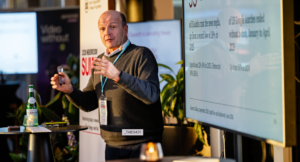
This is the quiet crisis unfolding across media, marketing, and corporate communication right now. We have handed the keys of efficiency to artificial intelligence, and in the rush to cut costs and scale output, we have forgotten where the assembly line is supposed to stop. Media strategist Dietmar Schantin, founder of the Institute for Media Strategies, has spent years working in the trenches of global newsrooms and publishing houses. His warning to executives, editors, and creators is blunt, urgent, and deeply unfashionable in a boardroom obsessed with automation: draw the line at the story.
Let the machines crunch the data. Let them sort the spreadsheets, transcribe the interviews, flag the anomalies, and distribute the packages.
Never let them write the soul.
The Seductive Trap of Effortless Scale
To understand why so many smart leaders are walking straight into this trap, consider a hypothetical media executive named Elena.
Elena runs a mid-sized regional news network. For a decade, she has watched advertising revenue bleed out to tech monopolies while printing and payroll costs climb. Every Monday morning, she stares at a spreadsheet that refuses to balance. Then, a vendor walks into her office with a software demo. The pitch is intoxicating. With an automated editorial pipeline, Elena can triple her daily output, cover every municipal meeting in four counties, and slash freelance budgets by sixty percent before the end of the quarter.
She signs the contract. Who wouldn't?
For the first three months, the metrics look like a miracle. Pageviews tick upward. Content volume explodes. The board applauds her vision.
Then, around month six, something invisible begins to rot.
Time on page drops. Newsletter open rates sag. Readers stop leaving comments. The local business owners who used to buy sponsorships because their customers trusted the paper quietly fail to renew. Elena’s publication has become a ghost ship—fully automated, sailing smoothly across the internet, carrying no passengers and moving no hearts.
This is not a fictional edge case. It is the exact pattern Schantin has observed across international media markets. When organizations treat journalism and storytelling as mere "content generation," they confuse volume with value. An algorithm can assemble sentences that mimic the cadence of human thought, much like a synthetic diamond mimics the sparkle of a stone forged under geological pressure. Under casual inspection, they look identical. Put them under a jeweler’s loupe, and the difference is absolute.
What a Machine Cannot Know
Why does synthetic storytelling fail, even as the underlying language models grow smarter every six months?
Because human storytelling is not an exercise in statistical probability. Large language models operate by predicting the next most likely word based on billions of patterns scraped from the past. By design, a machine gravitates toward the average. It smooths out the rough edges, polishes away the eccentricities, and defaults to the safest, most consensus-driven phrasing available.
Human truth lives in the exact opposite direction.
Truth lives in the hesitation before a grieving mother answers a reporter's question. It lives in the specific, illogical detail—the fact that a laid-off machinist kept his locker clean for thirty years, or that a mayor’s hands shook slightly when he signed a zoning ordinance he claimed to support. An algorithm cannot sit in a diner for two hours listening to a source talk about his fishing boat before he finally trusts you enough to hand over the whistleblower documents.
A machine has never felt fear. It has never risked its reputation to publish an uncomfortable fact. It has no skin in the game.
When Schantin argues for keeping the narrative human, he is not making a romantic plea for the days of typewriters and tobacco smoke. He is making a hard-nosed strategic argument about survival in an oversaturated information economy. When everyone has access to the same generative tools, automated prose becomes a commodity worth exactly zero. Scarcity creates value. Today, the scarcest resource on the internet is genuine human judgment, lived experience, and moral accountability.
The Invisible Contract With the Audience
Think about the last time an article, a speech, or a brand story genuinely moved you.
You did not feel a connection to the syntax. You felt a connection to another human consciousness across time and space. Every time a reader clicks a headline or opens a letter, they enter an invisible social contract. They are trading their most non-renewable asset—their attention—in exchange for the promise that another human being did the hard work of thinking, verifying, and caring enough to craft something worth reading.
Break that contract once, and the reader forgives you. Break it systematically by flooding your channels with machine-generated filler, and the trust evaporates permanently.
I learned this lesson the hard way early in my career, long before modern AI existed, when I was asked to churn out rapid-fire market summaries using rigid wire templates. On paper, I was productive. I filed twelve pieces a day. Yet when I met readers at an industry conference that autumn, not a single person remembered anything I had written. One subscriber looked at my badge and said, "Oh, you write the ticker updates. I just skim the numbers." The words I had spent weeks assembling were treated like wallpaper. It stung, because it was true. Without human perspective, reporting is just noise dressed up in paragraphs.
Building the Firewall Between Automation and Art
So where, practically, does a modern newsroom or creative team draw the boundary? Schantin’s framework does not reject technology; it disciplines it.
Imagine a surgical theater. The room is packed with extraordinary machinery—monitors tracking heart rates, precision imaging scanners, automated anesthesia pumps. Those tools keep the patient alive and give the surgeon superhuman visibility. Yet nobody in the room asks the heart monitor to hold the scalpel.
In editorial and strategic communication, artificial intelligence belongs on the diagnostic monitors, never on the scalpel.
- Use machines for ingestion and pattern recognition. Let AI comb through ten thousand pages of public financial filings, translate foreign-language transcripts, or spot statistical outliers in municipal budgets. That is drudgery, and automating drudgery liberates human minds.
- Use machines for structural hygiene. Let software check metadata, optimize headlines for search visibility, format audio files, and adapt aspect ratios across distribution channels.
- Reserve interrogation, synthesis, and voice exclusively for humans. The moment an idea must be weighed for ethical impact, contextualized within local history, or shaped into an emotional arc that commands human empathy, the machine steps back.
Consider what happens next when an organization enforces this firewall.
Instead of firing five reporters to buy an enterprise software license, a smart publisher keeps the five reporters and hands them tools that eliminate sixty percent of their administrative grunt work. Suddenly, those journalists are no longer chained to their desks rewriting press releases. They are out in the community, knocking on doors, asking uncomfortable questions, and bringing back stories no algorithm on earth could ever hallucinate.
The Courage to Remain Unmistakably Human
There is a deeper anxiety lurking beneath the executive obsession with AI efficiency, and it is worth naming honestly.
Human creativity is messy. It is slow. People get writer's block, argue over angles, miss deadlines, and bring inconvenient personal convictions to the editorial table. Managing human storytellers requires patience, leadership, and trust. Software never asks for a raise, never pushes back against a weak premise, and never loses sleep over whether a story is fair.
For a risk-averse manager, replacing messy humans with compliant algorithms feels like control.
In reality, it is surrender. By outsourcing the narrative core to machines, leaders surrender the very thing that makes their organization irreplaceable. They trade long-term cultural authority for short-term margin relief. They build a fortress of efficiency around an empty courtyard.
We are entering an era where audiences will develop an acute, almost instinctive allergy to synthetic prose. Readers are already learning to spot the telltale signs of machine writing—the bloodless neutrality, the rhythmic monotony, the polite avoidance of any sharp opinion. As the internet fills with beige, algorithmic sludge, human imperfection will become a badge of honor. A jagged sentence, an unexpected metaphor, a fiercely argued point of view—these will become the unmistakable fingerprints of life.
Dietmar Schantin’s line in the sand is not a barrier against the future. It is the only bridge across it.
Technology will keep advancing. The models will grow faster, cheaper, and more fluent with every passing season. Let them run the presses, sort the archives, and light the stage.
When the curtain rises, a human being still has to step forward and speak.