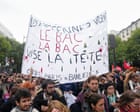
The international press loves a simple narrative. Whenever police clash with demonstrators on the Boulevard Saint-Germain, media outlets churn out the exact same story: an authoritarian strongman cracking down on public dissent to assert dominance. They frame Emmanuel Macron’s decree against "illegitimate" demonstrations as a show of force, a calculated display of state muscle meant to restore order.
They are completely misreading the room.
Decreeing an assembly illegal is not an exercise of power. It is an act of political bankruptcy. When a government reaches for administrative bans to suppress street protests, it isn't gaining a grip on unrest. It is publicly acknowledging that its institutional legitimacy has evaporated to the point where civil obedience must be coerced rather than negotiated.
The Lazy Consensus on French Street Politics
Mainstream commentary treats French rioting as a cyclical nuisance—a dramatic but ultimately temporary side effect of Fifth Republic democracy. The conventional take assumes Macron can simply weather the storm, enforce public order through heavy-handed policing, and force his policy agenda through the National Assembly via constitutional workarounds like Article 49.3.
This analysis relies on three flawed assumptions:
- That prohibition equals control. Declaring a protest illegal does not clear the streets; it merely strips moderate organizers of their leverage, handing total tactical command to decentralized, radical factions who never cared about permits in the first place.
- That street unrest in France is purely policy-driven. Commentators focus endlessly on pension ages, fuel taxes, or labor laws. They treat the street as a high-stakes bargaining table.
- That executive power in France is absolute. Because the Fifth Republic grants the President sweeping constitutional authority, foreign observers assume executive decrees equate to effective governance.
Here is the reality on the ground: the French administrative state is running an outdated playbook against an opponent that no longer plays by the rules of 20th-century labor politics.
The Illusion of Executive Strength
I have spent years analyzing European regulatory frameworks and political crises. If there is one pattern that repeats across capitals, it is this: weak leaders issue broad prohibitions; strong leaders do not need to.
When Macron labels protests "illegitimate," he creates a dangerous legal and operational paradox for French law enforcement.
Under standard French public safety protocols, authorized demonstrations follow negotiated routes. Union leaders coordinate with the Prefecture of Police. Stewards (service d'ordre) monitor the flanks, filter out agitators, and maintain a baseline of predictability.
When the state outlaws these gatherings wholesale, it collapses the buffer between peaceful trade unionists and militant Black Bloc groups. The unions walk away, the trained stewards stay home, and the police are left facing an amorphous, leaderless crowd with zero internal discipline.
+-----------------------------------------------------------------------+
|                       THE PROTEST DECREE PARADOX                       |
+-----------------------------------------------------------------------+
|  GOVERNMENT ACTION: Outlaws "Illegitimate" Public Demonstrations       |
+-----------------------------------------------------------------------+
                                  |
                                  v
+-----------------------------------------------------------------------+
|  INSTITUTIONAL EFFECT: Organized Unions & Stewards Withdraw           |
+-----------------------------------------------------------------------+
                                  |
                                  v
+-----------------------------------------------------------------------+
|  TACTICAL RESULT: Vacuum Filled by Decentralized, Unregulated Factions |
+-----------------------------------------------------------------------+
                                  |
                                  v
+-----------------------------------------------------------------------+
|  OUTCOME: Higher Violence, Lower Predictability, State Appears Weaker |
+-----------------------------------------------------------------------+
By removing the legal framework for dissent, the government destroys the very mechanism that keeps dissent manageable. It is an operational self-goal disguised as a law-and-order stance.
Dismantling the "Public Order" Flaw
People often ask: Shouldn't a sovereign government enforce the law when protests turn violent?
The question itself reveals a fundamental misunderstanding of statecraft.
Enforcing the law against criminal destruction is the baseline duty of any civil police force. But using blanket bans to preempt political assembly relies on a tactical fallacy: the idea that physical deterrence can solve a structural crisis of representation.
Consider the numbers. During peak mobilization cycles, the French Ministry of the Interior deploys tens of thousands of CRS (Compagnies Républicaines de Sécurité) and mobile gendarmerie units across major urban centers. The financial cost of equipment, overtime, and property damage run into hundreds of millions of euros per quarter.
Yet, riot control measures have zero long-term impact on the underlying drivers of unrest.
- Policing alters venue, not intent. Ban a march at Place de la République, and three hours later spontaneous flash mobs freeze traffic in Châtelet or set fires along the Ring Road.
- Prohibition accelerates radicalization. When peaceful avenues of petition are branded illegal, moderate citizens either drop out entirely or accept escalation as the only remaining lever of influence.
- The state consumes its own security capacity. Continuous emergency mobilization burns through police personnel, leading to tactical fatigue, systemic misconduct, and further erosion of public trust.
The strategy doesn't scale. It is a burn rate problem—both fiscal and political.
The Cost of the Contrarian Reality
Taking a realistic view of French governance requires abandoning comfortable political narratives. It means accepting uncomfortable truths that neither the Élysée nor the opposition want to broadcast.
The downside of admitting that executive bans fail is that it leaves no easy alternatives.
If crackdown tactics do not work, the state must enter prolonged political stalemates, compromise on core fiscal targets, or face perpetual gridlock. Re-establishing genuine dialogue requires rebuilding intermediate institutions—unions, regional councils, local municipal networks—that successive administrations spent decades intentionally weakening to centralize power in Paris.
You cannot centralize all decision-making in a single office and then express surprise when every grievance in the country targets that exact office.
How the State Reclaims Actual Control
If the goal is genuine stability rather than performative toughness, executive strategy has to pivot away from administrative prohibitions.
- Stop using constitutional shortcuts for structural reforms. Relying on mechanisms like Article 49.3 to pass contested legislation without a parliamentary vote creates a permanent crisis of procedural legitimacy. If a policy cannot survive a legislative vote, forcing it through guarantees street resistance.
- Re-engage institutional buffers. Trade unions are not the enemy of public order; they are its infrastructure. Restoring formal negotiation channels gives the public a representative voice, isolating genuine violent agitators from the broader populace.
- Decentralize police response. Relying on national paramilitary forces for local urban management escalation fuels anti-state sentiment. Community-aligned municipal policing models reduce friction points dramatically.
The myth of the strong executive banning its way to stability is broken. The longer Paris pretends that executive decrees equal public order, the longer the streets will prove them wrong.