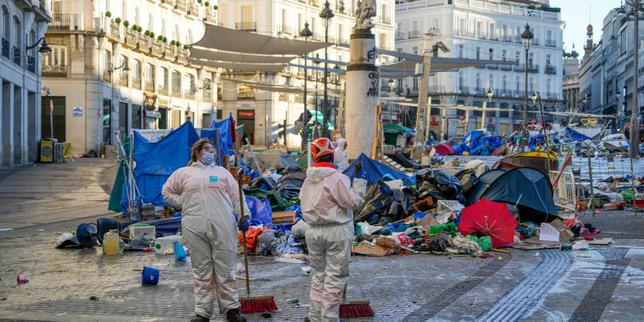
Spanish police cleared a sprawling housing protest camp in central Madrid days before a snap election, removing tents and dispersing demonstrators who had occupied public space to demand rent controls and expanded public housing. While official statements cited public order regulations and municipal sanitation codes, the timing reveals a deeper political calculation. Housing affordability has become the defining fault line in Spanish politics, and clearing the square removes a potent visual reminder of policy failure right before voters head to the polls.
The tents did not appear overnight. They were the culmination of years of mounting frustration across Spain's major urban centers, where wages have largely stagnated while residential rents have climbed out of reach for working families and young adults. In Madrid, the collision between global capital inflows, short-term tourist rentals, and a chronic shortage of state-subsidized apartments has pushed tenants to the brink. When protesters pitched camp in the heart of the capital, they forced an issue that political parties preferred to manage through carefully scripted campaign pledges into the daily reality of commuters and television cameras.
The Anatomy of a Pre-Election Clearance
Clearing a political encampment during an active campaign is never merely a logistical exercise. Municipal authorities and the central government's delegation in Madrid operate under strict legal frameworks governing the right to assembly, yet the enforcement of those rules often shifts depending on the political calendar. Under Spain's Citizen Security Law, unauthorized occupation of public thoroughfares can trigger rapid administrative removal, particularly when local officials argue that sanitation or pedestrian transit is compromised.
Police moved in during the early morning hours. That timing is standard operational doctrine across European capitals because it minimizes the number of bystanders, reduces the likelihood of live television broadcasts capturing chaotic clashes, and allows municipal sanitation crews to erase physical evidence of the protest before the morning rush hour begins. By the time office workers stepped out of metro stations, the banners were gone, the pavement was washed down, and the political friction had been temporarily scrubbed from the streetscape.
Yet the political reverberations cannot be hosed away so easily. In Spanish electoral politics, visible street mobilization carries historical weight. Every major administration remembers how the 15-M anti-austerity movement in 2011 transformed Puerta del Sol into a permanent broadcast studio of public discontent, fundamentally reshaping the party system for over a decade. Modern political strategists across the ideological spectrum view prolonged encampments not as benign expressions of free speech, but as existential threats to campaign messaging. If a governing coalition campaigns on economic growth and job creation, a tent city filled with employed workers who cannot afford a one-bedroom apartment destroys that narrative in a single camera frame.
Why Madrid Became the Epicenter of Spain's Housing Squeeze
To understand why protesters risked fines and police batons to hold ground in Madrid, one must look at the structural mechanics of the Spanish property market. Unlike northern European nations such as the Netherlands or Austria, where social housing accounts for roughly twenty to thirty percent of the total housing stock, Spain has spent decades building a system reliant on private ownership. Publicly owned social rental housing in Spain hovers below three percent of the national stock, leaving millions of residents entirely exposed to private market fluctuations.
For decades, this model functioned because mortgages were accessible and employment was tied to a domestic construction boom. When the 2008 financial crisis shattered that model, institutional investors and international private equity funds stepped into the vacuum, acquiring distressed residential assets at steep discounts. Over the subsequent years, as the Spanish economy recovered and Madrid positioned itself as a premier hub for international remote workers, students, and tourists, the nature of residential real estate changed fundamentally. Apartments ceased to be viewed primarily as shelter for local workers and increasingly functioned as high-yield financial instruments.
The Tourist Apartment Distortion
The rapid expansion of short-term tourist rentals has accelerated this displacement. When a landlord can generate more revenue renting a two-bedroom flat in central neighborhoods like Lavapiés, Malasaña, or Embajadores to weekend visitors for ten nights a month than by signing a five-year residential lease with a local teacher or nurse, the market responds predictably. Long-term supply shrinks. The remaining apartments command steep premiums, and the ripple effect pushes middle-income earners outward into peripheral districts like Vallecas or Carabanchel, driving up rents in historically working-class neighborhoods as well.
Wage Stagnation Meets Global Pricing
Local salaries simply have not kept pace with international real estate valuations. A young professional in Madrid earning an entry-level or mid-tier Spanish salary faces rental prices increasingly calibrated to global capital and foreign remote workers. According to widespread housing observatory data across Spain, tenants in major cities routinely spend upwards of forty to fifty percent of their net monthly income on rent and utilities alone—far exceeding the thirty percent threshold economists consider sustainable. When half of a paycheck disappears on the first of every month, savings vanish, family formation stalls, and political anger becomes inevitable.
The Legislative Deadlock Fueling Street Anger
Protesters in Madrid were not merely shouting into the void; they were reacting to the visible failure of recent legislative remedies. Spain passed a landmark national Housing Law intended to cool overheated rental markets by allowing regional authorities to declare "stressed zones," cap rent increases, and shift agency fees from tenants to landlords. On paper, the legislation looked like a decisive intervention. In practice, it exposed the deep constitutional friction between Spain's central government and its autonomous regions.
In Spain, housing policy is largely decentralized. Regional governments hold the primary legal authority to implement or ignore federal housing mechanisms. In the Community of Madrid, governed by a conservative administration committed to free-market deregulation and tax cuts, regional leaders flatly refused to apply the rent-cap provisions of the national law. They argued, with backing from real estate associations and several mainstream economists, that price controls inevitably backfire by causing landlords to withdraw properties from the long-term rental market altogether, further starving supply and driving underground transactions.
Left-wing parties and tenant unions countered that refusing to regulate prices while failing to build public housing leaves residents defenseless against speculative hikes. Caught between a central government pointing fingers at regional defiance and a regional government blaming federal overreach for investor uncertainty, Madrid's tenants realized that institutional gridlock would not lower their next lease renewal. Direct action became the fallback strategy when parliamentary politics stalled.
Political Optics Versus Electoral Reality
Calling a snap election compresses political timelines and raises the stakes for every public disturbance. When an election is called unexpectedly, parties have weeks rather than months to define the ballot question. Center-right candidates seek to frame the vote around economic dynamism, business-friendly policies, and public order. Center-left and progressive coalitions aim to center social protections, public services, and the cost-of-living crisis.
A visible protest camp disrupts both strategies simultaneously. For conservative municipal leaders, allowing an unauthorized camp to remain standing invites criticism from their own voter base that they are losing control of the streets and tolerating lawlessness. Ordering the police to dismantle the camp projects strength, decisiveness, and adherence to the rule of law—qualities that play well with older, property-owning voters who turn out reliably in Spanish elections.
Conversely, for progressive parties, the camp is a double-edged sword. While they often express rhetorical sympathy for housing activists, a prolonged protest highlights the inability of left-wing national policies to deliver immediate relief on the ground. Furthermore, images of police clashing with young protesters can either galvanize progressive turnout or alienate moderate swing voters who associate street protests with instability.
There is also a stark demographic divide at play in Spanish elections. Homeowners, who still make up roughly three-quarters of Spanish households—predominantly older citizens who paid off their mortgages decades ago—tend to vote at significantly higher rates than young renters. Politicians know the math. Alienating property owners who view rising real estate values as their primary nest egg carries an immediate electoral penalty, whereas failing to satisfy younger renters carries a delayed, fragmented risk. Clearing the square caters directly to the electorate most likely to cast a ballot on election day.
What Happens When You Clear the Square Without Fixing the Market
History across European cities demonstrates that dismantling a protest camp does not dismantle the underlying economic grievance. When authorities disperse demonstrators without addressing the structural imbalance between housing supply and local purchasing power, the pressure simply migrates elsewhere.
Tenant unions in Madrid and Barcelona have evolved dramatically over the past decade. They are no longer loose networks of idealists; they have become disciplined, legally savvy organizations capable of coordinating building-by-building rent strikes, blocking evictions through rapid-response networks, and mounting sustained legal challenges against corporate landlords. When police remove tents from a central plaza, organizers pivot immediately to neighborhood assemblies, targeted protests outside real estate investment summits, and coordinated administrative resistance.
If the incoming government following the snap election treats the housing crisis primarily as a public-order problem or a messaging hurdle, the cycle will repeat with greater intensity. Building genuinely affordable public housing takes years of land acquisition, zoning reform, and capital expenditure—timelines that rarely align with a four-year electoral cycle, much less the frantic weeks of a snap campaign. Converting vacant commercial properties, regulating tourist licenses with real enforcement teeth, and incentivizing long-term residential leases require political compromises that neither side of Spain's polarized parliament has shown the willingness to make.
The Real Measure of the Crackdown
Evaluating the Madrid police operation requires looking past the immediate press releases from city hall and the angry statements from activist groups. Police did what police are instructed to do when municipal authorities revoke tolerance for an unauthorized occupation: they cleared the pavement efficiently and restored normal traffic flow before morning commuters arrived.
The deeper story lies in why ordinary working citizens felt compelled to sleep on cardboard in a public square in the first place. A functioning housing market does not produce tent cities populated by full-time workers, students, and families. By removing the camp ahead of the vote, authorities successfully sanitized the backdrop for the final days of campaigning, ensuring that television broadcasts would show orderly streets rather than desperate banners. Yet once the ballots are counted and a new administration takes office, the exact same lease renewals will arrive in Madrid mailboxes, and no amount of police tape will make the numbers add up.