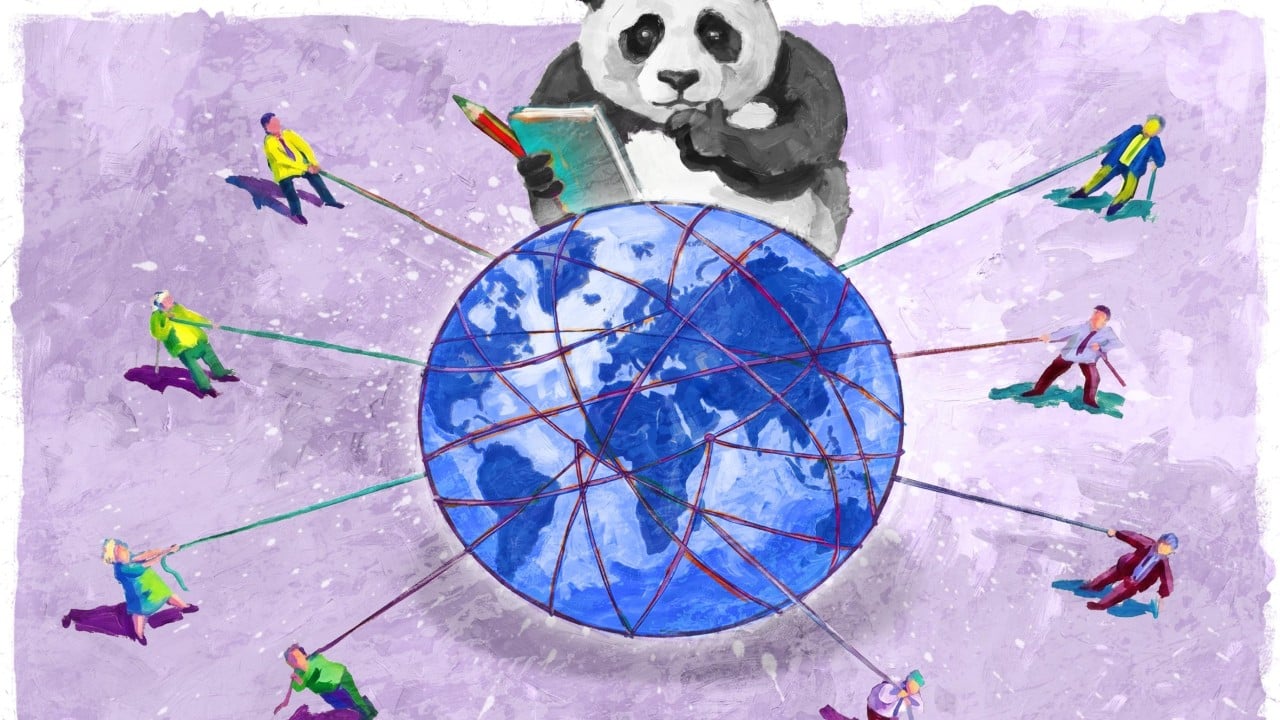
The coffee in the glass cup was already cold, filming over with a thin, metallic skin. Across the table, a man named Li traced the condensation line with a scarred thumb. Li is not a diplomat. He is a logistics coordinator in Guangzhou who spends his days orchestrating the movement of forty-foot steel containers across oceans he has never crossed.
"Everyone talks about the architecture," Li said, not looking up. "They draw lines on maps in Beijing, in Washington, in Brussels. They call it a multipolar order. But my trucks still sit at the border for three days because the paperwork doesn't match the new currency swap."
We live in the transition. The old room, built in the smoke-filled back-channels of post-war Bretton Woods, is drafty. The windows are cracked. Outside, a different crowd is gathering, carrying different ledgers, speaking in currencies that do not rely on the greenback. This is the multipolar world order taking shape—not as a sudden explosion, but as a slow, tectonic realignment of gravity.
Yet gravity is indifferent to human cost.
Consider the fundamental promise of this new century: that power should be diffuse, that no single capital should dictate the terms of trade, security, or ambition to the rest of the planet. It sounds liberating. It sounds like freedom from hegemony. But walk the docks of Piraeus, sit in the flickering fluorescent light of a debt-restructuring meeting in Lusaka, or listen to the low hum of server farms in Nairobi processing data under new digital sovereignty laws, and a heavier truth emerges.
Multipolarity without rules is just an old empire with multiple emperors.
To understand why this matters, we have to look past the grand communiques and the handshakes beneath chandeliers. We have to look at the machinery of trust. Trust is the invisible currency of international relations. When the unipolar anchor began to drag, the world didn't instantly find a harmonious equilibrium. Instead, it fractured into competing spheres of influence, each demanding loyalty, each writing its own rulebook.
Let us be honest about the anxiety underlying this shift. For decades, a certain predictability governed global markets. Flawed, yes. Dominant, often violently so. But predictable. You knew whose court to plead your case in. You knew whose navy kept the Malacca Strait open. Now, smaller nations find themselves caught in a high-stakes calculus of non-alignment, trying to extract infrastructure loans from Beijing while maintaining security umbrellas with Washington, all while domestic populations demand clean water, stable electricity, and jobs that pay in something worth holding onto.
Let me use a hypothetical scenario to ground this. Imagine a medium-sized agricultural exporter in South America trying to ship soybeans across a fractured digital trade network. Under the old system, one set of software protocols, one dominant maritime insurance market, and one primary reserve currency smoothed the friction. Today, that same exporter must navigate parallel financial messaging systems, conflicting cybersecurity compliance mandates, and shifting geopolitical alignments that can turn a routine customs clearance into a geopolitical hostage crisis overnight. The cost of this friction isn't borne by the ministers signing trade pacts. It is borne by the farmer whose margins evaporate while the bureaucrats argue over whose sovereign cloud hosts the shipping manifest.
This is why the burden of proof rests so heavily on the architects of this new era.
Power must demonstrate restraint. It is not enough to simply accumulate alternatives; those alternatives must prove themselves safer, fairer, and more reliable than the systems they seek to replace. If a multipolar world order is to avoid the historical traps of nineteenth-century spheres of influence—which inevitably ended in catastrophic friction—it must build institutions that transcend transactional opportunism.
History offers a brutal teacher here. Whenever global power diffuses without a corresponding web of shared norms, competition metastasizes into conflict. The transition from a unipolar moment to a multi-nodal reality is not a video game achievement. It is a fragile, messy negotiation between human lives, national pride, and economic survival.
When Li finally finished his coffee, he looked out the window at the gray Guangzhou morning, where cranes pierced the skyline like needles stitching together a garment that was changing faster than the pattern could follow.
"We don't need them to love each other," Li said softly, tapping the cold glass. "We just need them to agree on the depth of the water."